

 プレビュー
プレビュー
 シェアする
シェアする シェアする
シェアする
 詳細を見る
詳細を見る

 ダウンロード
 似ている作品
 X線調査
X線調査 スライドショー
 統計情報
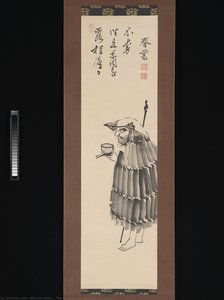
統計情報The Monk Daitō Kokushi as a Beggar
 801
801 99.0cm x 28.0cm
 詳細を見る
詳細を見る
ジークレー/アートプリント
迅速な制作と多彩な仕上げオプションを備えた、ミュージアムクオリティのジークレーまたはキャンバスプリント。 ( 手描きの絵画を購入 デジタル画像販売へ切り替え)




































標準サイズ
オーダーメイド
CM
INCH
作品のオリジナル比率に合わせた、当店の規定サイズからお選びください。
Loading sizes...

幅
高さ
特定のフレームやスペースに合わせて、ご自身でサイズを指定することも可能です。選択されたサイズが元の画像の比率と一致しない場合、作品をトリミングするか、鏡面反射または単色での塗りつぶしによって画像を拡張いたします。制作を開始する前に、ご確認用のデジタルモックアップをお送りいたします。
画面上のプレビューには、実際のトリミングや拡張は反映されませんのでご注意ください。最終的な構図を正確に確認できるのは、モックアップのみとなります。
カスタムサイズも承っておりますが、元の比率を維持するためには、あらかじめ用意されたリストからサイズを選択することをお勧めいたします。


 ガラスオプションは、110cm未満のサイズでのみご利用いただけます。

The Monk Daitō Kokushi as a Beggar
ジークレー/アートプリント
複製画のサイズ
-


合計金額
$ 62
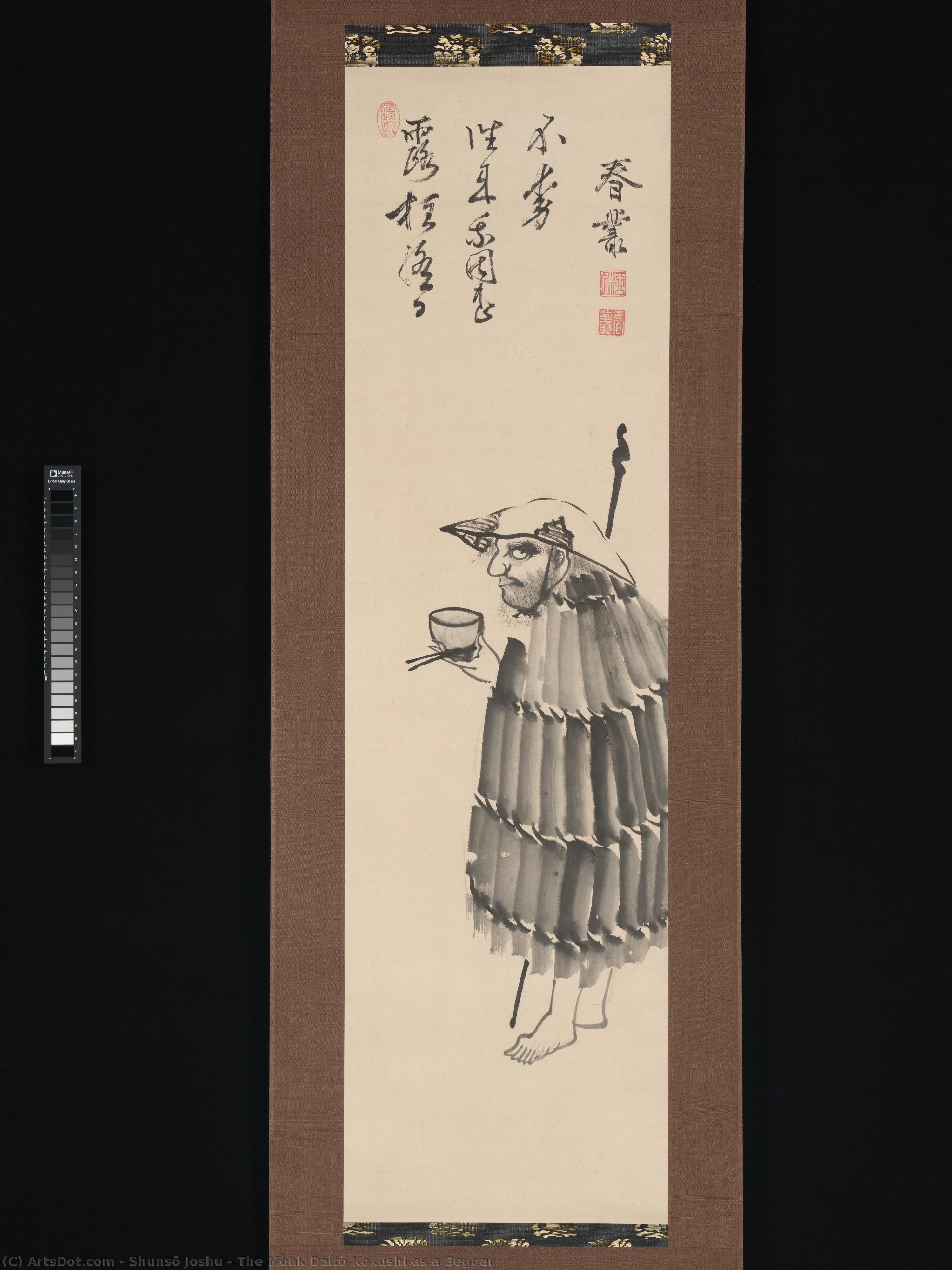
Monk Shunsō, a pupil of Reigen and Suiō, followed in the tradition of these and others in the lineage of Hakuin Ekaku in creating dynamically brushed images of famous Zen figures. Here he has depicted the emiment early-medieval monk Daitō Kokushi (Shūhō Myōchō, 1283–1337) in the guise of a beggar in a straw cloak and tattered sedge hat. The monk lived as a recluse for many years in Kyoto, taking refuge under Gojō Bridge. Daitō Kokushi ultimately established his legacy by founding Daitokuji in Kyoto, the great monastic complex of Rinzai Zen Buddhism. Hakuin considered Daitō Kokushi to be the head of lineage and thus painted many images of him; Shunsō followed in this tradition.
関連作品







アーティストの略歴
The Enigmatic Brush of Shunsō Joshu
Shunsō Joshu remains a figure shrouded in the mists of Japanese art history, an artist whose life details are sparsely documented yet whose work speaks volumes about the transition between traditional and modern aesthetics. Born in Japan (the exact year is currently unknown), Joshu emerged during a period of rapid societal change, as the nation grappled with Westernization while simultaneously striving to preserve its cultural heritage. Unlike many artists who embraced new techniques wholesale, Joshu forged a unique path—one deeply rooted in classical Japanese painting styles, particularly those of the Rinpa school, yet subtly infused with an atmosphere that anticipates the psychological depth of 20th-century art. His surviving works suggest a deliberate and introspective approach, favoring intimate compositions over grand narratives.Early Influences and Artistic Development
The precise details of Joshu’s early training remain elusive. However, scholars believe he received instruction in traditional *sumi-e* (ink wash painting) techniques, mastering the delicate balance between brushstroke, ink density, and empty space—hallmarks of Zen Buddhist aesthetics. The influence of the Rinpa school is undeniable; his use of bold colors, stylized forms, and decorative patterns echoes the work of artists like Ogata Kōrin and Tawaraya Sōtatsu. Yet, Joshu’s palette often leans towards a more subdued tonality, creating an air of melancholy and refinement that distinguishes him from his predecessors. He wasn't merely replicating established styles; he was internalizing them, filtering them through a distinctly personal sensibility. This early period likely involved meticulous study of classical literature and poetry, as evidenced by the frequent inclusion of calligraphic elements in his paintings—often verses that subtly enhance the emotional resonance of the visual imagery.Themes and Techniques: A World of Symbolic Resonance
Joshu’s oeuvre is characterized by a recurring set of motifs: birds and flowers, landscapes imbued with atmospheric perspective, and depictions of everyday objects rendered with exquisite detail. However, these are not simply representational images. They function as vehicles for conveying deeper philosophical ideas—the transience of life (*mono no aware*), the beauty of imperfection (*wabi-sabi*), and the interconnectedness of all things. His technique is marked by a remarkable control of ink wash painting; he could achieve an astonishing range of tonal values with minimal brushwork, creating images that are both ethereal and intensely focused. He frequently employed *tarashikomi*, a technique involving layering washes of ink to create subtle gradations and textures. The use of gold leaf, inherited from the Rinpa tradition, is also prominent in many of his works, adding a touch of opulence and symbolic weight. His landscapes are particularly noteworthy, often depicting misty mountains or secluded gardens—spaces that invite contemplation and evoke a sense of spiritual solitude.Historical Significance and Legacy
While Shunsō Joshu did not achieve widespread recognition during his lifetime, his work has garnered increasing attention in recent decades as scholars reassess the artistic landscape of late 19th-century Japan. He occupies a unique position—bridging the gap between traditional Japanese painting and the burgeoning modern art movements that would emerge in the early 20th century. His subtle yet profound exploration of psychological themes, coupled with his mastery of classical techniques, anticipates the work of artists like Kayahara Yoshio and Uemura Shōen. Though biographical details remain scarce, Joshu’s paintings offer a compelling glimpse into the mind of an artist deeply attuned to the beauty and fragility of existence. His legacy lies not in revolutionary innovation but in a quiet refinement—a testament to the enduring power of tradition and the transformative potential of individual vision.- His work is held in several private collections, primarily within Japan.
- Scholarly research continues to uncover more about his life and artistic connections.
- He represents a crucial link between the Rinpa school and early modern Japanese painting.
基本情報
- Artistic Movement Or Style: Ukiyo-e
- Date Of Death: Living
- Full Name: Shunsō Joshu
- Nationality: Japanese
- Notable Artworks: ['None listed']