


 プレビュー
プレビュー
 シェアする
シェアする シェアする
シェアする
 詳細を見る
詳細を見る

 ダウンロード
 似ている作品
 X線調査
X線調査 スライドショー
 Stats
StatsStill Life with Fruit and Glass


 詳細を見る
詳細を見る
オンラインプレビューをはるかに凌ぐ、高解像度で鮮明なデジタル画像をご購入いただけます。
各ファイルは、社内の専門家が高度なツールと熟練した手作業によるレタッチを用いて、細心の注意を払って準備されています。すべての画像において、卓越した鮮明度、正確な色彩再現性、そして繊細なディテールを保証いたします。
最終ファイルは、プロフェッショナルな編集・印刷環境ですぐにご利用いただけるよう最適化された状態で、72時間以内にメールにてお届けいたします。これは、一流のデザインスタジオ、出版社、ギャラリーから信頼されているものと同等の品質です。
デジタルアート
個人での鑑賞、印刷、クリエイティブなプロジェクト用に、高解像度ファイルをダウンロードできます。 ( Switch to Print 手描きの絵画を購入)
デジタル画像のご注文に付随する特典
高品質なデジタル画像配信を、確かな品質で。
ArtsDot.com を選ぶことは、単に画像を手に入れることではありません。それは、プロの手によって精密に仕上げられ、満足保証が付いた高品質なデジタルアートワークを受け取ることを意味します。ご注文いただいた際に自動的に付随する内容は、以下の通りです:

メールですぐにお届け
ご注文から72時間以内に、高解像度のデジタル画像ファイルがメールでお手元に届きます。すぐにそのままご利用いただけます。

AI技術で最適化されたデジタルファイル
お客様の作品は、高度なAIツールと専門家による手作業の編集を組み合わせてプロフェッショナルに最適化されており、細部のディテール、鮮明さ、そして正確な色再現性を最大限に引き出しています。

一生涯無料の再送サービス
ファイルを誤って削除したり、紛失してしまったりしましたか?ご安心ください。いつでも無料で再送いたします。

輸入手数料は一切かかりません
関税や手数料、配送料を気にすることなく、お気に入りのアートワークをすぐにお楽しみいただけます。デジタルダウンロードは常に免税です。

色彩再現の保証
プロ仕様のツールとカラーマネジメント技術を用いることで、デジタル画像が元の色を最大限に忠実に再現することを保証いたします。

100日間満足保証
ご購入いただいたデジタル画像にご満足いただけない場合は、100日以内であれば、理由を問わず修正または100%の返金対応をさせていただきます。

100% 返金保証
ご満足いただけない場合は、デジタルファイルを受け取ってから100日以内であれば、理由を問わず全額返金いたします。

まとめ買い割引
3枚購入で10%OFF - 5枚購入で15%OFF - 10枚以上購入で20%OFF。クリエイティブなプロジェクト、ギャラリー、エージェンシーに最適です。
A Symphony of Form and Color
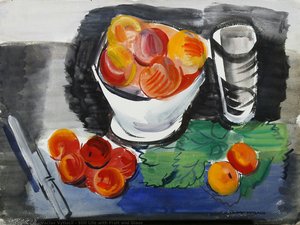
In the quiet intimacy of Still Life with Fruit and Glass, created in 1930, we encounter a moment of profound stillness captured through the lens of early twentieth-century modernism. The composition centers around a bountiful bowl, overflowing with the vibrant textures of apples, oranges, and tomatoes, which serve as anchors of warmth within the frame. Surrounding this central feast, scattered carrots and a delicate cup with a resting spoon introduce a sense of lived-in reality, suggesting a domestic scene paused in time. A solitary bottle perched in the upper left corner provides a structural counterpoint, guiding the eye through a carefully orchestrated arrangement of shapes and light. This work is not merely a depiction of food; it is an exploration of how light interacts with organic surfaces, turning everyday objects into vessels of aesthetic wonder.
The technique employed by Vaclav Vytlacil reflects his deep engagement with the evolving language of abstraction and form. While the subject matter remains rooted in the classical tradition of the still life, there is an unmistakable rhythmic quality to the brushwork that hints at the artist's future as a pioneer of American abstraction. The interplay between the heavy, saturated tones of the fruit and the more delicate, translucent qualities of the glassware creates a tactile experience for the viewer. Each stroke contributes to a sense of volume and weight, inviting the observer to feel the skin of the orange or the cool smoothness of the glass. For the discerning collector or interior designer, this painting offers a sophisticated balance of classical subject matter and modern sensibility, making it a versatile masterpiece for any curated space.
Beyond its visual splendor, the painting resonates with an emotional depth that speaks to the timelessness of the domestic sphere. There is a nostalgic, almost meditative quality to the arrangement, evoking a sense of abundance and the quiet beauty found in the mundane. As one of Vytlacil's earlier explorations, this piece serves as a bridge between the representational traditions he learned at the Art Institute of Chicago and the revolutionary "push and pull" theories he would later champion alongside Hans Hofmann. To possess a reproduction of this work is to bring a piece of art history into the home—a fragment of a transformative era where the boundaries of perception were being redrawn, offering both a window into the past and a timeless inspiration for the modern interior.
関連作品

作家の略歴
The Architect of Abstraction: The Life and Legacy of Vaclav Vytlacil
In the vibrant tapestry of American modernism, few threads are as intricately woven or as profoundly influential as those spun by Vaclav Vytlacil. Born in New York City on November 1, 1892, to Czech immigrants, Vytlacil’s journey was one of constant movement and artistic evolution. Though his roots were planted in the bustling energy of Manhattan, his early years in Chicago provided a diverse cultural backdrop that would later inform the rich, layered textures of his work. His formal odyssey began at the Art Institute of Chicago in 1906, where he first learned to translate the physical world into pigment and form. This foundational period was marked by a rigorous pursuit of technical mastery, a trait that would remain a cornerstone of his practice even as he ventured into the radical territories of abstraction.
The trajectory of Vytlacil’s career took a decisive turn when he moved to New York to study at the prestigious Art Students League in 1913. Under the watchful eye of the portraitist John C. Johansen, Vytlacil developed an acute sensitivity to tonal control and meticulous observation. However, the boundaries of traditional representation could not long contain his burgeoning curiosity. Seeking the vanguard of innovation, he turned his gaze toward Europe, immersing himself in the artistic currents of Munich. It was during this transformative period that he encountered the legendary Hans Hofmann. This meeting would become the defining moment of his life, establishing a profound intellectual and aesthetic bond. As one of Hofmann’s most devoted disciples, Vytlacil embraced the revolutionary principles of spatial tension and color dynamics, eventually becoming a vital conduit for these ideas as they crossed the Atlantic to reshape American art.
A Symphony of Form and Color
Vytlacil’s oeuvre serves as a breathtaking chronicle of an artist transitioning from the tangible to the transcendental. His early works often found beauty in the quietude of the domestic sphere, utilizing still life compositions to explore the interplay of light and volume. In masterpieces such as Still Life with Grapes, Vase, and Fish, one can witness the delicate tension between classical subject matter and modern experimentation. He possessed a singular ability to elevate the mundane—a cluster of grapes or the curve of a vase—into something monumental through deliberate brushwork and a sophisticated understanding of weight and balance. These compositions were not merely depictions of objects but were explorations of how light breathes life into form, creating a sense of three-dimensional presence that pulls the viewer into a shared, tactile space.
As his relationship with Cubist aesthetics deepened, Vytlacil’s work underwent a radical metamorphosis. The structured reality of his early still lifes gave way to the rhythmic energy of abstraction. His later compositions, such as the striking Abstract Composition [Triptych], demonstrate a mastery of geometric shapes, bold lines, and textured surfaces. In these works, the artist moved beyond the representation of objects to focus on the pure emotional resonance of color and space. He utilized the lessons learned from Hofmann to create canvases that felt alive with movement, where the boundaries between foreground and background dissolved into a harmonious dialogue of energetic strokes. This evolution reflects a lifelong commitment to pushing the limits of what paint could communicate, moving from the observation of the external world to the expression of an internal, rhythmic truth.
Historical Significance and Enduring Influence
Beyond his individual canvases, Vaclav Vytlacil played a crucial role in the pedagogical landscape of mid-century America. He was not merely a practitioner of modernism but one of its most dedicated educators and advocates. Following World War II, he became instrumental in disseminating the transformative teachings of Hans Hofmann across the United States, lecturing at various institutions and fostering a new generation of artists who would go on to define the American avant-garde. His ability to bridge the gap between European innovation and American experimentation helped solidify a unique identity for American abstraction, making it a formidable force on the global stage.
Today, the legacy of Vytlacil is preserved in the permanent collections of the world's most esteemed institutions, including:
- The Museum of Modern Art (MoMA)
- The Metropolitan Museum of Art
- The Smithsonian American Art Museum
Vytlacil’s contribution to art history lies in his role as a bridge-builder—between tradition and revolution, between the figurative and the abstract, and between the teachings of the Old World and the burgeoning spirit of the New. His life remains a testament to the power of artistic devotion and the enduring impact of a vision that seeks to find the infinite within the finite.
vaclav vytlacil
1890 - 1984
プロフィール概要
- Artistic Movement Or Style: Abstract American Art; Hans Hofmann's teachings
- Artists Or Movements Influenced By This Artist: Cubist Movement
- Artists Who Influenced This Artist: Hans Hofmann
- Date Of Birth: November 1, 1892
- Date Of Death: January 5, 1984
- Full Name: Vaclav Vytlacil
- Nationality: American
- Notable Artworks:
- Abstract Composition [Triptych]
- Still Life
- Place Of Birth: New York City, USA