Introduction
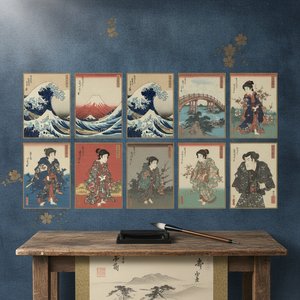
Imagine, if you will, stepping into the vibrant, bustling streets of Edo-period Japan, where the air is thick with the scent of cherry blossoms and the rhythmic sounds of a city in constant motion. This was the world of Ukiyo-e —the "pictures of the floating world." It was an era defined by a profound appreciation for the ephemeral: the fleeting beauty of a falling petal, the transient joy of a theater performance, and the delicate, passing moments of pleasure that make life so exquisitely precious. To look upon these works is not merely to view art, but to catch a glimpse of a heartbeat, frozen in time through the masterful marriage of woodblock carving and delicate pigment.
\Born from the rising merchant classes of Japan, Ukiyo-e broke away from the rigid, formal traditions of the past to celebrate the everyday. It captured the pulse of urban life—the elegance of kabuki actors, the grace of courtesans, and the breathtaking majesty of a landscape caught in a sudden rainstorm. Through the meticulous layering of colors and the sharp, decisive lines of the master printers, these works transformed common scenes into something transcendent. They were the windows through which a society viewed its own soul, capturing a sense of movement and light that would later travel across oceans to inspire the great Impressionists of Europe.
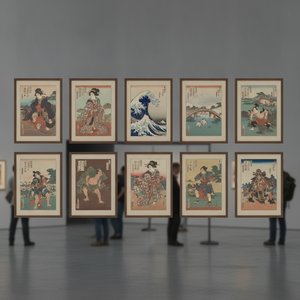
\Today, these masterpieces remain deeply resonant, offering us a sanctuary of stillness in our own fast-paced world. They remind us to find beauty in the transient and to honor the small, luminous details of our existence. As we wander through this curated selection, we invite you to linger on every line and shade. We have gathered ten definitive works—pieces that do more than just depict a scene; they define an entire movement's spirit. Let us begin our journey through these legendary impressions, tracing the delicate threads that connect the floating world of old Japan to the timeless emotions of the human heart.
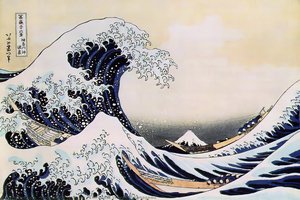
The Great Wave off Kanagawa - Katsushika Hokusai
To gaze upon Katsushika Hokusai’s The Great Wave off Kanagawa is to witness a moment where the ocean itself seems to breathe with a life of its own. In this 1831 masterpiece, Hokusai does not merely depict water; he composes a symphony of motion and tension. Can you feel the spray? The artist uses the striking, deep intensity of Prussian blue to pull you into the heart of the swell, where the cresting foam reaches out like clawed fingers, poised to overwhelm the fragile fishing boats below.
This iconic work from the Thirty-six Views of Mount Fuji series captures the very essence of the ukiyo-e movement—the beauty found within the fleeting, transient moment. While the colossal wave embodies nature's untamed power, the distant, snow-capped peak of Mount Fuji stands in silent, eternal stability. It is a breathtaking dialogue between the ephemeral and the permanent. Bringing this print into your space does more than decorate a wall; it invites a profound sense of drama and rhythmic grace, turning any room into a sanctuary of contemplative strength.
Femenine wave - Katsushika Hokusai
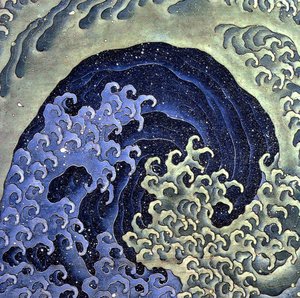 Femenine wave - Katsushika Hokusai
There is a rhythmic pulse in Feminine Wave by Katsushika Hokusai that seems to breathe alongside the viewer—not with the chaos of a storm, but with a profound, tidal understanding . This masterpiece from the late Edo period transcends the boundaries of a mere woodblock print; it acts as a mirror to the soul's own ebb and flow. As you gaze upon the sculpted crest of the Prussian blue vortex, you are not just observing a seascape, but witnessing a meditation on impermanence and the delicate dance between strength and grace.
Hokusai’s genius lies in the sensory layers: the crisp, white foam that feels almost tactile against the eye, and the soaring bird that introduces a fleeting moment of freedom amidst the ocean's power. To bring this work into your home is to invite a constant reminder of nature's eternal motion. It does not merely decorate a wall; it reminds you that you are part of a much larger, beautiful story—a single, graceful movement within the infinite waves of history.
Cranes on pine tree - Katsushika Hokusai
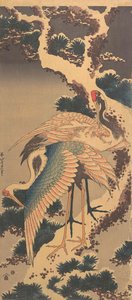 Cranes on pine tree - Katsushika Hokusai
To encounter Cranes on Pine Tree by Katsushika Hokusai is to step into a whispered prayer for longevity and grace. As one of the most profound jewels in the Ukiyo-e movement, this work transcends mere printmaking; it is a masterclass in atmospheric storytelling. Hokusai utilizes the delicate bokashi technique—layering sumi ink washes on fine washi paper—to create a misty, ethereal landscape where the boundaries between heaven and earth seem to dissolve.
The composition captures two cranes in a moment of quiet courtship, their elegant forms etched with precision against the resilient, textured branches of an ancient pine. This interplay of the fleeting (the birds) and the eternal (the tree) offers a deep emotional intelligence that has captivated collectors for centuries. For the modern connoisseur, this piece brings a sense of Zen-like serenity to a refined interior, acting as a timeless window into the soul of Edo-period Japan. It remains an essential masterpiece, embodying the very essence of harmony and the enduring beauty of the natural world.
The Sixth Month (Right) - Utagawa Kuniyoshi
 The Sixth Month (Right) - Utagawa Kuniyoshi
What story does the amber-hued landscape of The Sixth Month (Right) by Utagawa Kuniyoshi tell? In this 1849 masterpiece, the environment whispers of autumn’s arrival, where lanterns cast a soft, flickering glow over a garden dressed in seasonal splendor. As one of the most significant works defining the Ukiyo-e art movement , this print captures a profound moment of transition. Kuniyoshi, a master of narrative detail, uses the central figure—a woman elegantly holding a pumpkin amidst her attendants—to anchor a scene rich with the themes of harvest and the ephemeral nature of time.
The composition seamlessly blends traditional Japanese motifs with a burgeoning interest in light and perspective, marking a pivotal evolution in woodblock printing. For the modern collector, inviting such a piece into a home offers more than mere decoration; it provides a curated escape into the late Edo period. The warm, autumnal palette and the quiet, atmospheric tension evoke a sense of historical depth, allowing you to surround yourself with the serene, poetic beauty that defines this legendary era of Japanese art.
Fuji, Mountains in clear Weather (Red Fuji) - Katsushika Hokusai
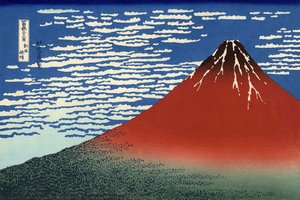 Fuji, Mountains in clear Weather (Red Fuji) - Katsushika Hokusai
In Fuji, Mountains in Clear Weather (Red Fuji) , Katsushika Hokusai achieves a breathtaking mastery of atmospheric light that transcends the traditional boundaries of woodblock printing. Rather than using heavy shadows, Hokusai utilizes a luminous, dawn-lit palette where the mountain itself seems to glow from within. The striking transition of the slopes into deep, warm ochres and vibrant vermillion suggests the first, searing touch of sunlight hitting the peak, creating a sense of spiritual awakening.
This sophisticated play of color and light—where the fiery mountain contrasts against the cool, ethereal whites of the clouds—is precisely what secured its place among the top 10 masterpieces of the Ukiyo-e movement . It is a moment of quiet grandeur captured in ink. When brought into a contemporary home through a high-quality reproduction, this work offers more than mere decoration; it introduces a profound sense of tranquility and prestige. The way the light seems to emanate from the canvas can add an incredible layer of depth and a soulful, sun-drenched elegance to any modern wall.
Akasaka, No. 37 - Utagawa Hiroshige
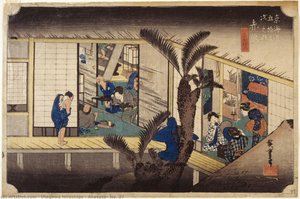 Akasaka, No. 37 - Utagawa Hiroshige
To step into the world of 19th-century Japan is to embrace a delicate dance between the fleeting moment and the eternal landscape. In Akasaka, No. 37 by Utagawa Hiroshoge , we find more than just a woodblock print; we encounter a quiet, breathing fragment of the Tokaido highway. As part of his legendary Fifty-three Stations of the Tōkaidō , this masterpiece captures the soft, atmospheric essence of Edo life with a sensitivity that feels remarkably modern.
Hiroshige invites us into a scene where human presence and nature exist in perfect, rhythmic harmony. Through masterful tonal gradations, he evokes the misty, cool air of the Akasaka station, using a palette that breathes with seasonal depth. The composition guides our eyes past travelers resting amidst lush foliage toward the distant, stable mountains, creating a sense of meditative stillness. It is this ability to transform a simple roadside stop into a profound study of light and tranquility that secures its place among the top 10 masterpieces of the Ukiyo-e movement . Even today, such works possess a luminous power, capable of bringing a sense of historical grace and soulful peace to any contemporary space.
The Imagire Sea Ferry, Maisaka, from the series The Fifty-three Stations of the Tokaido (Gyosho edition) - Utagawa Hiroshige
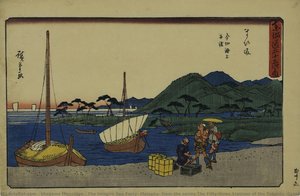 The Imagire Sea Ferry, Maisaka, from the series The Fifty-three Stations of the Tokaido (Gyosho edition) - Utagawa Hiroshige
In The Imagire Sea Ferry, Maisaka , Utagawa Hiroshige captures the very heartbeat of the Edo period, weaving a delicate tapestry of movement and coastal serenity. As part of his legendary series, The Fifty-three Stations of the Tokaido , this masterpiece stands as a cornerstone of the Ukiyo-e movement, renowned for its ability to transform a bustling transit hub into a poetic meditation on light and atmosphere. The scene breathes with life; colorful umbrellas dot the shoreline like fallen petals, while sturdy boats rest upon the water, mirroring the rhythmic ebb and flow of human migration.
Hiroshige’s mastery of perspective and subtle color gradients creates an immersive sensory experience, evoking the salt-tinged air of the Japanese coast. For the modern collector, this work offers a timeless elegance that transcends centuries. Its balanced composition—blending the energetic vitality of travelers with the tranquil permanence of the sea—provides a sophisticated focal point for contemporary interiors, bringing a sense of historical depth and serene, atmospheric beauty to any curated space.
Kabuki Actor Ōtani Oniji III as Yakko Edobei - toshusai sharaku
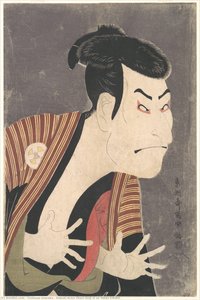 Kabuki Actor Ōtani Oniji III as Yakko Edobei - toshusai sharaku
In the breathtaking composition of Kabuki Actor Ōtani Oniji III as Yakko Edobei by Tōshūsai Sharaku, we encounter a masterclass in structural tension and geometric precision. The print is anchored by a striking verticality, where the sharp, decisive lines of the actor’s intense gaze and the dramatic sweep of his traditional costume create a profound sense of equilibrium. This internal balance—a rhythmic interplay between the stark, dark negative space and the sudden, vibrant focal point of the red scarf—achieves a timeless perfection that has secured its place among the top 10 masterpieces that defined the Ukiyo-e art movement .
There is a hauntingly beautiful resonance between Sharaku’s use of light and shadow and the principles of modern minimalist design. The way he strips away the superfluous to focus on raw, psychological essence allows this work to ground a contemporary aesthetic with effortless grace. To display such a piece is to invite a sophisticated, avant-garde drama into one's home, where the weight of history meets the clean, quiet elegance of the present day.
Early Department from a Daimyo - Utagawa Hiroshige
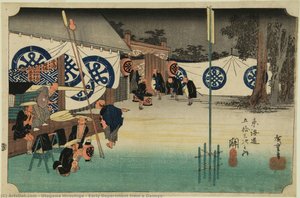 Early Department from a Daimyo - Utagawa Hiroshige
To encounter Early Department from a Daimyo by Utagawa Hiroshige is to step through a delicate portal into the heart of Edo-period Japan, unveiling a moment of profound serenity captured in woodblock. This masterpiece earns its place among the world's greatest ukiyo-e works through its exquisite ability to balance the rigid social hierarchies of the Tokugawa shogunate with the transient, shared joys of the 'floating world.'
Hiroshige orchestrates a rhythmic tapestry of human connection; amidst the disciplined silhouettes of samurai practicing archery, one finds the casual wanderers of the riverside, all bathed in a soft, atmospheric haze. The palette is a masterclass in restraint, utilizing muted greys, earthy browns, and tranquil blues that resonate deeply with the refined aesthetics of a modern, minimalist interior. Its influence on later masters like Van Gogh underscores its enduring legacy. For the discerning collector, this print offers more than mere decoration; it provides a timeless window into a vanished era, bringing a sense of historical depth and poetic stillness to any curated space.
Keishi (Kyoto), Capital - Utagawa Hiroshige
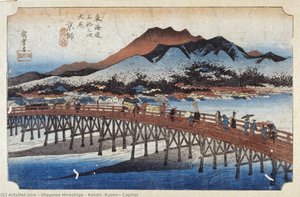 Keishi (Kyoto), Capital - Utagawa Hiroshige
In Keishi (Kyoto), Capital , Utagawa Hiroshige invites us to step onto the bustling Keishi bridge, capturing the very pulse of Edo-period Japan. As a cornerstone of our selection of the Top 10 Masterpieces That Defined the Ukiyo-e Art Movement , this 1834 woodblock print transcends mere landscape; it is a poetic meditation on connection and transit. Through his masterful use of bokashi —that delicate, misty gradation of color—Hiroshige evokes the soft atmosphere of a traveling day, where the gentle flow of the river meets the rhythmic movement of merchants and pilgrims.
The print’s placement in this definitive collection stems from its profound ability to blend the monumental with the mundane. The distant mountains provide a timeless backdrop to the fleeting, human moments captured beneath colorful umbrellas. It serves as a poignant reminder of the beauty found in transition, much like the Impressionist masters who would later find inspiration in his light and composition. For the modern collector, bringing this piece into a curated space offers more than decor; it introduces a serene, historical dialogue, inviting a sense of rhythmic peace and cultural depth into the contemporary home.
Conclusion
As the light fades on our journey through these floating worlds, we find that the essence of Ukiyo-e remains far more than a mere chapter in an art history textbook. These masterpieces—with their delicate lines, profound stillness, and vibrant captures of fleeting moments—do not belong solely to the past. They live within us, echoing in the way we find beauty in a sudden rain shower, the quiet grace of a passing shadow, or the simple elegance of a seasonal bloom. They are living presences that bridge the centuries, inviting us to slow our breath and find poetry in the everyday.
To bring these works into your own sanctuary is to invite an eternal dialogue between the soul and the space you inhabit. Whether it is the rhythmic strength of a wave or the soft intimacy of a portrait, each piece carries a heartbeat that continues to shape our modern interiors and stir our deepest emotions. They remind us that while life is transient, the beauty we capture within it can remain timeless. We invite you to continue this exploration and find your own connection to these storied impressions by wandering through our full collection , where every brushstroke serves as a quiet window into a world of enduring wonder.