
The Architecture of Illusion: When Canvas Becomes a Living Experience
 Beyond the Eye: Masterpieces That Redefine Visual Perception and the Art of Optical Illusion
The Architecture of Illusion: How Op Art Challenges the Retinal Experience To gaze upon a true masterpiece of optical art is to enter into a silent dialogue with one's own biology. Unlike traditional representational art, which seeks to mirror the ex...
To stand before a true masterpiece is to enter into a profound, almost sacred, conversation that transcends the mere act of looking. There exists a fleeting, magical moment when the eyes and the continuous flow of the mind engage in a silent, beautiful conflict. This is the essence of optical illusion art—a genre where the canvas ceases to be a flat surface and instead becomes a portal into a realm of shifting boundaries. In these works, we encounter a profound dialogue between perception and reality, where the artist does not simply present an image but orchestrates a physiological event. The viewer is no longer a passive observer sitting in a quiet gallery; they become an active participant in a rhythmic dance of light and geometry.
This architectural approach to art challenges our very understanding of space and form. Unlike traditional representational art, which seeks to mirror the external world through the careful application of light and shadow, illusionistic works function as a sophisticated interrogation of the human retina. They invite us to question the stability of what we see, creating a sense of depth where none exists and movement where there is only pigment. It is an experience that transforms a room from a static environment into a breathing, pulsing space, much like the immersive, hallucinatory landscapes found in the works of surrealist masters.
Masters of Motion: Exploring the Kinetic Energy of Duchamp and Vasarely
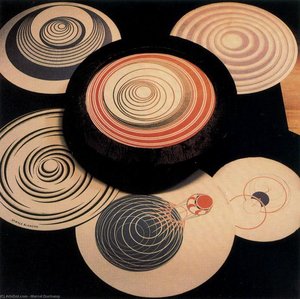 Rotoreliefs (Optical Discs)
The Optical Dance of Marcel Duchamp’s Rotoreliefs Marcel Duchamp, a name synonymous with artistic rebellion and intellectual provocation, stands as one of the most influential figures in 20th-century art. While celebrated for his “readymades” – every...
The history of art is punctuated by rebels who sought to break the stillness of the frame. Marcel Duchamp, a name synonymous with intellectual provocation, famously moved beyond what he termed retinal art—works that merely pleased the eye—to explore the very nature of motion itself. His Rotoreliefs, or optical discs, represent a breathtaking chapter in this pursuit. These were not static paintings meant for quiet contemplation; they were designed to be activated. When mounted on a spinning turntable, these lithographed patterns of concentric circles and spiraling designs would morph and distort, creating a mesmerizing sense of depth and instability that forced the viewer to witness an illusion unfold in real-time.
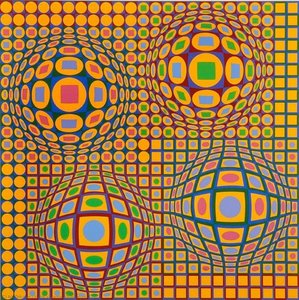
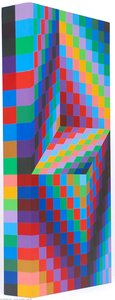
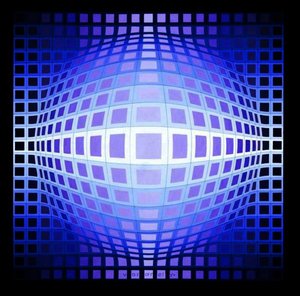
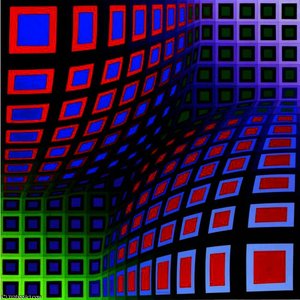
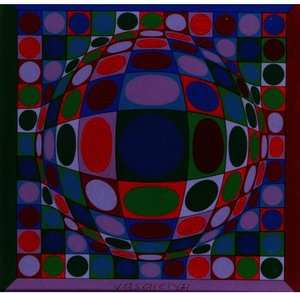
Following this lineage of movement, we find the hypnotic world of Victor Vasarely, the undisputed godfather of the Op Art movement. Vasarely abandoned the path of medicine to master a different kind of anatomy: the mechanics of human perception. His work, such as the vibrant Ter, a 1, acts as a visual glitch, using mathematical precision and high-contrast geometric forms to trick the eye into seeing motion where there is only canvas. Much like his predecessors, Vasarely’s compositions are not mere decorations; they are interactive encounters that demand full attention, pulling the viewer into a high-voltage dimension of pure, kinetic energy.
The Science of Seeing: How Op Art Interrogates the Human Retina
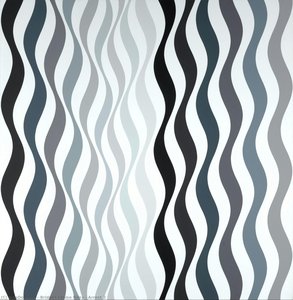 bridget louise riley
Bridget Riley: Architect of Illusion Bridget Louise Riley, born in London in 1931 and now residing across Cornwall, France, and London, is an artist whose work has fundamentally reshaped our understanding of perception. More than simply a painter, sh...
At its most fundamental level, visual perception is the ability to detect light and use it to form an image of our environment. However, art has the power to manipulate this biological process, turning the eye into a laboratory for experimentation. The movement known as Op Art functions through a deep engagement with Gestalt psychology—the mind's natural tendency to organize fragmented visual elements into unified, meaningful wholes. By strategically placing high-contrast colors and precise geometric patterns, artists like Bridget Riley or the contemporary figure 1010 create "visual voids" or flickering boundaries that exploit the way our brain interprets spatial relationships.
This scientific interplay is often a delicate dance of chromatic induction and light manipulation. When we encounter works that utilize intense color contrasts, our retina experiences a physiological response that can cause colors to appear to shift or vibrate. This is not a trick played on the mind, but rather an exploration of how the nervous system processes signals from the eye. The brilliance of these artists lies in their ability to use the raw power of light and contrast to create a sense of breathing life within a static medium, making the viewer acutely aware of the biological machinery of sight itself.
Beyond the Static Image: Finding Depth in Contemporary Sensory Art
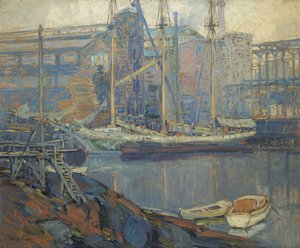 walter farndon
The Enigmatic Worlds of Walter Farndon Walter Farndon is a contemporary artist whose work delves into the fascinating realm where perception and reality intertwine. Though biographical details remain somewhat elusive, his paintings speak volumes – th...
The exploration of perception did not end with the mid-century masters; it has evolved into a contemporary movement where reality and illusion continue to intertwende. Artists such as Walter Farndon carry this legacy forward, creating carefully constructed visual experiences that challenge our understanding of depth and form. His work draws upon the principles of sensory illusion art to create canvases that are not merely windows onto another world, but portals into the mechanics of seeing itself. Through the use of precise patterns and an understanding of how the brain organizes space, these contemporary works continue to push the boundaries of what a painting can achieve.
Even in the urban landscape, the illusion persists. The artist known as 1010 utilizes large-scale murals to create abstract "holes" in the very fabric of our cities. By applying layers of color and light outlines, these works create an optical illusion of three-dimensionality, questioning the nature of solid space. This ongoing evolution proves that the fascination with the unseen—the ability to find depth, movement, and mystery within a flat surface—remains one of the most compelling frontiers in the world of fine art.
Curating the Unseen: Bringing Optical Wonder into Your Modern Home
 Captivating the Eye: The Sublime Mastery of Trompe l'œil and Optical Illusion Artworks
The Silent Dialogue: Where Perception Meets the Canvas Mind-Bending Masterpieces: A Visual Journey Through the World's Most Captivating Optical Illusion Artworks The Art of Deception: An Introduction to Optical Illusions in Fine Art There exists a pr...
Integrating these mesmerizing works into your personal space offers an opportunity to transform a house into a sanctuary of discovery. Whether it is a large-scale multi-panel set that spans a staircase or a single, striking focal point in a minimalist living room, art that plays with perception adds a layer of intellectual and sensory richness to interior design. At ArtsDot.com, we believe that everyone should feel confident in bringing these profound experiences home. We specialize in the creation of high-quality, hand-painted reproductions that capture the tactile depth and vibrant energy of these masterpieces.
For those looking to recreate the magic of a museum within their own walls, our collection allows you to browse by color, mood, or even room type, making the discovery process effortless. From the thick, textured impasto brushstrokes that mimic the soul of an original oil painting to custom commissions where we can "remix" history—perhaps painting a modern memory in the light-drenched style of Monet—we provide the tools to curate a space that is as intellectually stimulating as it is beautiful. Embrace the unexpected, and let your walls tell a story of movement, light, and the infinite wonders of the human eye.