The Strategic Role of Art in Hospitality: Establishing Brand Identity through Visual Storytelling
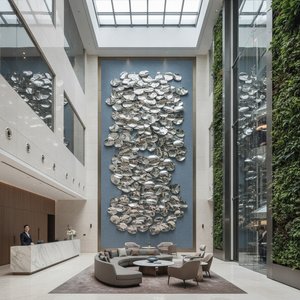 Large-Scale Art Solutions for Commercial and Hospitality Interiors: A Professional Guide to Scalable Decor
Establishing Visual Identity: The Strategic Role of Large-Scale Art in Hospitality Mastering the Layered Look: An Expert Guide to Art Groupings and Multi-Panel Displays for Luxury Hotel Interiors The Architecture of Walls: Establishing Visual Hierarc...
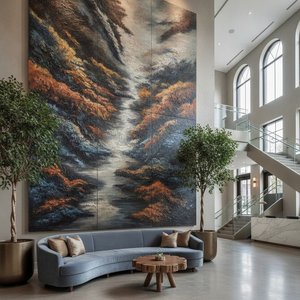
In the high-stakes arena of luxury hospitality design, a wall is never merely a boundary; it is a canvas awaiting a narrative. For the discerning hotel designer, the selection of artwork transcends mere decoration, serving as a fundamental pillar of brand storytelling and spatial atmosphere. Art acts as the silent ambassador of the guest experience, anchoring a brand identity in historical continuity and sophisticated elegance. When a space is curated with intention, the artwork provides a psychological anchor, establishing a fundamental sense of permanence and prestige that transforms a transient commercial space into a destination of substance.
The strategic deployment of art allows designers to manipulate mood through visual stimuli with surgical precision. In grand lobbies, commanding pieces can establish a focal point that guides the guest's eye, while in more intimate suites, subtle works can foster a sense of tranquility and escape. By selecting pieces that resonate with the architectural language of the property—whether through the bold presence of Baroque realism or the delicate intimacy of the Northern Renaissance—designers create an emotional connection that remains long after the guest has departed. This visual dialogue is what separates a standard lodging facility from a curated luxury experience, turning every corridor and lounge into a chapter of a larger, unforgettable story.
Mastering Scale and Proportion: Utilizing Large-Format Works to Define Architectural Space
 Mastering Scale: How Large-Format Art Creates Illusionary Space in Grand Hospitality Interiors
The Architecture of Perception: Utilizing Large-Format Art to Expand Grand Atriums Woman Red Hair, Large Mouth, Large Foot Influenced by action painting and featuring a striking red-haired woman with oversized features against a vibrant yellow and pi...
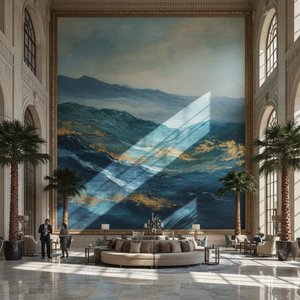
In grand hospitality interiors, particularly within soaring atriums or monumental lobbies, the physical constraints of an urban footprint often stand in direct opposition to the brand’s promise of boundless escape. For the designer, the challenge lies in utilizing large-scale art as a tool for the architecture of perception. A singular, expansive canvas does more than occupy a wall; it acts as a structural element that redefines the room's geometry. By introducing a focal point of significant scale, the designer can anchor the vastness of an atrium, preventing the eye from wandering aimlessly and instead directing it toward a curated horizon.
The true mastery of scale lies in using art to dissolve the hard edges of modern construction. A well-placed, large-scale masterpiece creates a visual weight that balances heavy architectural features like marble columns or steel beams. This is not merely about decoration but about the intentional use of scale to create an illusion of infinite expansion. When a painting possesses enough presence to command a massive wall, it effectively pushes the boundaries of the room outward, tricking the eye into perceiving a depth that the physical architecture may not actually provide. Through large-format murals and bespoke canvas rolls, designers can even recreate historical grandeur, such as Renaissance ceilings, within contemporary structures.
Achieving Cohesion: Implementing Multi-Panel Group Sets and Custom Color Matching for Interior Narratives
 Large Interior with Six Figures
Large Interior with Six Figures: A Window Into Vuillard’s Intimate Vision Jean Edouard Vuillard's "Large Interior with Six Figures," painted in 1897, stands as an emblem of the Nabis movement and a testament to Vuillard’s singular ability to distill ...
A cohesive interior narrative requires more than just aesthetic intuition; it demands a synchronized approach to texture and tone. One of the most sophisticated methods for achieving this is through the multi-panel revolution, utilizing triptychs and polyptychs to span expansive atriums or long corridors. These group sets allow a single, powerful image to be split across three, four, or five panels, creating a modern architectural look where colors and brushstrokes flow seamlessly across every panel. This technique is particularly effective for wide walls or staircases, providing a rhythmic visual progression that guides movement through the hotel.
Beyond scale, true cohesion is found in the details of color and customization. The ability to "remix" art history allows designers to tailor works to a specific brand palette. Through professional digital mockup services, it is possible to see a composition before painting begins, ensuring that the hues of an oil reproduction perfectly complement the upholstery, flooring, and architectural finishes. Whether it is requesting a photo to be painted in the impasto style of Van Gogh or adjusting the luminosity of a landscape to match a room's lighting, this level of customization ensures that every piece of art is an integrated component of the interior architecture rather than an afterthought.
Streamlining Procurement: Overcoming Logistical Fragmentation with Integrated Bespoke Art Solutions
 Elevate Your Hotel Interiors: The All-in-One Solution for Seamless, High-Impact Art Procurement
The Designer's Dilemma: Overcoming Fragmentation in Art Procurement Interior architecture Interior architecture is the design of a building or shelter from the inside out, or the design of a new interior for a type of home that can be fixed. It can r...
For the modern hotel designer, the pursuit of a cohesive interior narrative is often interrupted by the logistical chaos of fragmented procurement. The vision for a grand lobby or a curated corridor requires more than just aesthetic intuition; it demands a synchronized supply chain that can bridge the gap between a conceptual sketch and a physical masterpiece. Too often, designers find themselves trapped in a cycle of managing disparate vendors—one for framed prints, another for custom murals, and yet another for bespoke furniture—each with their own timelines, quality standards, and communication gaps.
This fragmentation does more than just drain time; it dilutes the brand identity that the designer is working so tirelessly to establish. When procurement is disconnected, the risk of stylistic inconsistency and logistical failure increases exponentially. True excellence in hospitality is achieved when art procurement is treated as a strategic integration. By utilizing an all-in-one solution that handles everything from custom commissions and large-scale integration to professional framing and global logistics, designers can ensure that every texture and tone contributes to a unified, prestigious destination without the burden of managing a fractured supply chain.
The Technical Edge: Ensuring Longevity and Quality through Hand-Painted Oil Reproductions and Professional Framing
 Oil paint
Oil paint is a type of slow-drying paint that consists of particles of pigment suspended in a drying oil, commonly linseed oil. Oil paint also has practical advantages over other paints, mainly because it is waterproof. The earliest surviving example...
In the high-stakes environment of commercial hospitality, the durability of art is as critical as its beauty. The choice between a Giclée print and a handmade oil reproduction defines the "soul" of the space. While prints offer efficiency, a handmade oil reproduction on 100% cotton canvas provides a tactile depth that cannot be replicated by digital printing. These works feature visible brushstrokes and a deeper tonal range, offering a physical presence that commands respect. To ensure long-term preservation, professional-grade materials are essential, such as the use of flexible gesso to prevent cracking and specific oils like safflower to prevent the yellowing of whites over time.
The final layer of protection lies in engineering and framing. For large-scale projects, custom canvas wrap engineering—such as MirrorWrap or ExtendedWrap—ensures that the artwork continues around the edges for a seamless look, while reinforced stretcher bars prevent warping over time. Furthermore, the application of a Damar varnish protects the surface from dust, moisture, and atmospheric pollutants, ensuring the pigments remain vibrant for generations. When these technical standards are met, art becomes a lasting investment in the property's heritage, providing a sense of permanence that supports the hotel's long-term brand value.
This article was prepared for the professional designers and procurement managers of ArtsDot.com. For expert assistance with large-scale hospitality projects, please visit our professional trade program at ArtsDot.com.