

 Pregledaj u prostoru
 Pošalji
 Podeli
 Detalji o delu

 Преузми
 Slični predmeti
 Rendgenski snimak
 Slajdovi
 Stats
StatsModel for 'Torsion'


 Pročitaj više
Ručno rađena uljana reprodukcija
Ručno oslikano uljanim bojama na platnu u dimenzijama i okviru po vašem izboru, izrađeno po porudžbini od strane naših umetnika. ( Switch to Print Switch to Digital Image)




P118B $10

P118H $10

P118W $10

P438Z $10

P508JH $12

P508YH $12

P805H $10

P805Z $10

P919BZ $10

P919G $10

P919XJ $10

P959ZH $10

P968JZ $12

W106C $8

W218G $10

W218JH $8

W218Y $10

W307PJ $10

W316G $10

W316PJ $8

W316Y $10

W398PJ $8

W4111J $10

W500HY $15

W500JH $15

W692G $12

W849H $8

W940BG $15

W953PJ $8




Izaberite jednu od naših unapred definisanih veličina koje odgovaraju originalnim proporcijama umetničkog dela.

Можете унети сопствене димензије како бисте прилагодили дело одређеном оквиру или простору. Ако одабрана величина не одговара пропорцијама оригинала, слика ће бити исечена или проширена додатним елементима који се ручно насликавају. Дигитални prikaz ће вам бити послат на одобрење пре почетка производње.
Имајте на уму да преглед на екрану не одражава стварно исецање или проширење. Само приказ (mockup) ће тачно приказати коначну композицију.
Иако су доступне прилагођене величине, препоручујемо да одаберете димензију из дефинисане листе како бисте сачували оригиналне пропорције.
Nakon narudžbine, tim ArtsDot.com će klijentu putem e-pošte poslati uputstva i dostaviti prikaz predloženog rešenja
Isporuka širom sveta () za 3/4 nedelje umesto uobičajenih 5 nedelja. (8 септембар). Bez kompromisa po pitanju kvaliteta.

Besplatna ekspresna dostava širom sveta

Visokokvalitetno laneno platno

Kompletno osiguranje transporta

Garancija povraćaja carine i uvoznih dažbina

Garancija vernosti boja

Politika povraćaja u roku od 100 dana (isključivo u slučaju nedostataka)

Garancija povrata novca od 100%

Popust pri grupnoj kupovini
 Opcija sa staklom dostupna je samo za dimenzije manje od 110 cm

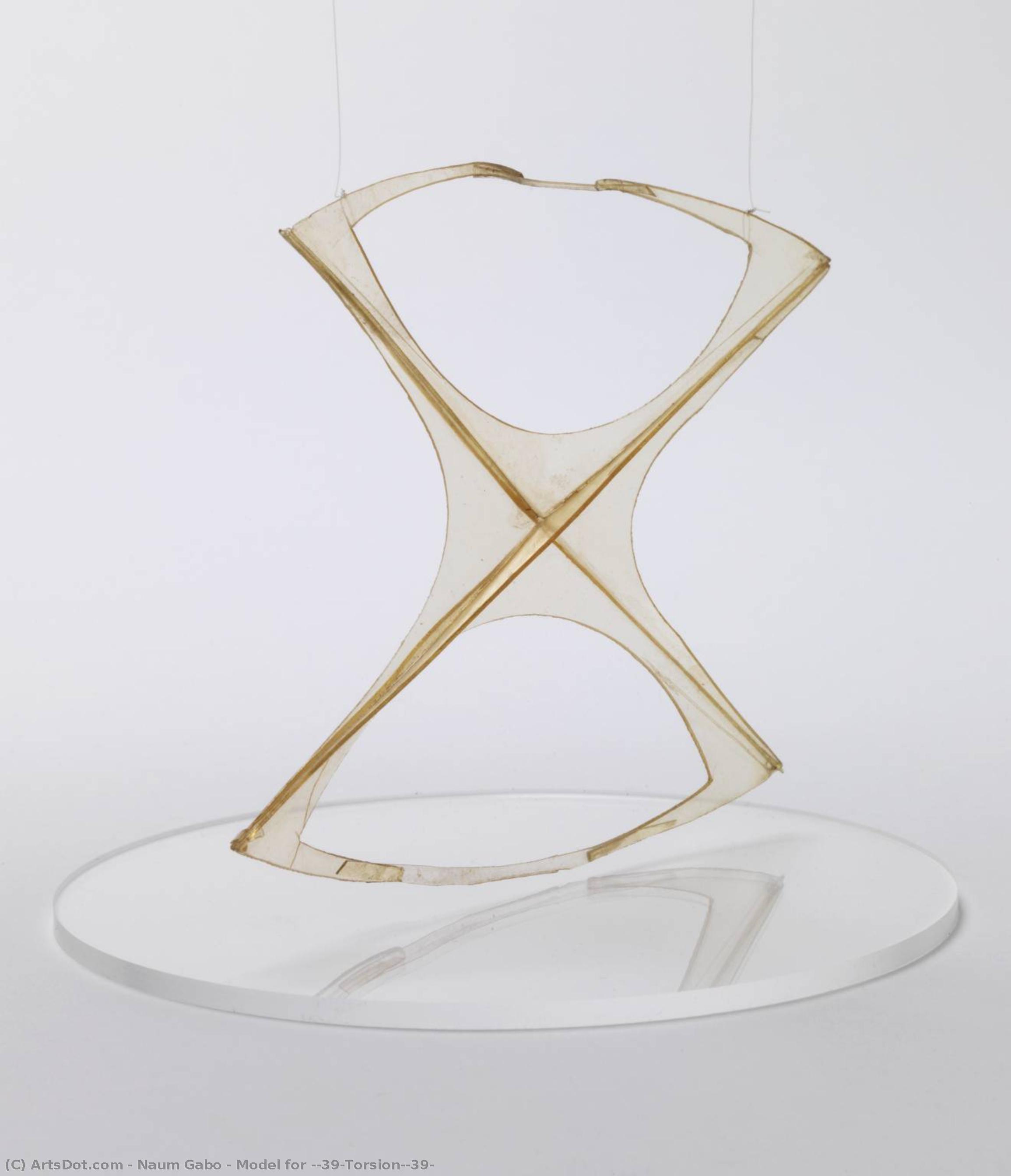
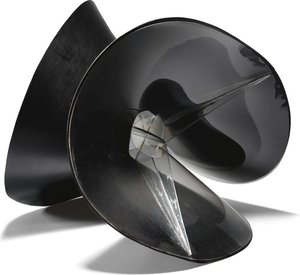
Model for 'Torsion'
Tehnika reprodukcije
Dimenzije reprodukcije
-


Konačna cena
$ 263
Model for 'Torsion': A Pioneering Vision of Kinetic Sculpture
Naum Gabo’s ‘Model for ‘Torsion,’ created in 1928–36, stands as an emblem of Constructivism and a cornerstone in the evolution of twentieth-century sculpture. Born Naum Neemia Pevsner in Bryansk, Russia, Gabo embarked on a lifelong artistic odyssey fueled by unwavering conviction that art could mirror the dynamism inherent within modern life—a belief profoundly shaped by his upbringing amidst engineering principles. Collaborating closely with his brother Antoine, he championed bold experimentation and challenged conventional sculptural traditions, establishing himself as a pivotal figure in shaping the aesthetic landscape of his era. The sculpture itself embodies Gabo’s core philosophy: an exploration of space and time through geometric abstraction. Constructed primarily from translucent acrylic or glass—a material chosen for its ability to convey both solidity and ethereal lightness—the piece presents an elongated ‘X’ shape, subtly curving along its axis. Mounted on a simple white circular pedestal, the composition prioritizes clarity and visual impact, directing attention entirely to the object's form and texture. Lines dominate the artwork, defining the sharp angles of the 'X' and emphasizing its graceful curves—a deliberate contrast that underscores Gabo’s fascination with opposing forces.- Material: Translucent Acrylic or Glass
- Dimensions: Unknown
- Date: 1928–36
Srodna umetnička dela


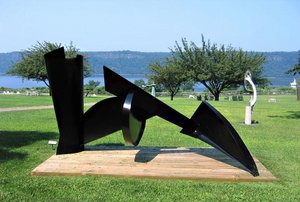
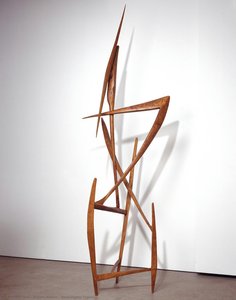
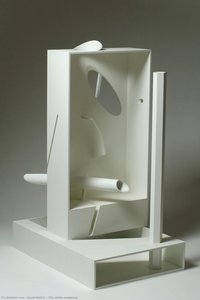
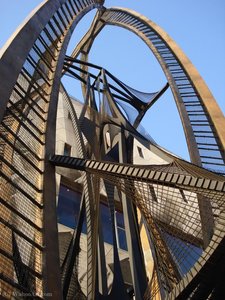
Biografija umetnika
A Pioneer of Kineticism: The Life and Art of Naum Gabo
Naum Gabo, born Naum Neemia Pevsner in 1890 in the Russian town of Bryansk, stands as a monumental figure in the evolution of twentieth-century sculpture. His journey was one of constant exploration, driven by a profound belief in the power of abstract art to reflect the dynamism of the modern world and express fundamental human experiences. Gabo wasn’t merely sculpting forms; he was investigating space, time, and the very essence of perception. The son of an engineer, Boris Pevsner, his early life instilled within him a fascination with structure and mechanics – influences that would profoundly shape his artistic vision. He shared a close bond with his brother Antoine Pevsner, also a prominent Constructivist artist, leading him to adopt the name “Gabo” to distinguish their work. This familial connection fostered a lifelong dialogue about art’s potential, culminating in collaborative manifestos and exhibitions that challenged conventional artistic boundaries. His multilingualism – fluency in Russian, German, French, and English – facilitated his peripatetic life, allowing him to engage with avant-garde circles across Europe and eventually the United States.From Russia's Avant-Garde to Global Influence
Gabo’s artistic development was inextricably linked to the revolutionary fervor of early twentieth-century Russia. After initial studies in medicine and natural sciences at Munich University, followed by engineering training, he immersed himself in the Parisian art scene alongside his brother Antoine around 1913. The seeds of his future style were sown during this period, as he absorbed influences from Cubism and Futurism while simultaneously developing a unique approach rooted in geometric abstraction. Upon returning to Russia following the 1917 revolution, Gabo became deeply involved in the burgeoning Constructivist movement. He, alongside Antoine Pevsner, articulated their vision in the “Realistic Manifesto” of 1920 – a pivotal text that rejected the decorative aspects of earlier abstract movements and championed a new art focused on representing "kinetic rhythms," the fundamental forms of our perception of time and space. This manifesto wasn’t simply an aesthetic declaration; it was a philosophical statement about art's role in reflecting the scientific and social progress of the age. The brothers staged an open-air exhibition in Moscow to accompany its release, boldly presenting their ideas directly to the public. However, the increasingly restrictive political climate in Russia led Gabo to leave the country in 1922, embarking on a journey that would take him through Berlin, Paris, Oslo, and finally, London before settling in the United States.Sculpting Space and Time: A Revolutionary Approach
Gabo’s artistic innovations were characterized by a relentless exploration of new materials and techniques. He moved beyond traditional sculptural mediums like stone and bronze, embracing industrial materials such as nylon, wire, lucite, glass, and metal to create works that defied conventional notions of form and volume. A defining feature of his work was his interest in “negative space” – the voids and openings within a sculpture. He didn’t see these spaces as mere absences but as integral components of the artwork itself, possessing a concrete reality equal to that of solid mass. His *Linear Constructions* (1942-1971) exemplify this approach, utilizing nylon filament to create delicate, ethereal structures that define space rather than occupying it. Perhaps his most groundbreaking achievement was his pioneering work in kinetic sculpture. *Kinetic Sculpture (Standing Waves)* (1920), often considered the first true kinetic artwork, demonstrated Gabo’s fascination with movement and time as essential elements of artistic expression. He wasn't simply creating static objects; he was crafting experiences that unfolded over time, engaging the viewer in a dynamic interplay between form and perception.Legacy and Enduring Significance
Throughout his career, Naum Gabo received significant recognition for his contributions to modern sculpture. Major retrospectives were held at the Tate Gallery in London (1966) and numerous institutions across Europe and America showcased his work. He completed several public commissions, including *Constructie* in Rotterdam and *Revolving Torsion* in London, though many ambitious projects remained unrealized due to logistical or financial constraints. His influence extended beyond sculpture, impacting architecture, design, and even dance. Gabo’s unwavering commitment to abstraction, his innovative use of materials, and his exploration of space and time continue to inspire artists today. He left behind a body of work that challenges us to reconsider the very nature of sculpture – not as a representation of reality, but as an embodiment of its underlying forces and rhythms. His legacy lies in his ability to transform abstract concepts into tangible experiences, inviting viewers to engage with art on a deeply intellectual and emotional level. He died in Connecticut in 1977, leaving behind a profound artistic inheritance that continues to resonate within the world of modern and contemporary art.Key Works & Collections
- Hommage à Naum Gabo (Homage to Naum Gabo) by Jankel Adler – A testament to Gabo’s influence on other artists.
- Untitled (416) – Demonstrates his mastery of abstract form and material exploration.
- Untitled, (1957) – An example of his urban sculpture and architectural studies.
- His works are prominently featured in the collections of:
- The Tate Gallery, London
- The Museum of Modern Art, New York
- The Guggenheim Museum, New York
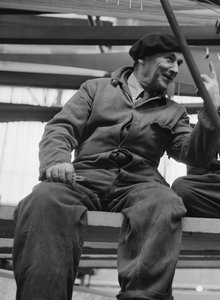
Naum Gabo
1890 - 1977 , Russia
Osnovne informacije
- Artistic Movement Or Style: Constructivism, Kinetic Art
- Artists Or Movements Influenced By This Artist:
- Antoine Pevsner
- Cubism
- Bauhaus
- De Stijl
- Artists Who Influenced This Artist: ['Wassily Kandinsky']
- Date Of Birth: 1890
- Date Of Death: 1977
- Full Name: Naum Gabo
- Nationality: Russian
- Notable Artworks:
- Hommage à Naum Gabo
- Untitled (416)
- Untitled (1957)
- Place Of Birth: Bryansk, Russia
Povezani članci
Beyond Form & Color: Geometric Abstraction's Evolution in 20th/21st Century Art
Explore the evolution of geometric abstraction from Cubism to contemporary art. Discover key artists like Malevich & Mondrian, investment insights, and expert collecting advice at ArtsDot.

Bronze Sculptures That Defined Art History | ArtsDot
Journey through art history with our Top 10 bronze sculptures! Explore masterpieces by Rodin, Michelangelo & more. Discover stories behind iconic statues and find museum-quality reproductions for your home decor at ArtsDot.com.
Beyond Form & Color: Geometric Abstraction's Enduring Legacy in Art History
Explore the captivating world of geometric abstraction! Discover its origins, key artists like Malevich & Mondrian, and why this movement remains highly valued by art collectors today. Expert insights at ArtsDot.

The Enduring Form: Exploring Themes & Techniques in Sculpture Across Historical Periods
Explore the rich history of sculpture from ancient masterpieces to contemporary innovations. Discover key techniques, influential artists & investment potential for discerning art collectors.

Top 10 dela geometrijske apstrakcije koje morate videti | ArtsDot.com
Istražite 10 remek-dela geometrijske apstrakcije – Mondrian, Malevič i Kandinski. Otkrijte priče iza ovih ikoničnih slika i pronađite inspiraciju za dekoraciju enterijera sa ArtsDot.com! Reprodukcije vrhunskog kvaliteta.