Introduction
Step into a world where the boundaries between dream and reality dissolve, where the familiar becomes strange, and where the subconscious is given a vivid, tactile form. To wander through the works of Max Ernst is not merely to view art, but to embark on a psychological pilgrimage. It is an invitation to look beneath the surface of our waking lives and confront the beautiful, often unsettling, landscapes of the human psyche.
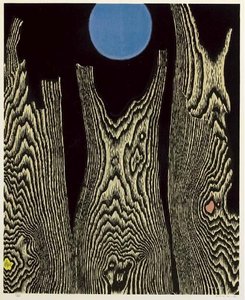
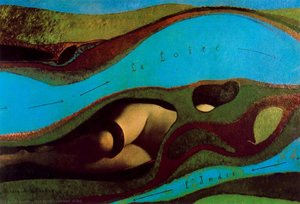
Born in Brühl, Germany, amidst a landscape of deep intellectual inquiry, Ernst emerged as a restless architect of the imagination. His journey was forged in the fires of profound historical upheaval; having witnessed the fragmentation of Europe during the Great War, he found himself drawn to the radical disruptions of Dada and the dream-logic of Surrealism . He did not seek to replicate the light-drenched serenity of the Impressionists, but rather to capture the textured, often chaotic pulse of the unconscious mind. Through pioneering techniques like frottage —the rubbing of textures to reveal hidden shapes—and intricate collages, he taught us that art could be found in the accidental, the weathered, and the unexpected.
These twenty-five masterpieces remain profoundly meaningful today because they speak to a universal truth: our inner worlds are as vast and complex as any external horizon. In an age of digital perfection, Ernst’s emphasis on texture, chance, and the raw power of imagery serves as a poignant reminder of the mystery that resides within us all. His ability to transform a simple rubbing or a scrap of paper into a doorway to another dimension continues to haunt and inspire.
As we prepare to journey through this curated selection, let us move slowly. We will encounter birds that are part man, forests that breathe with hidden life, and landscapes that feel like memories from a dream we once had but cannot quite recall. Prepare yourself to see the world not as it appears, but as it is felt—layered, enigmatic, and utterly spellbinding.
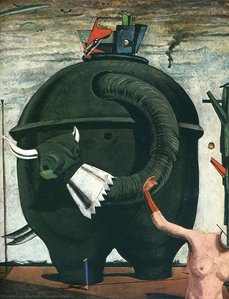
The Elephant Celebes - Max Ernst
 The Elephant Celebes - Max Ernst
In the pantheon of 20th-century Surrealism, few works possess the haunting, dreamlike magnetism of The Elephant Celebes . Created in 1921, this masterpiece stands as a cornerstone of Max Ernst’s transition from the chaotic disruptions of Dada to the profound psychological depths of Surrealism. It is a visual fever dream, where the boundaries between the mechanical and the organic dissolve into a singular, unsettling mystery.
The composition invites us into a realm of illogical juxtapositions: a massive, boiler-like creature—reminiscent of an elephant yet strangely metallic—dominates the canvas, topped with a whimsical red cat. Through textured, impasto-like layers and a muted, earthy palette, Ernst evokes a sense of ancient ritual blended with modern anxiety. This artwork earns its place among the top 25 works of Max Ernst by challenging our very perception of reality, urging us to find beauty in the bizarre. For the discerning collector, bringing such a piece into a curated space offers more than mere decor; it introduces a timeless, intellectual conversation, transforming a room into a sanctuary for contemplation and the exploration of the subconscious mind.
Europe after the Rain II - Max Ernst
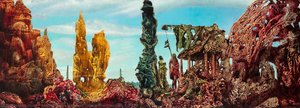 Europe after the Rain II - Max Ernst
To stand before Europe after the Rain II is to witness the very pulse of Surrealism. One cannot help but be captivated by the thick, visceral textures where Max Ernst’s pioneering techniques—reminiscent of his famed frottage and grattage —create a landscape that feels alive. The surface is a rhythmic dance of impasto; rugged, organic formations in deep ochre, burnt orange, and fiery red rise like geological anomalies, their edges catching the light to reveal a profound, tactile depth. These weathered textures do more than depict decay; they embody the psychological erosion of a continent during the shadows of 1942.
As we curate this selection of the top 25 artworks of Max Ernst, our mission at ArtsDot.com is to ensure this three-dimensional soul is never lost to a flat print. Our hand-painted oil reproductions meticulously recreate these heavy brushstrokes and layered pigments on cotton canvas, preserving the atmospheric weight and dreamlike mystery of Ernst’s vision for your own collection.
Of This Men Shall Know Nothing - Max Ernst
 Of This Men Shall Know Nothing - Max Ernst
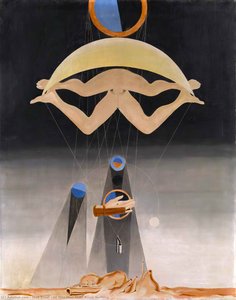
Imagine standing on the threshold of a dream, where the boundaries between the waking world and the subconscious dissolve into a quiet, unsettling mystery. In Of This Men Shall Know Nothing , Max Ernst invites us into this liminal space, capturing a moment of profound existential tension. Created in 1923, this masterpiece serves as a bridge between his Dadaist roots and the burgeoning Surrealist movement, reflecting a period of intense psychological exploration.
The painting presents an enigmatic landscape where elongated figures float suspended by celestial strings, tethered to luminous blue spheres that pierce the dark, muted shadows. There is a haunting beauty in the way Ernst uses a palette of beige, earth tones, and deep grays to evoke a sense of cosmic isolation. This work earns its place among the top 25 artworks of Max Ernst because it does more than depict a scene; it provokes a dialogue with the unknown. Bringing such a thought-provoking piece into your home allows you to embrace the profound, inviting a sense of wonder and intellectual depth into your daily surroundings.
Napoleón en el desierto - Max Ernst
 Napoleón en el desierto - Max Ernst
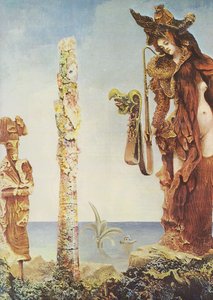
To gaze upon Napoleón en el desierto is to step into a fever dream where the boundaries of history and myth dissolve into a haze of ochre and shadow. In this 1941 masterpiece, Max Ernst invites us into a landscape of profound disorientation, where crumbling columns and turbulent waters mirror the psychological unrest of a world in upheaval. It earns its place among the top 25 artworks of Max Ernst through its breathtaking ability to weave symbolic narratives—using masked figures and elaborate, melancholic attire to explore the depths of the human subconscious.
The painting’s power lies in its tactile mystery; one can almost feel the weathered textures and the heavy, atmospheric light through the layers of oil. At ArtsDot.com, we strive to honor this surrealist legacy. Our hand-painted oil reproductions capture every intentional brushstroke and the rich, earthy palette of Ernst's vision, allowing you to bring this evocative sense of wonder and historical depth into your own sanctuary, preserving the very soul of the Surrealist movement.
The Robing of the Bride - Max Ernst
 The Robing of the Bride - Max Ernst
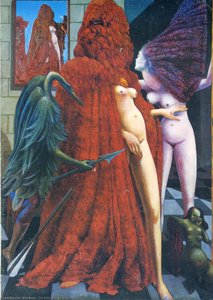
In The Robing of the Bride , Max Ernst orchestrates a profound tension between organic chaos and structural precision. The composition is anchored by a striking geometric interplay; the heavy, angular drapery of the commanding red figure provides a stabilizing weight that balances the ethereal, fluid lines of the nude female forms. This careful arrangement of shapes—from the sharp spear held by the mythic bird to the soft, billowing textures of the purple hair—creates a rhythmic, almost architectural harmony. It is this internal balance that secures its place among the top 25 artworks of Max Ernst , offering a sense of timeless perfection amidst the surrealist dreamscape.
Much like the principles found in modern minimalist design, the painting uses bold, concentrated focal points to ground its more unsettling elements. The way the intense crimson hues interact with muted, earthy tones creates a sophisticated visual equilibrium that resonates beautifully within contemporary interiors. For the discerning collector, this work offers more than just psychological drama; it provides a masterclass in how structural stability can elevate the most profound explorations of the unconscious mind.
Les dieux obscurs (Dark Gods) - Max Ernst
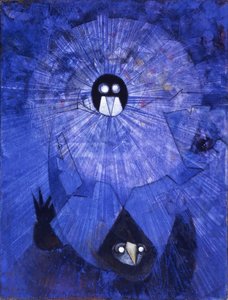 Les dieux obscurs (Dark Gods) - Max Ernst
In Les dieux obscurs (Dark Gods), the eye is immediately drawn to the visceral, tactile tension of Max Ernst’s brushwork. One can almost feel the heavy, rhythmic application of oil paint, where thick impasto ridges meet smoother, shadowy transitions to create a landscape of profound psychological weight. This mastery of texture allows the colossal, watchful eyes of the humanoid form to emerge from a sea of deep blues and blacks, casting an unsettling, primordial light upon the vulnerable, bird-like figure below.
This painting stands as a cornerstone in our collection of the top 25 artworks of Max Ernst because it captures the very essence of Surrealist exploration—the intersection of dream and nightmare. At ArtsDot.com, our mission is to honor this incredible materiality. We do not merely print; our artists hand-paint each reproduction on 100% cotton canvas, meticulously recreating every directional line and textured stroke. We ensure that the haunting, three-dimensional soul of Ernst’s vision is preserved, bringing the profound emotional depth of these dark, archetypal gods into the intimate sanctuary of your own home.
Stratified Rocks, Nature's Gift of Gneiss Lava Iceland Moss… - Max Ernst
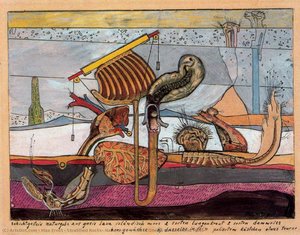 Stratified Rocks, Nature's Gift of Gneiss Lava Iceland Moss… - Max Ernst
To gaze upon Stratified Rocks, Nature's Gift of Gneiss Lava Iceland Moss… is to step directly into the fever dream of a world recovering from the tremors of war. In this 1920 masterpiece, Max Ernst does not merely depict a landscape; he conjures a primordial, volcanic realm where the boundaries between the organic and the ritualistic dissolve entirely. The light here does not illuminate so much as it haunts, casting a flat, diffused glow over a chaotic ceremony of distorted, animalistic figures.
As you wander through this composition, you feel the textured weight of the dark red and brown rock formations, as if the very earth is breathing with an ancient, unsettling energy. The central vessel, anchored by a complex web of ropes, pulls your eye into a dance of Expressionist tension and Surrealist mystery. It is a work of profound psychological depth, where every jagged line and layered brushstroke whispers of the subconscious. Bringing this piece into your collection means inviting a portal of historical intrigue and dreamlike intensity into your home, turning a simple wall into a window to the era of Dada.
untitled (8351) - Max Ernst
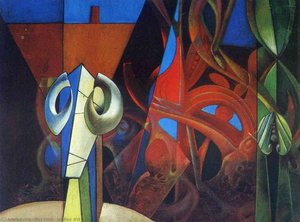 untitled (8351) - Max Ernst
To gaze upon untitled (8351) is to step directly into the fractured psyche of the Weimar era. While many remember Max Ernst for his playful Dadaist roots, this 1927 masterpiece reveals a much deeper, more unsettling mastery of the subconscious. The canvas breathes with an eerie, atmospheric tension, draped in bruised violets and sun-scorched ochre. At its heart stands a colossal, featureless monolith—a silent sentinel that commands the desolate landscape, surrounded by enigmatic, bird-like figures that seem to emerge from a fever dream.
Ernst’s technical genius here lies in his ability to marry meticulous oil painting with the chaotic spirit of automatism . By bypassing rational thought, he allowed textures and strange, sculptural forms to coalesce through chance, creating a visual language of profound psychological depth. This piece stands as one of the top 25 artworks of Max Ernst because it does not merely depict a scene; it evokes an emotion. For the discerning collector, hanging such a provocative work in a modern study or home office provides more than just decoration—it fosters an atmosphere of intellectual curiosity and boundless, creative introspection.
After Us Motherhood - Max Ernst
Step into a dreamscape where the boundaries of reality dissolve, and find yourself standing before “After Us Motherhood.” In this 1927 masterpiece, Max Ernst invites us to abandon rational thought and surrender to the unsettling, beautiful logic of the subconscious. The canvas presents a hauntingly intimate tableau: a vulnerable infant perched atop a table, surrounded by a menagerie of birds and shadowed by the looming, primal presence of a dragon.
Ernst’s mastery of texture creates an immersive atmosphere; through meticulous layering, he achieves a tactile depth that mirrors the unpredictable nature of dreams. The palette—a swirling vortex of evocative oranges, deep blues, and luminous yellows—pulses with emotional tension. As one of the most profound works in the top 25 artworks of Max Ernst , this piece serves as a meditation on creation amidst chaos. Bringing such a work into your home offers more than mere decoration; it provides a window into the psyche, inspiring a sense of deep reflection and intellectual curiosity within any modern living space.
The Forest - Max Ernst
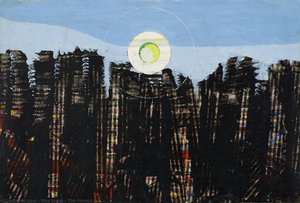 The Forest - Max Ernst
In the quietude of The Forest by Max Ernst, time seems to suspend itself, caught in a nocturnal breath between reality and the subconscious. This masterpiece earns its place among the top 25 artworks of Max Ernst through its profound ability to transform a simple landscape into a psychological voyage. The canvas is bathed in an ethereal, lunar glow, where cool blues and deep greens whisper of secrets held within the shadows of distorted monoliths and skeletal trees.
Ernst invites us into a dreamscape where the boundary between the urban and the organic dissolves; the luminous moon acts as a silent sentinel over a cityscape that feels both ancient and alien. The texture of his expressive brushwork breathes life into this nocturnal mystery, offering a sense of movement that pulls the viewer deeper into his surreal vision. For the modern collector, possessing such a piece brings a sophisticated layer of intellectual depth to a room, providing a focal point of quiet contemplation and a window into the beautiful, unsettling depths of the human psyche.
Le Petite Tortue - Max Ernst
 Le Petite Tortue - Max Ernst
In the quiet presence of Le Petite Tortue , one does not simply observe a sculpture; one enters a conversation with light and shadow. Completed in 1967, this breathtaking work in polished black marble serves as a masterclass in how Max Ernst, a pioneer of the Surrealist movement, could command the very essence of form. As you move around the piece, the high sheen of the marble does not merely reflect the room—it composes light like a silent sonata, creating sharp, dancing highlights that trace the edges of its geometric planes.
The sculpture rises in a delicate, vertical dance: a substantial base supporting an inverted bowl, which in turn cradles a slender, pointed apex. It is a profound meditation on balance and the tension between solid mass and the breathing void of negative space. Within this arrangement, Ernst invites us to find stability amidst the abstract. To possess such a piece is to bring a portal of contemplative stillness into your home, where the interplay of dark stone and brilliant light turns any corner into a sanctuary of modern elegance.
Moonmad - Max Ernst
 Moonmad - Max Ernst
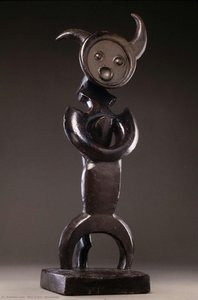
In the hauntingly beautiful sculpture Moonmad , Max Ernst invites us into a realm where the boundaries between the conscious mind and the subconscious dissolve. As one of the most profound entries in our collection of the top 25 artworks of Max Ernst , this piece captures that quintessential Surrealist shock—the moment when a dream intrudes upon reality. The stylized face, frozen in an expression of breathless astonishment, serves as a visceral symbol of the psychological vulnerabilities we all carry.
Ernst’s mastery lies in his ability to use raw, metallic forms to articulate deep-seated anxieties and the sudden, irrational jolts of human emotion. To encounter Moonmad is to confront the unsettling beauty of the unknown. For the discerning collector, this work offers more than mere decoration; it provides a centerpiece for intellectual reflection. Integrating such a powerful, emotive sculpture into a modern interior creates a timeless dialogue between historical avant-garde mastery and contemporary elegance, reminding us that true art does not just decorate a space—it awakens the soul.
Illustration to "A Week of Kindness" - Max Ernst
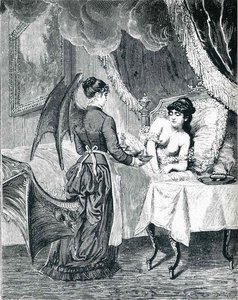 Illustration to "A Week of Kindness" - Max Ernst
In the hauntingly quiet corridors of 1934, Max Ernst’s Illustration to "A Week of Kindness" emerges as a profound psychological landscape, inviting us into a realm where domesticity and nightmare intertwine. This masterpiece stands among the top 25 artworks of Max Ernst due to its ability to dissolve the boundaries of reality through a single, unsettling image. Within this monochrome bedroom, the air feels heavy with unspoken anxieties; we witness a reclining figure in a dreamlike trance, shadowed by a companion whose sudden, bat-like wings disrupt the mundane stillness of the furniture.
Through meticulous hatching and cross-hatching, Ernst creates a tactile, gothic texture that pulls the viewer into his subconscious architecture. The interplay of deep shadows and flickering light evokes a sense of vulnerability and mystery that remains strikingly relevant in our modern fascination with the uncanny. As a centerpiece for any curated collection, this work serves as a powerful cultural talking point, reminding us how the surrealist movement continues to capture the beautiful, dark complexities of the human psyche.
Temptation of St. Anthony - Max Ernst
 Temptation of St. Anthony - Max Ernst
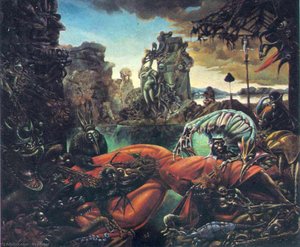
To step before Temptation of St. Anthony by Max Ernst is to surrender the safety of the waking world and descend into a fever dream where the boundaries of the soul begin to fray. Painted in 1945, as the shadows of World War II loomed large over humanity, this masterpiece stands as a profound psychological landscape. It is a visceral exploration of the internal struggle between virtue and the insidious allure of desire.
Ernst employs a breathtakingly complex technique, layering textures that invite the eye to wander through a realm of unsettling beauty. One can almost feel the weight of the thick impasto around the central figure, seated precariously upon a red cushion, while the delicate, fluttering presence of beetles and butterflies introduces a sense of organic decay. The composition, with its distorted perspectives and fragmented forms, mirrors the instability of the human psyche. As one of the top 25 artworks of Max Ernst, this piece remains a timeless testament to the power of Surrealism, offering a hauntingly beautiful way to transform a modern space into a sanctuary for deep, emotional reflection.
Paysage avec lac et chimères - Max Ernst
 Paysage avec lac et chimères - Max Ernst
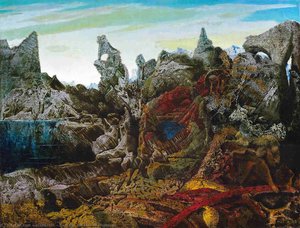
To stand before a work of this magnitude is to step into the fractured psyche of an era caught between dream and catastrophe. In Paysage avec lac et chimères by Max Ernst, we encounter a landscape that breathes with the heavy, uncertain air of 1940 Europe. As the world descended into the shadows of war, Ernst turned inward, using the canvas to navigate his own isolation and the profound disorientation of the human spirit.
This masterpiece earns its place among the top 25 artworks of Max Ernst through its breathtaking use of decalcomania —a technique where thinned paint is pressed onto surfaces to create spontaneous, organic textures. These Rorschach-like patterns form a world of muted earth tones and deep blues, where a tranquil lake reflects a sky of haunting stillness. Amidst jagged rock formations, unsettling chimeras emerge from the mist, their fragmented forms symbolizing the disintegration of tradition. The tactile depth of the brushwork invites us to touch the very edge of the subconscious. Even today, this painting serves as a profound emotional anchor, reminding us how art can transform a space into a sanctuary for contemplation and mystery.
Ubu Imperator - Max Ernst
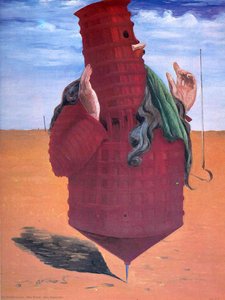 Ubu Imperator - Max Ernst
In the haunting presence of “Ubu Imperator,” one is immediately struck by a sense of profound, unsettling stillness, as if catching a glimpse of a secret held within a fever dream. As you stand before this 1923 masterpiece, the gaze of the central figure—a tyrannical ruler seated upon a throne of interwoven branches—confronts you with the heavy, complex weight of authority and the fragility of power. The delicate presence of a bird perched precariously above creates a breathtaking tension, a silent dialogue between grandeur and vulnerability that resonates deeply within the soul.
This work remains a cornerstone of the top 25 artworks of Max Ernst because it serves as a universal mirror to our own subconscious anxieties and hidden desires. The revolutionary use of texture, reminiscent of his signature frottage technique, invites a tactile connection to the canvas. Bringing such a powerful emotional resonance into your home can transform a quiet corner or a personal sanctuary into a space for profound reflection, where the boundaries between reality and the dreamworld softly dissolve.
Scène - Max Ernst
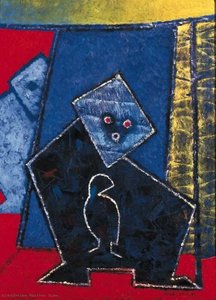 Scène - Max Ernst
To gaze upon “Scène” by Max Ernst is to step through a veil into the very architecture of a dream. In this hauntingly beautiful tableau, the boundaries between our waking reality and the deep subconscious dissolve, leaving us suspended in a moment of profound psychological tension. The painting captures a striking encounter: an avian figure poised in predatory contemplation before a mysterious blue box, its sharp red trim acting as a vibrant pulse against the textured, organic landscape.
This masterpiece earns its place among the top 25 artworks of Max Ernst by redefining how we perceive the unseen. Through his pioneering use of texture—reminiscent of burlap and paper pulp—Ernst invites us to touch the canvas with our eyes, experiencing a tactile depth that transcends mere pigment. At ArtsDot.com, we believe such evocative works should not be confined to museum halls; they are meant to breathe within your personal sanctuary. Bringing “Scène” into your home transforms a simple wall into a window of infinite mystery, turning your living space into a sophisticated statement of intellectual and emotional depth.
Everyone Here Speaks Latin - Max Ernst
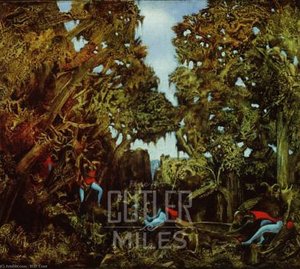 Everyone Here Speaks Latin - Max Ernst
To encounter Everyone Here Speaks Latin by Max Ernst is to step through a threshold where the waking world dissolves into the profound mysteries of the subconscious. Created in 1943, amidst the heavy shadows of World War II, this masterpiece serves as a surrealist echo of antiquity, blending the primal whispers of a dense forest with the intellectual weight of history. As you wander through this painted thicket, your eyes meet ambiguous figures—some reclining, some standing—lost within a landscape that feels both whimsical and deeply existential.
Ernst utilizes a visceral, tactile technique rooted in automatism ; the heavy impasto creates ridges and valleys that make the trees feel as though they are breathing. Elements like a solitary umbrella, a distant boat, and a quiet bench emerge from the textured canvas, inviting you to contemplate themes of protection and transition. Owning this work isn’t merely a purchase; it is an inheritance of a lineage of taste. With our hand-painted reproductions, this legacy of Surrealism moves from the museum archives directly to your walls, allowing you to live within the dreamscape of one of the 20th century's greatest visionaries.
Dibujo al natural - Max Ernst
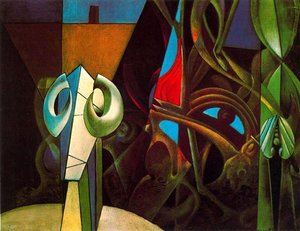 Dibujo al natural - Max Ernst
To gaze upon Dibujo al natural is to step directly into the fever dream of Max Ernst, where the boundaries between the animate and the inanimate dissolve into a hauntingly beautiful mystery. There is a profound, quiet tension in this work; it captures that universal moment of psychological transition, where the familiar world begins to warp under the weight of the subconscious. It earns its place among the top 25 artworks of Max Ernst because it serves as a masterclass in Surrealist storytelling, utilizing strange, symbolic objects—a watchful eye, a displaced clock, and the imposing presence of avian forms—to evoke a sense of deep, intellectual intrigue.
The composition invites us to wander through layers of dreamlike imagery, where every shadow holds a secret. At ArtsDot.com, we believe such evocative power should not be confined to museum walls. Our master artists meticulously recreate the textures and unsettling depths of Ernst’s vision on 100% cotton canvas, ensuring that the tactile soul of his surrealist landscapes—the very essence of his psychological exploration—can reside within your own sanctuary.
Barbarians Marching to the West - Max Ernst
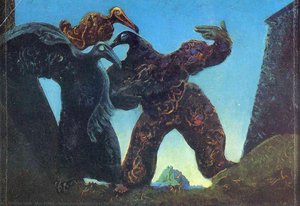 Barbarians Marching to the West - Max Ernst
In the hauntingly beautiful landscape of 1937, Max Ernst birthed a visual fever dream titled “Barbarians Marching to the West.” This masterpiece serves as a visceral distillation of the global anxieties gripping the world on the precipice of war. As a cornerstone of the Surrealist movement, the work transcends mere representation to explore the profound instability of the human condition, thrusting the viewer into an otherworldly terrain where dream and reality dissolve into cosmic dread.
The composition is anchored by two colossal, predatory birds locked in an unsettling dance of aggression. These avian titans act as metaphors for unstoppable forces of destruction, while a solitary human figure stands near the periphery—a silent witness to the unfolding catastrophe. To behold this work is to witness Ernst’s revolutionary use of grattage ; by scraping paint to reveal geological textures, he creates a surface that feels unearthed rather than painted. For those seeking to surround themselves with genius, this painting offers more than decoration; it provides a transformative window into the fractured psyche of history.
Pieta or Revolution by Night - Max Ernst
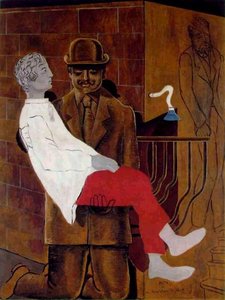 Pieta or Revolution by Night - Max Ernst
To stand before Pieta or Revolution by Night is to feel the heavy, somber weight of Max Ernst’s brushwork pressing against the soul. The texture of this masterpiece is a haunting landscape of shadows; one can almost sense the thick, deliberate layering of oil that creates an atmosphere of existential dread. Ernst utilizes a dark, nocturnal palette where light does not illuminate, but rather struggles to emerge from a suffocating gloom. This piece holds its place among the top 25 artworks of Max Ernst because it masterfully bridges the chaotic rebellion of Dada with the psychological depths of Surrealism, transforming a classical religious motif into a visceral, modern tragedy.
At ArtsDot.com, we believe such profound emotional depth should never be lost to a flat print. Our hand-painted oil reproductions are meticulously crafted to preserve this tactile, three-dimensional quality . By recreating every deliberate stroke and the heavy impasto texture of Ernst’s vision on fine cotton canvas, we ensure that the unsettling magnetism and physical presence of this surrealist icon can command the air of your own private gallery.
It's a Highway to Heaven - Max Ernst
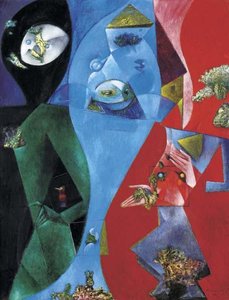 It's a Highway to Heaven - Max Ernst
What story does the fractured landscape of identity tell within "It's a Highway to Heaven" by Max Ernst? To encounter this masterpiece is to step through a portal where the boundaries of the self begin to dissolve into a kaleidoscope of superimposed faces. Emerging from the radical shifts of the Surrealist movement, this work broke ground by rejecting traditional portraiture in favor of a psychological labyrinth, using layered visages to mirror the complexity of the subconscious mind.
The painting vibrates with an unsettling yet sublime energy; the central figure’s green tones and the whimsical presence of scattered birds create a dreamlike atmosphere that feels both ancient and avant-garde. For the discerning collector seeking a curated escape, this piece offers more than mere decoration—it provides a window into a deeper reality. Its rich, tactile textures and the interplay of collage-like elements make it a profound addition to any sophisticated space, inviting a sense of mystery and intellectual depth that transforms a modern home into a sanctuary of historical wonder.
Fleurs-écaille - Max Ernst
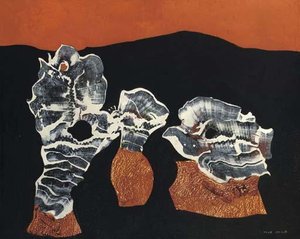 Fleurs-écaille - Max Ernst
In Fleurs-écaille by Max Ernst, a profound, monochromatic stillness dominates the soul, setting a mood of quiet introspection and ancient mystery. The absence of vibrant color allows the viewer to focus entirely on the interplay of light and shadow across a landscape of stone and shell. This mastery of a grayscale palette—achieved through sophisticated collage and delicate dry-brushing—is precisely why this work earns its place among the top 25 artworks of Max Ernst . By stripping away the distraction of hue, Ernst reveals a visceral, tactile topography that feels unearthed from a dream.
For the discerning collector or interior designer, this piece serves as a sophisticated anchor for a modern living space. The neutral, ethereal tones offer an unparalleled opportunity to curate emotional lighting; imagine this work illuminated by soft, directional lamps that accentuate its rugged textures. It brings a sense of architectural weight and calm to a dining room or gallery wall, acting less like a mere painting and more like a meditative, found object that invites guests into a deeper, psychological dialogue with the space.
Forêt et soleil - Max Ernst
To possess a piece like Forêt et soleil by Max Ernst is to invest in a profound legacy of twentieth-century mastery and a testament to a truly discerning collector's taste. As one of the most significant works within the top 25 artworks of Max Ernst, this nocturnal dreamscape stands as a pillar of Surrealist achievement, commanding immense respect in the global art market for its psychological depth and historical importance.
The painting invites us into a dense, hallucinatory woodland where the moonlight pierces through distorted, textured boughs, casting an ethereal glow upon a solitary, watchful bird. Ernst utilizes a meticulous layering technique to create a sense of rhythmic mystery, where the forest serves as a metaphor for the vast, shadowed reaches of the unconscious mind. The interplay of silver light and deep, enigmatic shadows creates a sensory experience that is both unsettling and serene.
For the modern connoisseur, a high-quality oil reproduction of this masterpiece brings an unparalleled aesthetic authority to luxury interiors. It serves as a sophisticated focal point, offering the same emotional resonance and intellectual status as the original, perfect for elevating a contemporary space with the haunting beauty of a dream realized.
Landscape with Wheatgerm - Max Ernst
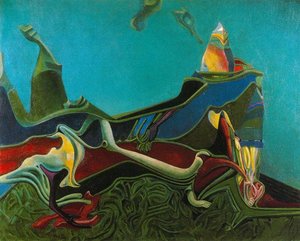 Landscape with Wheatgerm - Max Ernst
Owning Landscape with Wheatgerm by Max Ernst isn’t merely a purchase; it is an inheritance of the surreal. As one of the most profound entries in our collection of the top 25 artworks of Max Ernst, this 1936 masterpiece serves as a delicate window into the human psyche. Ernst invites us into a dreamscape where the rational world dissolves, replaced by a vision that is both hauntingly beautiful and deeply unsettling. Through a masterful layering of textures, he captures the tension between fertility and fragility, using the wheatgerm as a symbol of embryonic potential set against a landscape of profound uncertainty.
The painting breathes with a life of its its own, where birds drift through mountainous vistas and figures emerge from the subconscious shadows. To bring this piece into your home is to embrace a lineage of taste, transforming your walls into a gallery of psychological depth. With our hand-painted oil reproductions, the tactile essence of Ernst’s vision—the interplay of light, shadow, and symbolic weight—becomes a permanent, soulful presence in your private collection.
Conclusion
As we draw the curtain on this journey through the labyrinthine mind of Max Ernst, we are left not with a mere list of images, but with the lingering echoes of a soul that dared to find beauty in the fragmented and the unexpected. To gaze upon these works is to participate in a quiet, enduring dialogue that transcends the decades separating his brush from our eyes. Each piece serves as a bridge, connecting the turbulent uncertainties of the early twentieth century to our own modern search for meaning, reminding us that art is never truly static; it is a living, breathing presence that continues to pulse with life within our homes and our hearts.
These masterpieces do more than decorate a wall; they invite a metamorphosis of space, turning a simple room into a sanctuary of contemplation and wonder. Whether through the textured mystery of his frottage or the dreamlike logic of his collages, Ernst invites us to look beneath the surface of reality. It is a profound privilege to witness how these visions continue to shape our creative impulses and stir the depths of our collective imagination. We invite you to continue this intimate exploration and find your own connection to his surrealist legacy by wandering through our full collection , where the whispers of history meet the warmth of a hand-painted present.