

 Preview
 Send
Send Share
Share
 Details

 Download
 Similars
 X-Ray
X-Ray Diaporama
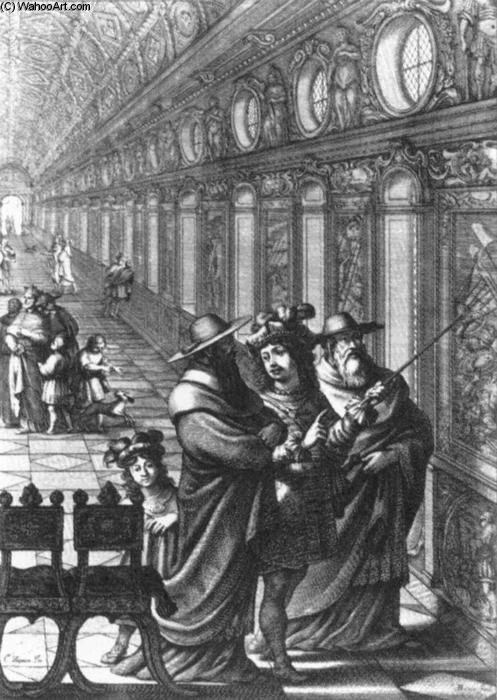
Roger Showing a Gallery of Paintings to Several Cardinals


 Read More
Purchase a high-resolution, enhanced digital image, far superior to the online preview.
Each file is meticulously prepared by our in-house specialists using advanced tools and expert manual retouching. We ensure every image has exceptional clarity, precise color accuracy, and fine detail.
The final file is delivered via email within 72 hours, optimized for immediate use in professional, editorial, and print environments. This is the same quality trusted by top-tier design studios, publishers, and galleries.
Digital Image
Download a high-resolution file for personal display, printing, and creative projects. ( Buy Print Buy Hand Made Painting)
Included in Every Digital Image Order
Expert Digital Delivery, Guaranteed
When you choose ArtsDot.com, you're not just getting an image - you're receiving a professionally enhanced digital artwork, crafted with precision and backed by a satisfaction guarantee. Here's everything that comes with your order, automatically:

Fast Email Delivery
Your high-resolution digital image file will be emailed to you within 72 hours of ordering - ready for immediate use.

AI-Enhanced Digital File
Your artwork is professionally optimized using advanced AI tools and manual editing, ensuring maximum detail, clarity, and color accuracy.

Free Lifetime Re-Delivery
Accidentally deleted or lost your file? No worries - we'll resend it to you anytime, free of charge.

No Import Fees - Ever
Enjoy your artwork instantly with zero customs, duties, or delivery fees - digital downloads are always tax-free.

Color Accuracy Guarantee
We ensure your digital image reflects the original colors as closely as possible using professional tools and color management.

60-Day Satisfaction Guarantee
If you're not satisfied with your digital image, we'll revise it or refund 100% within 60 days - no questions asked.

100% Money-Back Guarantee
Not satisfied? Get a full refund within 60 days of receiving your digital file - no questions asked.

Bulk Order Discounts
Buy 3 images, save 10% - Buy 5, save 15% - Buy 10+, save 20%. Great for creative projects, galleries, and agencies.
Collectible Description
A Baroque Tableau: Unveiling the Layers of "Roger Showing a Gallery of Paintings to Several Cardinals"
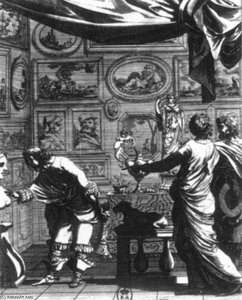
Abraham Bosse’s 1656 engraving, “Roger Showing a Gallery of Paintings to Several Cardinals,” isn't merely a depiction of a historical scene; it’s a meticulously constructed microcosm of power, piety, and the burgeoning world of artistic patronage in 17th-century France. The image, recently rediscovered and brought back into focus through digital restoration, offers a rare glimpse into the opulent courtly life of Cardinal Mazarin and the complex dynamics between artists, patrons, and religious authority. Bosse, a master of etching known for his unflinching portrayals of Parisian society, transforms a biblical narrative—likely referencing the deposition of David—into a vibrant tableau brimming with detail and symbolic weight.
The scene unfolds within a vast, multi-tiered hall, its architecture echoing the grandeur of Renaissance Italy. Columns rise towards an unseen ceiling, arches frame doorways leading to unknown spaces, and a dense throng of figures occupies every available vantage point. At the center stands Roger, a figure shrouded in a dark robe, gesturing expansively as he presents a gallery of paintings to a group of Cardinals – their scarlet robes signifying their high ecclesiastical status. The composition is deliberately crowded, reflecting the density of courtly life and the sheer volume of artistic production during this period. Bosse’s masterful use of perspective creates a sense of depth, yet the flattened space emphasizes clarity over strict realism, prioritizing the communication of the scene's narrative rather than its photographic accuracy.
The Art of Etching: Technique and Detail
Bosse’s skill as an etcher is immediately apparent in the intricate detail of the engraving. He employed a technique known as “drypoint,” utilizing a sharpened needle to scratch directly into a copper plate, creating delicate lines that would then be bitten with acid. This method produced a velvety texture and a subtle tonal range, lending a remarkable richness to the image. The artist’s meticulous hatching and cross-hatching create shadows and highlights, suggesting form and volume with astonishing precision. Notice particularly the rendering of the Cardinals' robes – each fold and wrinkle meticulously etched, conveying both their wealth and authority. The use of light and dark is not merely decorative; it serves to guide the viewer’s eye through the complex composition, highlighting key figures and drawing attention to the central action.
Furthermore, Bosse's innovative approach extended beyond simple etching. He frequently combined etching with engraving techniques, achieving a remarkable balance between the delicate lines of the drypoint and the sharper definition of the engraved areas. This hybrid technique allowed him to create images that were both visually stunning and technically sophisticated – a hallmark of his artistic style.
Symbolism and Context: A Courtly Drama
Beyond its immediate visual appeal, “Roger Showing a Gallery of Paintings” is rich in symbolic meaning. The act of presenting paintings represents the dissemination of knowledge, power, and religious doctrine—all crucial elements within the context of Cardinal Mazarin’s court. The presence of the Cardinals suggests the influence of the Church on artistic patronage, while the figures surrounding Roger – soldiers, attendants, and onlookers – hint at the political intrigue and social maneuvering that characterized this era. The inclusion of a crown and sword further reinforces the theme of authority and power.
The image’s connection to the biblical narrative of David's deposition adds another layer of interpretation. David, often associated with artistic genius and prophetic vision, is depicted as vulnerable and exposed, mirroring the precarious position of artists within a courtly environment. The gallery itself can be seen as a metaphor for the broader world of art—a space filled with both beauty and potential danger.
A Window into 17th-Century France
“Roger Showing a Gallery of Paintings” offers an invaluable window into the artistic, political, and social landscape of 17th-century France. Abraham Bosse’s masterful engraving captures not only a specific historical event but also the spirit of a vibrant and complex era. Reproductions of this remarkable work provide a tangible connection to the past, allowing us to appreciate the artistry, ingenuity, and cultural significance of one of France's most celebrated printmakers. Its intricate details and compelling narrative continue to fascinate art lovers and collectors alike, cementing Bosse’s legacy as a pivotal figure in the history of European art.
Related Artworks
Artist Biography
The Chronicler of Seventeenth-Century Splendor
Abraham Bosse stands as a pivotal figure in French Baroque art, celebrated primarily for his groundbreaking etchings that captured the vibrant tapestry of seventeenth-century Paris and its aristocratic circles. Born to Huguenot parents in Tours, France—a city scarred by religious conflict—Bosse’s formative years instilled within him a profound appreciation for detail and observation, qualities that would define his artistic vision throughout his prolific career. His father was a tailor, providing Bosse with an early understanding of craftsmanship and meticulous rendering, skills he would later translate into the exacting precision of his prints.
The trajectory of his life took a decisive turn when he moved toward greater horizons, embarking on a formal apprenticeship with Melchior Tavernier, an Antwerp-born engraver and publisher, around 1620. This partnership proved instrumental in establishing his reputation as one of the era's foremost printmakers. Tavernier’s influence extended beyond mere technical guidance; he fostered Bosse’s burgeoning fascination with artistic innovation and encouraged him to explore diverse subjects. Early etchings, notably those produced under Tavernier’s patronage, demonstrated a nascent stylistic sensibility rooted in Dutch and Flemish art traditions—a deliberate choice that simultaneously honored established precedents while subtly injecting them with distinctly French nuances.
Technical Mastery and the Callot Influence
A pivotal encounter with Jacques Callot in Paris around 1630 irrevocably altered Bosse's artistic trajectory. Callot’s revolutionary etching techniques—characterized by a remarkable level of textural detail and a masterful manipulation of tonal gradation—became an immediate inspiration for Bosse, who enthusiastically adopted these innovations. This embrace of Callot’s approach resulted in prints that possessed an unparalleled realism, allowing Bosse to render the delicate textures of lace, the sheen of silk, and the complex architectural perspectives of Parisian interiors with breathtaking clarity.
Bosse's work often transcended simple documentation, moving into the realm of social commentary and allegorical depth. His ability to weave together the mundane and the magnificent is evident in several key themes of his oeuvre:
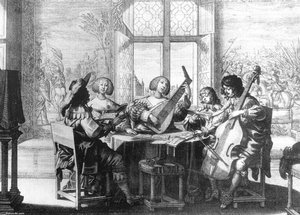
- The Elegance of Social Ritual: Through works like Musical Society (1635), he captured the lively, sophisticated gatherings of the Parisian elite, documenting the era's social etiquette and musical culture.
- Sensory Allegories: In masterpieces such as The Five Senses: Hearing (1635), Bosse utilized his technical prowess to explore human perception, blending scenes of musicians and historical drama into a singular, evocative composition.
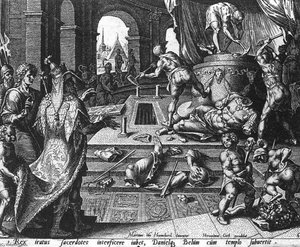
- Narrative Grandeur: His engravings, including Roger Showing a Gallery of Paintings to Several Cardinals (1656), demonstrated his capacity for dramatic storytelling, utilizing intricate detail to depict biblical figures amidst courtly intrigue.
Legacy and Historical Significance
Beyond the copperplate, Bosse’s impact on the art world was institutional and enduring. As a founding member of the Académie Royale, he helped shape the formal standards of French art, ensuring that the precision and observational rigor he championed would become hallmarks of the national style. His meticulous attention to fashion and interior design has made his work an invaluable primary source for historians seeking to understand the material culture of the 17th century.
The influence of Bosse’s unique blend of realism and technical innovation extended far beyond the borders of France, reaching later masters such as William Hogarth. By bridging the gap between the meticulous traditions of Northern Europe and the burgeoning grandeur of the French Baroque, Abraham Bosse created a visual language that remains as captivating today as it was during the reign of Louis XIV. His legacy lives on in every fine line of his etchings, which continue to breathe life into the vanished world of old Paris.
Abraham Bosse
1604 - 1676 , France
Quick Facts
- Artistic Movement Or Style: Baroque
- Artists Or Movements Influenced By This Artist: ['William Hogarth']
- Artists Who Influenced This Artist:
- Jacques Bellange
- Jacque Callot
- Date Of Birth: c. 1604
- Date Of Death: 14 February 1676
- Full Name: Abraham Bosse
- Nationality: French
- Notable Artworks:
- The Five Senses: Hearing
- Barbier
- Roger Showing a Gallery of Paintings
- Place Of Birth: Tours, France

