 Preview
 Send
Send Share
Share
 Details

 Download
 Similars
 X-Ray
X-Ray Diaporama
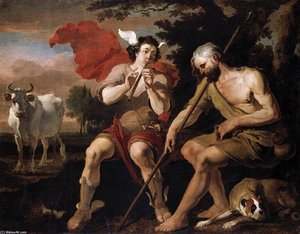
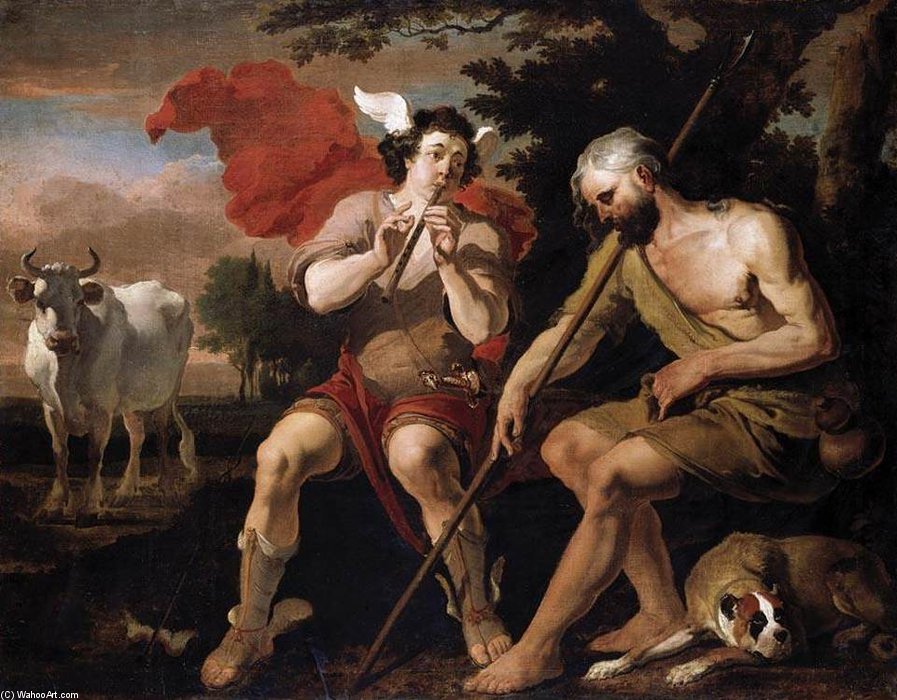
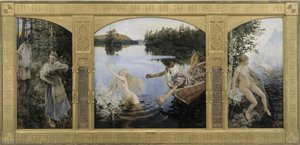
Mercury And Argos
 Read More
Hand Made Oil Reproduction
Hand-painted oil on canvas in your size and frame, made to order by our artists. ( Buy Print Buy Image)




































Pick from our preset sizes that match the artwork's original proportions.

You may enter your own dimensions to fit a specific frame or space. If your selected size does not match the original image's proportions, we will either crop the artwork or extend the painting with additional hand-painted elements. A digital mockup will be sent for your approval before production begins.
Please note that the on-screen preview does not reflect the actual cropping or extension. Only the mockup will accurately show the final composition.
While custom sizes are available, we recommend selecting a dimension from the predefined list to preserve the original proportions.
After order, ArtsDot.com team will email client for instructions and provide a mockup preview
Worldwide Delivery () in 3/4 weeks instead of standard 5 weeks. (17 August). No compromise on quality.

Free Worldwide Express Shipping

High-Quality Linen Canvas

Full Shipping Insurance

Customs Tax Refund Guarantee

True Color Matching Guarantee

60-Day Return Policy (Defects Only)

100% Money-Back Guarantee

Bulk Discount Offer
 Glass option is only available in size under 110 CM

Mercury And Argos
Reproduction Medium
Reproduction Size
-


Total Price
$ 263
Related Artworks
Artist Biography
The Master of the Chase: The Life and Legacy of Abraham Danielsz Hondius
In the vibrant tapestry of the Dutch Golden Age, few artists captured the raw, visceral energy of the natural world as effectively as Abraham Danielsz Hondius. Born in Rotterdam around 1631 to a family rooted in craftsmanship—his grandfather being a stonemason from Zierikzee—Hondius emerged as a singular voice in seventeenth-century painting. His artistic journey was not merely one of technical mastery, but a profound exploration of the tension between predator and prey. Trained under the watchful eyes of Pieter de Bloot and the renowned Cornelis Saftleven, Hondius became a vital part of the influential Leiden School. This formative period provided him with more than just foundational skills; it immersed him in a stylistic language where the dramatic interplay of light and shadow could breathe life into the most rugged landscapes.
Hondius’s career was marked by a restless, ambitious spirit that saw him move from the industrious streets of Rotterdam to the bustling artistic hub of Amsterdam in 1659. However, it was his relocation to London in 1666 that would ultimately define his historical footprint. This transition to England brought about a period of intense experimentation. While some scholars note stylistic inconsistencies during these years—a common struggle for artists navigating the shifting tastes of the era—it was precisely this fluidity that allowed him to refine his specialization. He dedicated more than two-thirds of his life's work to the study of animals, specifically focusing on the high-stakes drama of hunting expeditions.
A Symphony of Light and Instinct
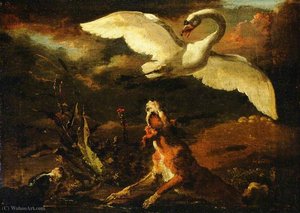
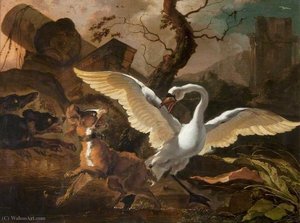
To gaze upon a Hondius masterpiece is to enter a world of heightened emotion and theatrical movement. His technique was a sophisticated blend of Mannerist complexity and the dramatic chiaroscuro popularized by Caravaggio. He possessed an uncanny ability to use light not just to illuminate, but to direct the viewer's eye toward the focal point of a struggle. In works such as Hounds Putting up a Swan, one can feel the palpable tension in the air; the dark palette and dynamic composition serve to emphasize the primal nature of predation and the symbolic weight of the encounter.
His versatility extended far beyond the hunt, though the wild remained his primary muse. Hondius was equally adept at rendering:
- Serene Landscapes: Where he captured the atmospheric beauty and rural charm of the Dutch countryside, as seen in The Stag Hunt.
- Genre Scenes: Depictions of everyday life that offered a window into the social fabric of the seventeenth century.
- Religious Compositions: Utilizing his mastery of light to evoke spiritual depth and solemnity.
Whether he was painting a boisterous Boar Hunt filled with foxes and birds or a quiet, meticulously detailed animal study, his brushwork remained remarkably consistent in its ability to convey texture—the coarse fur of a hound, the sleek feathers of a swan, or the damp earth of a forest floor. This meticulous attention to detail ensured that his works were not merely records of events, but immersive sensory experiences.
Historical Significance and Artistic Endurance
The legacy of Abraham Danielsz Hondius lies in his ability to bridge the gap between the observational precision of Dutch realism and the dramatic flair of the Baroque movement. He did not merely paint animals; he painted the essence of survival. His contribution to London’s artistic landscape during the late seventeenth century helped introduce a specific brand of Dutch naturalism to an English audience, enriching the local tradition with his mastery of wildlife and sporting scenes.
Today, Hondius is remembered as a master of movement and atmosphere. His works serve as vital historical documents of the era's fascination with the hunt, a pastime that was as much about social status as it was about the thrill of the chase. Through his eyes, we see the Dutch Golden Age not just through its portraits of wealthy merchants, but through the untamed, beautiful, and often violent reality of the natural world he so lovingly documented.
abraham danielsz hondius
1631 - 1691 , Netherlands
Quick Facts
- Artistic Movement Or Style: Baroque
- Artists Or Movements Influenced By This Artist: ['']
- Artists Who Influenced This Artist: ['Pieter de Bloot']
- Date Of Birth: 1631
- Full Name: Abraham Danielsz Hondius
- Nationality: Dutch
- Notable Artworks:
- Hawking Party
- Sporting scene
- Hounds Putting up a Swan
- Place Of Birth: Rotterdam, Netherlands