 Preview
 Send
Send Share
Share
 Details

 Download
 Similars
 X-Ray
X-Ray Diaporama
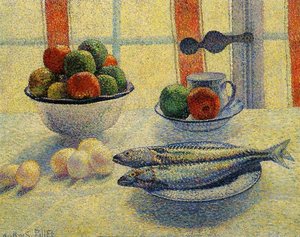
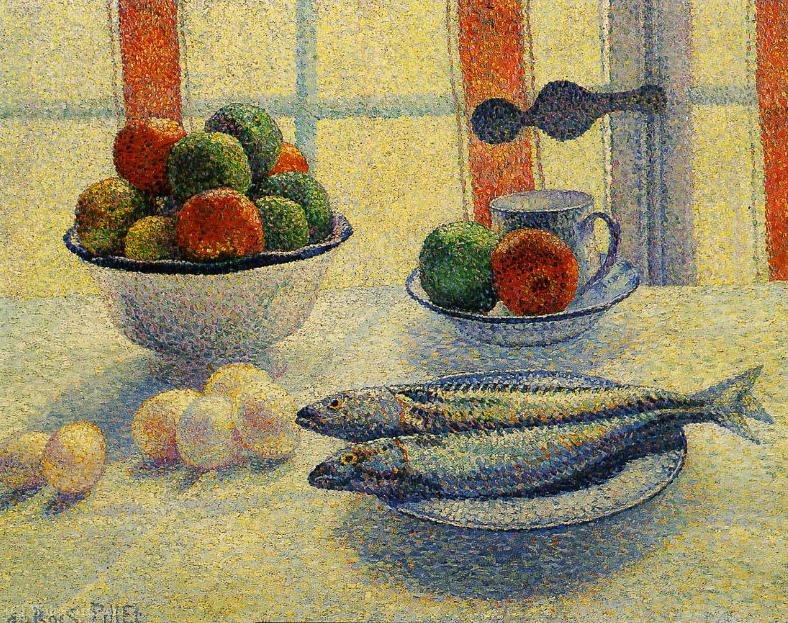
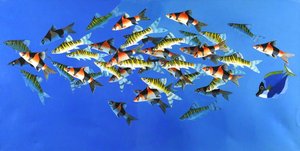
Still Life with Fish
 Read More
Hand Made Oil Reproduction
Hand-painted oil on canvas in your size and frame, made to order by our artists. ( Buy Print Buy Image)




































Pick from our preset sizes that match the artwork's original proportions.

You may enter your own dimensions to fit a specific frame or space. If your selected size does not match the original image's proportions, we will either crop the artwork or extend the painting with additional hand-painted elements. A digital mockup will be sent for your approval before production begins.
Please note that the on-screen preview does not reflect the actual cropping or extension. Only the mockup will accurately show the final composition.
While custom sizes are available, we recommend selecting a dimension from the predefined list to preserve the original proportions.
After order, ArtsDot.com team will email client for instructions and provide a mockup preview
Worldwide Delivery () in 3/4 weeks instead of standard 5 weeks. (17 August). No compromise on quality.

Free Worldwide Express Shipping

High-Quality Linen Canvas

Full Shipping Insurance

Customs Tax Refund Guarantee

True Color Matching Guarantee

60-Day Return Policy (Defects Only)

100% Money-Back Guarantee

Bulk Discount Offer
 Glass option is only available in size under 110 CM

Still Life with Fish
Reproduction Medium
Reproduction Size
-


Total Price
$ 263
Related Artworks
Artist Biography
The Dual Life of a Soldier-Painter
In the grand tapestry of nineteenth-century French art, few figures possess a narrative as strikingly dualistic as Albert Dubois-Pillet. To many, he was a disciplined officer of the French army, a man defined by the rigid structures of military academy life and the heavy responsibilities of command. Yet, beneath the uniform beat a heart deeply attuned to the luminous possibilities of color and light. Born in Paris in 1846 and raised amidst the vibrant landscapes of Toulouse, Dubois-Pillet’s life was a constant negotiation between the duty of the sword and the passion of the brush. His journey through the Franco-Prussian War and his subsequent experiences as a prisoner of war provided a somber, resilient backdrop to an artistic soul that sought beauty in the ephemeral.
This tension between his two worlds was so profound that he even sought to camouflage his creative identity. In 1884, in a clever attempt to shield his artistic pursuits from the scrutiny of his military superiors, he began signing his canvases with "Dubois"—incorporating his mother’s maiden name, Pillet, to create a pseudonym that allowed his talent to breathe without compromising his rank. This period of his life was marked by a remarkable self-reliance; as an autodidact, he lacked formal academic training, yet he possessed an intuitive grasp of composition and light that would eventually place him at the very center of the Neo-Impressionist revolution.
A Revolution of Dots and Light
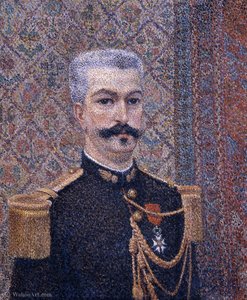
As Dubois-Pillet’s career matured, his brushwork underwent a radical transformation, moving away from traditional methods toward the groundbreaking technique known as Pointillism. Influenced by the visionary works of Georges Seurat and Paul Signac, he embraced the scientific application of tiny, distinct dots of pure pigment. This method, often referred to as Divisionism, relied on the viewer's eye to optically blend colors, creating a shimmering, vibrating effect that captured the true essence of sunlight and atmosphere. His friendship with Seurat was not merely social but deeply intellectual, as they shared a common goal: to deconstruct light into its fundamental components.
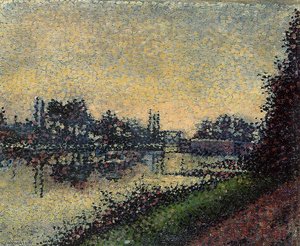
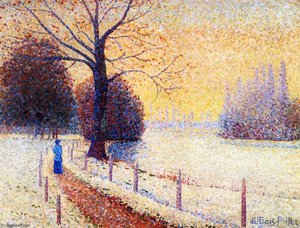
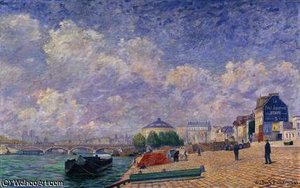
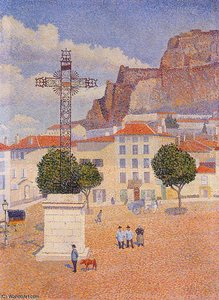
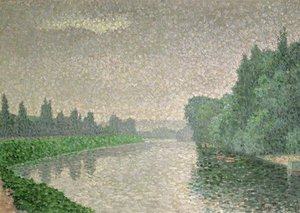
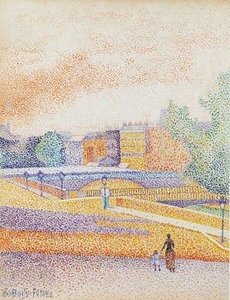
His mastery of this technique allowed him to breathe life into diverse subjects, from the quiet stillness of a portrait to the sweeping vistas of the French countryside. His works, such as "The Banks of the Seine at Neuilly" and "Le Puy in the Snow," demonstrate an extraordinary ability to use color to evoke temperature, moisture, and time of day. Through the meticulous application of pigment, he could transform a simple landscape into a sensory experience, where the air feels heavy with mist or bright with the midday sun. This experimental spirit was so potent that it occasionally brought him into conflict with the military establishment, which eventually prohibited him from exhibiting his work in 1886—a restriction he defiantly ignored.
Legacy and the Independent Spirit
The historical significance of Albert Dubois-Pillet extends far beyond his individual canvases; he was a foundational pillar of the Société des Artistes Indépendants. In 1884, alongside luminaries like Seurat and Signac, he helped draft the statutes for this group, which sought to provide a platform for artists outside the restrictive confines of the official Salon. His commitment to artistic freedom was a testament to his character, mirroring his refusal to let military mandates stifle his creative expression. Even when transferred to the remote post of Le Puy-en-Velay as commander of the local gendarmerie, his connection to the avant-garde remained unbroken.
Though his life was tragically cut short by a smallpox outbreak in 1890, his impact on the Neo-Impressionist movement remains indelible. The posthumous exhibition of sixty-four of his works in 1891 served as a poignant tribute to a man who had successfully bridged two seemingly irreconcilable worlds. Today, his paintings stand as vibrant testaments to the power of observation and the enduring strength of the human spirit. His oeuvre continues to captivate collectors and historians alike, offering a window into a period of profound artistic transition where the boundaries of perception were being forever redrawn through the delicate dance of light and dot.
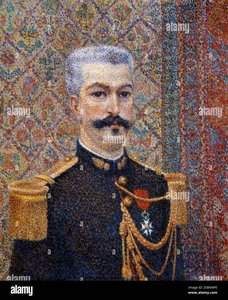
albert dubois pillet
1846 - 1890 , France
Quick Facts
- Artistic Movement Or Style: Neo-Impressionism
- Artists Or Movements Influenced By This Artist: ['Claude Lantier']
- Date Of Birth: October 28, 1846
- Date Of Death: 1890
- Full Name: Albert Dubois-Pillet
- Nationality: French
- Notable Artworks:
- The Banks of the Seine at Neuilly
- Le Puy in the Snow
- Place Of Birth: Paris, France