 Preview
 Send
Send Share
Share
 Details

 Download
 Similars
 X-Ray
X-Ray Diaporama
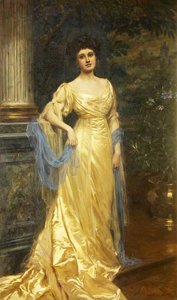
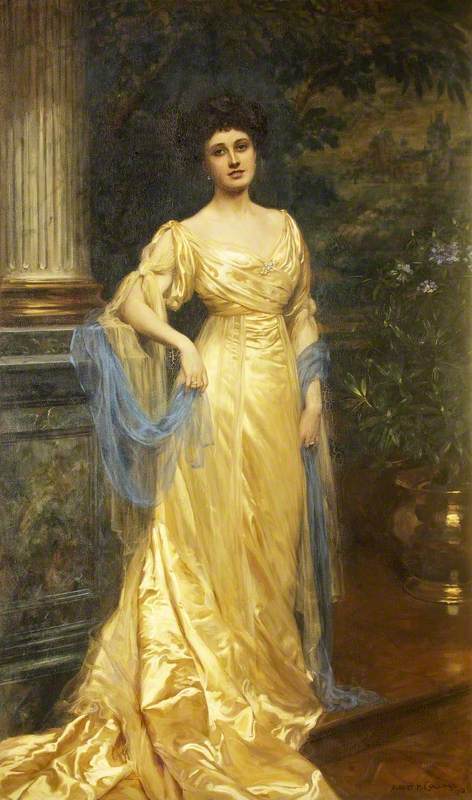
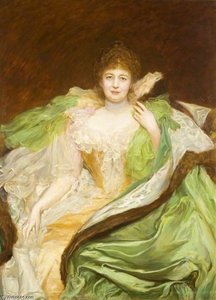
The Honourable Victoria ('Via') Florence de Burgh Long (1880–1920), Lady Gibbs
 1908
1908 226.0 x 134.0 cm
 National Trust
 Read More
Giclée / Art Print
Museum-quality giclée or canvas print with fast production and flexible finish options. ( Buy Hand Made Painting Buy Image)




































Pick from our preset sizes that match the artwork's original proportions.

You may enter your own dimensions to fit a specific frame or space. If your selected size does not match the original image's proportions, we will either crop the artwork or extend the image with a mirrored or solid-fill edge. A digital mockup will be sent for your approval before production begins.
Please note that the on-screen preview does not reflect the actual cropping or extension. Only the mockup will accurately show the final composition.
While custom sizes are available, we recommend selecting a dimension from the predefined list to preserve the original proportions.
Worldwide Delivery () in 2 weeks instead of standard 4/5 weeks. (27 August)

Free Worldwide Express Shipping

High-Quality Linen Canvas

Full Shipping Insurance

Customs Tax Refund Guarantee

True Color Matching Guarantee

60-Day Return Policy (Defects Only)

100% Money-Back Guarantee

Bulk Discount Offer
 Glass option is only available in size under 110 CM

The Honourable Victoria ('Via') Florence de Burgh Long (1880–1920), Lady Gibbs
Giclée / Art Print
Reproduction Size
-


Total Price
$ 63
Related Artworks





Artist Biography
The Soul Behind the Canvas: The Life and Legacy of Albert Henry Collings
In the golden twilight of the Victorian era, a period defined by both rigid social structures and a burgeoning fascination with psychological depth, Albert Henry Collings emerged as a master of the human essence. Born in 1868, Collings was an artist whose life was deeply intertwined with the vibrant pulse of London. His journey into the heart of British portraiture began not merely as a pursuit of skill, but as a profound commitment to capturing the silent narratives held within a single gaze. Having been raised in a family with strong artistic inclinations, his path was paved with the colors and textures of his heritage, leading him from the halls of Marlborough College to the prestigious studios of the Slade School of Fine Art.
It was at the Slade that Collings encountered the transformative influence of Hubert Walter Beaumont. Under Beaumont’s mentorship, the young artist moved beyond the simple imitation of form, learning instead the delicate art of tonal harmony and realistic representation. This period of rigorous training instilled in him a lifelong dedication to technical proficiency, yet it also gifted him with something far more elusive: the ability to infuse his subjects with an inner life. Collings did not merely paint faces; he painted souls, utilizing a meticulous approach to light and shadow that allowed the character of his sitters to breathe upon the canvas.
A Mastery of Light, Shadow, and Substance
The technical brilliance of Collings lies in his ability to marry painstaking realism with a subtle, atmospheric modulation. Working primarily in oils, he possessed an extraordinary command over the medium, blending pigments to achieve nuanced gradations that lent his portraits an unparalleled sense of immediacy. His canvases often eschewed the loud, decorative embellishments popular among some of his contemporaries, opting instead for a muted palette dominated by earthy tones and sophisticated shadows. This preference for understated elegance created a contemplative mood, inviting the viewer to linger on the subtle textures of skin, fabric, and light.
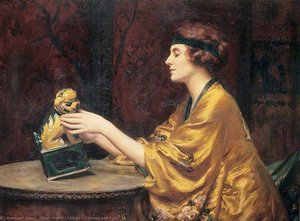
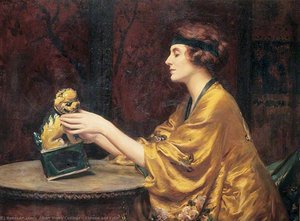
While portraiture remained his primary calling, Collings’s versatility allowed him to explore figure subjects through watercolours and pastels, demonstrating a breadth of skill that commanded respect across the London art scene. His work often featured a captivating use of chiaroscuro, where the dramatic interplay between light and dark served to heighten the emotional weight of his compositions. Whether depicting a dignified gentleman or a more whimsical scene like his 1917 masterpiece, Kimono and Kylin, his hand is always recognizable by its precision and its profound respect for the subject's dignity.
Achievements and Enduring Significance
The professional trajectory of Albert Henry Collings was marked by significant accolades that cemented his status within the British artistic establishment. His dedication to the craft earned him a place among the most respected members of the Royal Society of British Artists, where he was elected a member in 1897 after exhibiting nearly a hundred works. His influence extended to other prestigious institutions, including regular contributions to the Royal Academy and the Royal Institute of Painters in Water Colours. These exhibitions were not merely displays of talent but were vital contributions to the evolution of British portraiture during a period of immense cultural transition.
Beyond his individual accolades, Collings’s historical significance lies in his role as a bridge between the traditionalism of the Victorian age and the approaching complexities of the modern era. His ability to secure official commissions for portraits of prominent figures ensured that his work became part of the visual record of his time. Today, the legacy of Albert Henry Collings lives on through the enduring emotional resonance of his paintings. He remains a celebrated figure for those who seek art that transcends mere likeness, offering instead a window into the quiet, dignified, and deeply human moments of a bygone age.
albert henry collings
1868 - 1947
Quick Facts
- Artistic Movement Or Style: Portraiture
- Date Of Birth: 1868
- Date Of Death: 1947
- Full Name: Albert Henry Collings
- Nationality: British
- Notable Artworks: ['Gibbs & Pickford']
- Place Of Birth: England