- Home

- Print on canvas
- alexander c. mcintosh, chebon ahbulah (laughing boy), lumhee holot-tee (blue eagle)
 Preview
 Send
Send Share
Share
 Details

 Download
 Similars
 X-Ray
X-Ray Diaporama
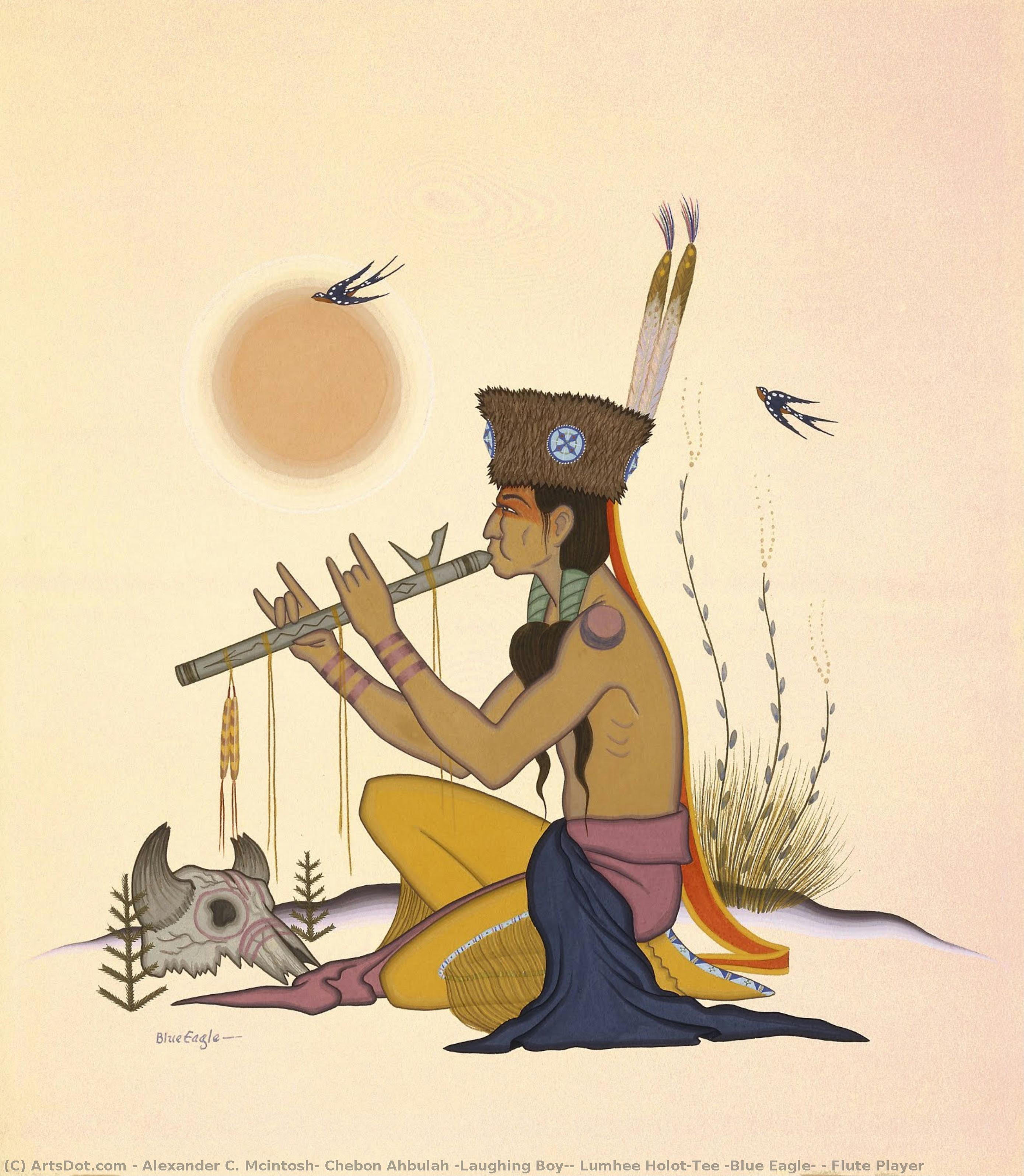
Flute Player

 Read More
Giclée / Art Print
Museum-quality giclée or canvas print with fast production and flexible finish options. ( Buy Hand Made Painting Buy Image)




































Pick from our preset sizes that match the artwork's original proportions.

You may enter your own dimensions to fit a specific frame or space. If your selected size does not match the original image's proportions, we will either crop the artwork or extend the image with a mirrored or solid-fill edge. A digital mockup will be sent for your approval before production begins.
Please note that the on-screen preview does not reflect the actual cropping or extension. Only the mockup will accurately show the final composition.
While custom sizes are available, we recommend selecting a dimension from the predefined list to preserve the original proportions.
Worldwide Delivery () in 2 weeks instead of standard 4/5 weeks. (25 August)

Free Worldwide Express Shipping

High-Quality Linen Canvas

Full Shipping Insurance

Customs Tax Refund Guarantee

True Color Matching Guarantee

60-Day Return Policy (Defects Only)

100% Money-Back Guarantee

Bulk Discount Offer
 Glass option is only available in size under 110 CM

Flute Player
Giclée / Art Print
Reproduction Size
-


Total Price
$ 63
Related Artworks


Artist Biography
A Life Woven in Color and Culture: The Story of Acee Blue Eagle
Alexander Cornelius McIntosh, known to the world as Acee Blue Eagle, was more than just an artist; he was a cultural bridge, a dedicated educator, and a passionate advocate for Native American traditions. Born August 17, 1909, north of Anadarko, Oklahoma, into the Muscogee (Creek) Nation, his life unfolded as a vibrant tapestry woven with artistic expression, intellectual pursuit, and unwavering commitment to preserving his heritage. The name “Acee” originated as a childhood nickname, while "Blue Eagle" was adopted from a revered family surname, reflecting a deep connection to ancestral roots. From an early age, McIntosh’s lineage instilled in him a sense of responsibility towards his people and their rich cultural legacy—a responsibility he embraced wholeheartedly throughout his life. His upbringing wasn't solely defined by tradition; it was also marked by formal education at Haskell Institute, Chilocco Indian Agricultural School, Bacone College, and the University of Oklahoma, shaping him into a uniquely positioned figure capable of navigating both worlds with grace and purpose.The Shaping of a Style: Flatstyle Painting and Artistic Influences
Acee Blue Eagle’s artistic journey truly blossomed at the University of Oklahoma under the tutelage of Oscar B. Jacobson. It was here that he encountered and wholeheartedly adopted the “flatstyle” painting technique, a revolutionary approach characterized by simplified forms, bold outlines, and an intentional rejection of traditional perspective and shading. This wasn't merely a stylistic choice; it was a deliberate departure from European artistic conventions, embracing instead a visual language more aligned with Native American aesthetics and storytelling traditions. The flatstyle allowed Blue Eagle to distill the essence of his subjects—Muscogee life, ceremonial scenes, wildlife, particularly deer, and portraits of fellow Native Americans—into powerful, iconic images. His paintings weren’t about replicating reality; they were about conveying its spirit, its meaning, and its cultural significance. This period also saw him serve in the United States Army Air Corps during World War II, an experience that led to creating murals at various military posts, further expanding his artistic reach. In 1932, a significant milestone arrived with inclusion in the painting event at the Summer Olympics art competition, marking early international recognition.A Global Ambassador of Native American Art
The mid-1930s proved pivotal for Blue Eagle’s career. A landmark invitation to lecture on American Indian art at Oxford University in England in 1935 catapulted him onto the global stage, allowing him to share the beauty and depth of Native American artistic traditions with a wider audience. This wasn't simply an academic exercise; it was a cultural exchange, a moment of profound understanding and appreciation. Upon his return, he assumed the role of director of the art program at Bacone College, where he fostered a new generation of Native American artists and helped shape what became known as the “Bacone style” – a distinctive approach that built upon the flatstyle principles while incorporating individual expression and cultural narratives. In 1938, his reputation reached new heights with a solo exhibition at the prestigious Grand Central Art Galleries in New York City, solidifying his position as a leading figure in American art. Simultaneously, he actively participated in New Deal art projects, creating impactful murals for institutions across Oklahoma—classrooms at the University of Science and Arts of Oklahoma in Chickasha, and post office murals in Seminole and Coalgate—transforming public spaces into vibrant canvases celebrating Native American culture and history.Legacy and Enduring Influence
Acee Blue Eagle’s impact extended far beyond his artistic creations. He was a tireless educator, nurturing talent at Bacone College and later at Oklahoma State Technical School in Okmulgee. His dedication to fostering the next generation of Native American artists ensured that cultural traditions would continue to thrive. Throughout his life, he received numerous accolades—election to the Indian Hall of Fame, inclusion in “Who’s Who of Oklahoma” and “International Who’s Who,” recognition as "Outstanding Indian in the United States" (1958), and a medal presented by Emperor Haile Selassie I in Ethiopia. These honors weren't merely acknowledgements of his artistic skill; they were testaments to his profound cultural contributions and his role as an ambassador for Native American people. His most recognized works, such as “Two Deer and Raincloud,” “Flute Player,” and “Woman and Deer,” housed at the National Cowboy & Western Heritage Museum in Oklahoma City, continue to captivate audiences with their vibrant colors, simplified forms, and powerful storytelling. Acee Blue Eagle passed away on June 18, 1959, but his legacy endures—a lasting testament to a life dedicated to art, education, and the preservation of Muscogee Creek culture. He remains an inspiration for artists and scholars alike, ensuring that Native American traditions are celebrated and cherished for generations to come.Notable Works
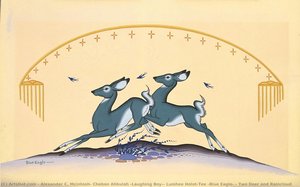
- Two Deer and Raincloud: A striking example of Blue Eagle’s flatstyle technique, depicting the spiritual connection between humans and nature.
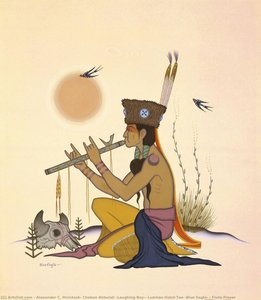
- Flute Player: Captures the soulful beauty of traditional Muscogee music and its cultural significance.
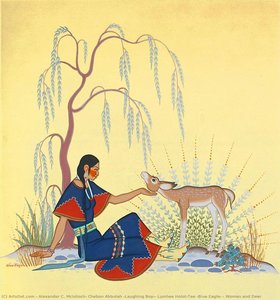
- Woman and Deer: A powerful portrayal of harmony and respect within the natural world, showcasing Blue Eagle’s mastery of composition and color.
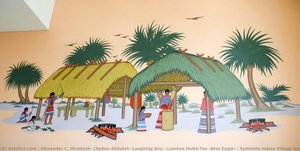
- Seminole Indian Village Scene (Post Office Mural, Seminole, Oklahoma): Demonstrates his ability to translate cultural narratives into large-scale public art.
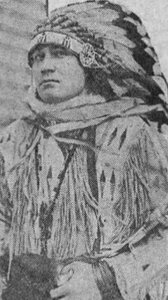
alexander c. mcintosh, chebon ahbulah (laughing boy), lumhee holot-tee (blue eagle)
1909 - 1959 , United States of America
Quick Facts
- Artistic Movement Or Style: Flatstyle painting
- Artists Or Movements Influenced By This Artist: ['Bacone style painters']
- Artists Who Influenced This Artist: ['Oscar B. Jacobson']
- Date Of Birth: August 17, 1909
- Date Of Death: June 18, 1959
- Full Name: Alexander C. McIntosh
- Nationality: Native American (Muscogee)
- Notable Artworks:
- Two Deer and Raincloud
- Flute Player
- Woman and Deer
- Place Of Birth: Anadarko, USA