

 Preview
 Send
Send Share
Share
 Details

 Download
 Similars
 X-Ray
X-Ray Diaporama
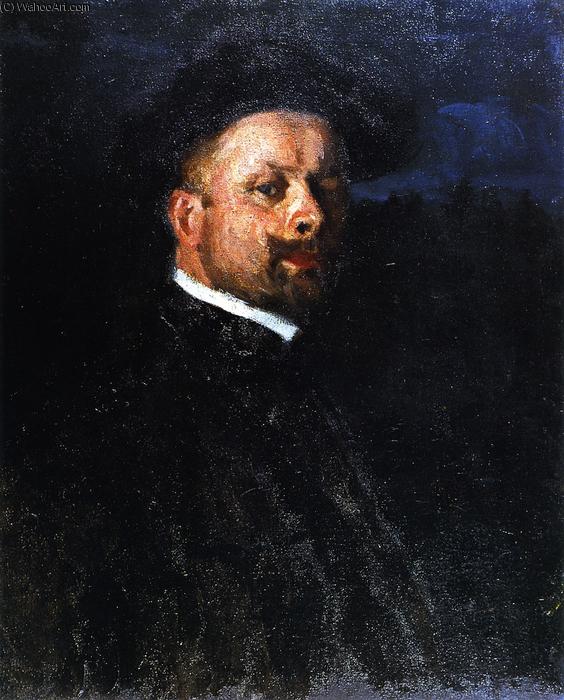
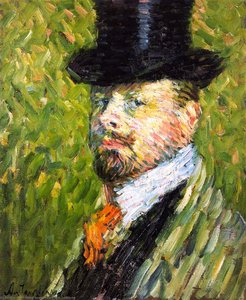
Self Portrait in Hat
 Oil On Canvas
- WallArt
- Expressionism
 1893
1893- 19th Century
 71.0 x 58.0 cm
 Omsk Museum of Fine Arts
 Read More
Purchase a high-resolution, enhanced digital image, far superior to the online preview.
Each file is meticulously prepared by our in-house specialists using advanced tools and expert manual retouching. We ensure every image has exceptional clarity, precise color accuracy, and fine detail.
The final file is delivered via email within 72 hours, optimized for immediate use in professional, editorial, and print environments. This is the same quality trusted by top-tier design studios, publishers, and galleries.
Digital Image
Download a high-resolution file for personal display, printing, and creative projects. ( Buy Print Buy Hand Made Painting)
Included in Every Digital Image Order
Expert Digital Delivery, Guaranteed
When you choose ArtsDot.com, you're not just getting an image - you're receiving a professionally enhanced digital artwork, crafted with precision and backed by a satisfaction guarantee. Here's everything that comes with your order, automatically:

Fast Email Delivery
Your high-resolution digital image file will be emailed to you within 72 hours of ordering - ready for immediate use.

AI-Enhanced Digital File
Your artwork is professionally optimized using advanced AI tools and manual editing, ensuring maximum detail, clarity, and color accuracy.

Free Lifetime Re-Delivery
Accidentally deleted or lost your file? No worries - we'll resend it to you anytime, free of charge.

No Import Fees - Ever
Enjoy your artwork instantly with zero customs, duties, or delivery fees - digital downloads are always tax-free.

Color Accuracy Guarantee
We ensure your digital image reflects the original colors as closely as possible using professional tools and color management.

60-Day Satisfaction Guarantee
If you're not satisfied with your digital image, we'll revise it or refund 100% within 60 days - no questions asked.

100% Money-Back Guarantee
Not satisfied? Get a full refund within 60 days of receiving your digital file - no questions asked.

Bulk Order Discounts
Buy 3 images, save 10% - Buy 5, save 15% - Buy 10+, save 20%. Great for creative projects, galleries, and agencies.
Collectible Description
A Window Into the Soul: Alexej von Jawlensky’s ‘Self Portrait in Hat’
The Omsk Museum of Fine Arts holds within its walls a treasure – Alexej Georgewitsch von Jawlensky’s ‘Self Portrait in Hat,’ painted in 1893. This oil on canvas is more than just a likeness; it's a raw, intensely personal expression of the artist’s inner world, a cornerstone of early Expressionism and a testament to Jawlensky’s mastery of color and emotion. Measuring 71 x 58 cm, the painting immediately commands attention with its bold brushstrokes and vibrant palette – a deliberate departure from the prevailing academic styles of the time.
The Language of Emotion: Style and Technique
Jawlensky's approach was revolutionary. He rejected meticulous detail in favor of conveying feeling directly through color and form. The loose, almost frantic application of paint creates a palpable sense of urgency and movement. Notice how the brushstrokes aren’t blended; instead, they retain their individual character, contributing to the painting’s dynamic energy. The use of impasto – thick layers of paint – particularly evident in the hat and beard, adds a tactile quality, inviting the viewer to almost feel the texture beneath their gaze. The composition itself is deceptively simple: Jawlensky presents himself squarely before us, wearing a hat and glasses, his expression a serious one that seems to pierce through the canvas. This directness, this refusal to shy away from confronting the viewer, was central to Expressionism’s core tenets.
A Portrait of Introspection
The painting's power lies in its ability to evoke a profound sense of introspection. The subject’s gaze is unwavering, almost challenging, yet simultaneously melancholic. It’s a portrait not just of a man, but of a soul grappling with questions of identity and existence. The dark background serves to isolate the figure, intensifying the focus on his face and amplifying the emotional weight of the scene. The choice of a hat and glasses adds layers of meaning – perhaps representing a desire for protection from the world, or a deliberate attempt to shield one’s thoughts. Considering Jawlensky's biography—his early struggles with self-doubt and displacement—the painting resonates with a deep sense of personal struggle.
Historical Context & Legacy
Created in 1893, ‘Self Portrait in Hat’ represents a pivotal moment in the development of Expressionism. Jawlensky was at the forefront of this movement, alongside artists like Kandinsky and Munch, who sought to express subjective experience rather than objective reality. The painting's influence can be seen in subsequent generations of artists who embraced bold color and emotional intensity. Further enriching our understanding of Jawlensky’s work are his other notable pieces, such as ‘Portrait in Grey Suit,’ ‘Still Life with Colored Tablecloth,’ and ‘Road in Füssen – Snowy Landscape,’ each showcasing a unique facet of his artistic vision. The Omsk Museum's collection provides invaluable context for appreciating the significance of this particular self-portrait within Jawlensky’s broader oeuvre.
Related Artworks
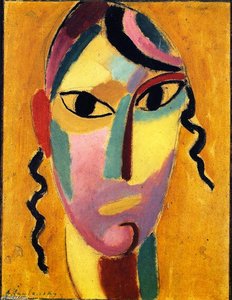
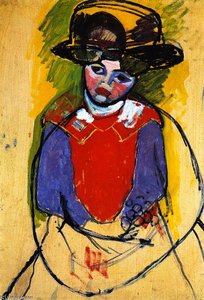
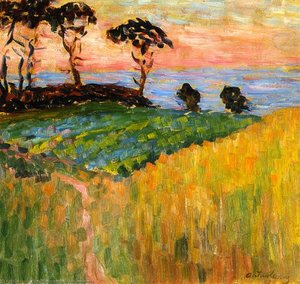
Artist Biography
A Life Painted in Emotion: The Journey of Alexej von Jawlensky
Alexej von Jawlensky, born Alexej Georgewitsch von Jawlensky on March 13, 1864, in the Russian town of Torzhok, embarked on a path that would firmly establish him as a pivotal figure within early twentieth-century Expressionism. His formative years were characterized by frequent relocations, culminating in a settling within Moscow at the age of ten—an experience that likely instilled a sense of displacement and perhaps, a yearning for deeper connection, themes subtly woven into the emotional core of his later artistic explorations. Initially drawn to a military career, Jawlensky’s encounter with the vibrant world of art during the 1880 Moscow World Exposition proved transformative. This exposure ignited within him a passion that would ultimately supersede any sense of duty, leading him down a path dedicated to visual expression. Securing a posting in St. Petersburg through his social connections allowed Jawlensky to formally study at the Art Academy from 1889 to 1896, balancing artistic pursuits with military obligations. It was during this period that he crossed paths with Ilya Repin, a prominent Russian realist painter, and more importantly, met Marianne von Werefkin. Werefkin, herself an accomplished artist of considerable means, became not only his mentor but also a crucial benefactor, providing him the financial stability to fully dedicate himself to his craft. Their relationship was complex, deeply intertwined with artistic ambition and mutual support, shaping the trajectory of both their careers.
Munich and the Seeds of Expressionist Innovation
The move to Munich in 1894 marked a turning point for Jawlensky. He enrolled at Anton Ažbe’s private school, immersing himself in an environment that encouraged experimentation and challenged conventional academic approaches. This period witnessed his growing engagement with avant-garde ideas circulating within the European art world. The influence of artists like Ferdinand Hodler, Jan Verkade, and Paul Sérusier proved particularly significant, exposing him to principles of symbolism and synthetism—movements that prioritized subjective experience and emotional resonance over strict representational accuracy. Jawlensky’s artistic style began to evolve, moving away from the realism he had initially studied. He became increasingly interested in exploring the expressive potential of color and form, simplifying compositions and intensifying hues to convey inner states rather than merely depicting external appearances. This exploration led him towards abstraction, a path that would define much of his later work. His involvement with groups like the Neue Künstlervereinigung München (NKvM) further solidified his commitment to artistic innovation, placing him at the heart of a burgeoning Expressionist movement. The NKvM, though short-lived, was a crucible for radical ideas, and Jawlensky’s participation demonstrated his willingness to challenge established norms and embrace new modes of visual language.
The Mystical Heads: A Descent into Spiritual Essence
Around 1909, Jawlensky embarked on what would become his most iconic series—the “Mystical Heads.” These intensely colored portraits, often depicting faces reduced to essential forms, are not merely representations of individuals but rather explorations of spiritual essence and inner life. The heads possess a haunting quality, their simplified features and vibrant palettes conveying a sense of profound emotion and psychological depth. Works like Schokko with Red Hat (1909) and Portrait of Alexander Sakharoff (1909) exemplify this period, showcasing his mastery of color and composition. These weren’t portraits in the traditional sense; they were attempts to capture something beyond physical likeness—the soul, the inner landscape of the sitter. He distilled faces into geometric shapes, emphasizing the power of color to evoke emotion and spiritual resonance. Throughout the 1910s, Jawlensky continued to refine his style, moving towards an even greater degree of abstraction. His compositions became increasingly geometric, with forms distilled to their most fundamental elements. He developed a formulaic approach, often employing a limited range of colors arranged in carefully balanced configurations. Violet Turban (1911) demonstrates this stylistic evolution, showcasing his ability to create powerful visual statements through the interplay of color and shape.
Exile, Resilience, and Lasting Legacy
The outbreak of World War I brought upheaval to Jawlensky’s life. Expelled from Germany in 1914 due to his Russian origins, he sought refuge in Switzerland, where he encountered Emmy Scheyer. Scheyer became a devoted champion of his work, tirelessly promoting it in the United States and securing him recognition on an international stage. Despite facing increasing health challenges—including severe arthritis that progressively limited his ability to paint—Jawlensky continued to create until his death in Wiesbaden, Germany, on March 15, 1941. His later works, created under immense physical hardship, are a testament to his unwavering dedication to artistic expression. Today, Alexej von Jawlensky is celebrated as a key figure in the development of Expressionism. His paintings are held in prominent museum collections worldwide, including the Museum Ostwall in Dortmund and the Städtische Galerie im Lenbachhaus in Munich. His exploration of color, form, and spiritual themes continues to resonate with audiences, solidifying his place as one of the most important artists of the early twentieth century. He left behind a body of work that is both visually striking and emotionally profound, offering a glimpse into the inner world of an artist who dared to challenge conventions and embrace the power of subjective expression.
Influences and Artistic Associations
Jawlensky’s artistic journey was shaped by a network of influential figures and movements:
- Ilya Repin: Early mentor providing foundational training in realist techniques.
- Marianne von Werefkin: Crucial benefactor, mentor, and artistic partner who supported his development.
- Ferdinand Hodler: Influenced Jawlensky’s use of simplified forms and symbolic imagery.
- Jan Verkade & Paul Sérusier: Introduced him to the principles of symbolism and synthetism, shaping his approach to color and composition.
- Wassily Kandinsky & Franz Marc: Collaborators within Der Blaue Reiter, fostering a shared commitment to artistic innovation.
These relationships were not merely passive influences; they were dynamic exchanges that fueled Jawlensky’s creative evolution and contributed to the rich tapestry of early Expressionist art. His legacy continues to inspire artists today, reminding us of the power of art to transcend boundaries and explore the depths of human emotion and spirituality.
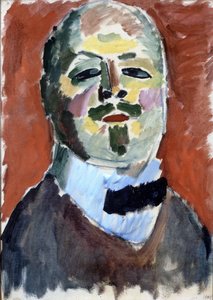
Alexej von Jawlensky
1864 - 1941 , Russia
Quick Facts
- Artistic Movement Or Style: Expressionism
- Artists Or Movements Influenced By This Artist:
- Der Blaue Reiter
- Die Blaue Vier
- Artists Who Influenced This Artist:
- Ilya Repin
- Marianne von Werefkin
- Ferdinand Hodler
- Date Of Birth: March 13, 1864
- Date Of Death: March 15, 1941
- Full Name: Alexej von Jawlensky
- Nationality: Russian
- Notable Artworks:
- Schokko with Red Hat
- Violet Turban
- Self-Portrait
- Place Of Birth: Torzhok, Russia

