 Preview
 Send
Send Share
Share
 Details

 Download
 Similars
 X-Ray
X-Ray Diaporama
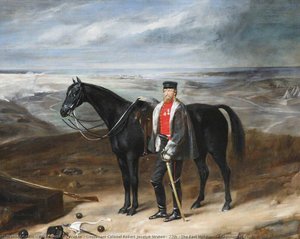
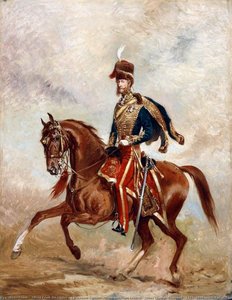
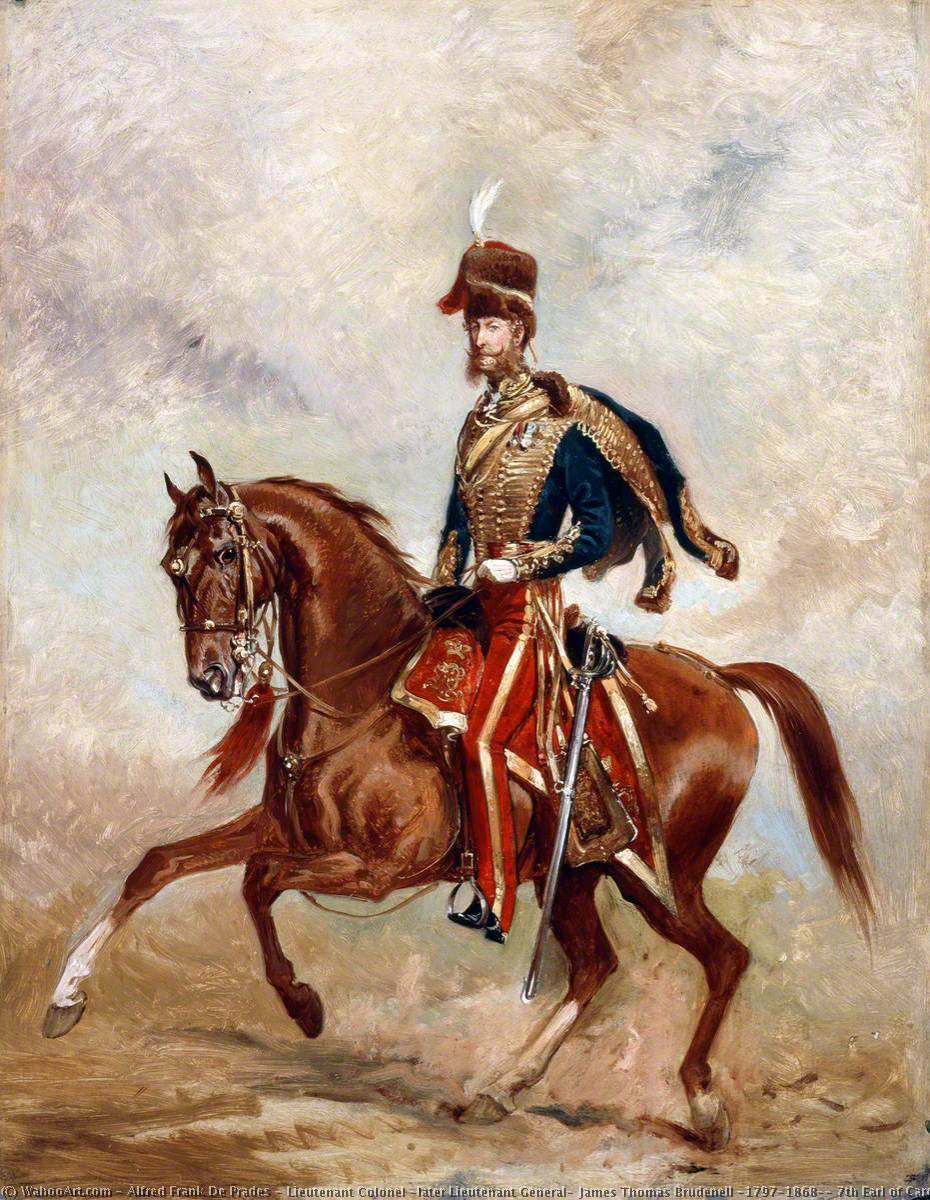
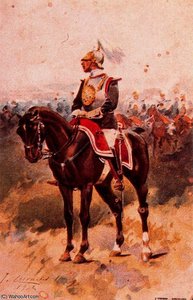
Lieutenant Colonel (later Lieutenant General) James Thomas Brudenell (1797–1868), 7th Earl of Cardigan, 11th (Prince Albert’s Own) Hussars
 Romanticism
 1854
1854 60.0 x 48.0 cm
 Read More
Hand Made Oil Reproduction
Hand-painted oil on canvas in your size and frame, made to order by our artists. ( Buy Print Buy Image)




































Pick from our preset sizes that match the artwork's original proportions.

You may enter your own dimensions to fit a specific frame or space. If your selected size does not match the original image's proportions, we will either crop the artwork or extend the painting with additional hand-painted elements. A digital mockup will be sent for your approval before production begins.
Please note that the on-screen preview does not reflect the actual cropping or extension. Only the mockup will accurately show the final composition.
While custom sizes are available, we recommend selecting a dimension from the predefined list to preserve the original proportions.
After order, ArtsDot.com team will email client for instructions and provide a mockup preview
Worldwide Delivery () in 3/4 weeks instead of standard 5 weeks. (17 August). No compromise on quality.

Free Worldwide Express Shipping

High-Quality Linen Canvas

Full Shipping Insurance

Customs Tax Refund Guarantee

True Color Matching Guarantee

60-Day Return Policy (Defects Only)

100% Money-Back Guarantee

Bulk Discount Offer
 Glass option is only available in size under 110 CM

Lieutenant Colonel (later Lieutenant General) James Thomas Brudenell (1797–1868), 7th Earl of Cardigan, 11th (Prince Albert’s Own) Hussars
Reproduction Medium
Reproduction Size
-


Total Price
$ 263
Related Artworks
![Vida De Miguel De Cervantes Saavedra (life Of Miguel De Cervantes Saavedra). Book V Of The Edition Of Don Quixote (biblioteca Nacional De España)\n\n[7] — Martín Fernández De Navarrete Y Ximénez De Tejada, Academic Art](/media/artworks/images/thumbnails/99/f9/99f969c294754562907a5ffd062310fa.jpg)
Artist Biography
Alfred Frank de Prades (1825–1885): The Equestrian Visionary
Alfred Frank de Prades (signed works as A F de Prades; 24 March 1825 – 7 July 1885) was a French painter working in Victorian England. An animalier best known for his paintings of horses and military subjects, de Prades’ works follow very closely the tradition of George Stubbs (1724–1806), a style which popularized him among the noble British sporting set, who heavily patronized the artist from about 1850 until his death in 1885. He was considered to be one of the foremost equine painters of his time, capturing the dynamism and grandeur of equestrian art with remarkable precision and emotional intensity.Early Life and Training
Alfred Frank de Prades was born in Lunel, Hérault, France, the son of Emile Jacob Pierre Marie Simon Alexandre Prades-Prestreau (Genoa 1794-St Helier after 1879), a Huguenot shipping magnate, and Pascale Victoire Garnier (Lunel, Hérault, 1806—Meulan-en-Yvelines, 1875). Information on his formative years is scarce, yet it’s evident that he spent his childhood in England from the age of 16 when his father relocated to London following a dramatic separation from his wife. This early exposure to British culture profoundly shaped his artistic sensibilities and fueled his lifelong fascination with equine subjects. While details regarding his formal training remain elusive, evidence suggests he honed his skills independently, demonstrating an instinctive understanding of animal anatomy and movement—a characteristic that would become central to his distinctive style. His prodigious talent was recognized at a young age, as evidenced by “Down the Stretch,” painted in 1838, which showcases his nascent artistic vision and unwavering dedication to capturing the essence of equine behavior.Victorian England and Patronage
De Prades established himself in London’s Covent Garden area, becoming a regular participant in exhibitions at the British Institution and the Royal Academy of Arts—institutions that championed innovation against the rigid formalism of their counterparts. His acceptance into the Royal Academy marked a pivotal moment in his career, affording him access to influential circles and securing commissions from prominent figures like King Edward VII, who commissioned “Fairplay,” a portrait of his racehorse winner at Sandown. This royal patronage solidified de Prades’ reputation as a celebrated artist within Victorian society, attracting considerable admiration for his skill and artistic integrity. His canvases adorned the halls of Buckingham Palace and other aristocratic residences, reflecting the prevailing tastes of the era and cementing his legacy as one of Britain's foremost equine painters.Artistic Style and Technique
De Prades’ distinctive style—characterized by meticulous detail and a palpable sense of movement—bears unmistakable hallmarks of George Stubbs (1724–1806), whose pioneering approach to equestrian art had captivated the British sporting elite. Like Stubbs, de Prades prioritized anatomical accuracy and dynamic composition, striving to convey not merely the appearance of horses but also their inherent vitality and power. He employed a masterful blend of oil paints—often incorporating glazing techniques—to achieve luminous colors and textural richness, capturing the subtle nuances of light and shadow with breathtaking subtlety. His canvases pulsate with energy, conveying the thrill of racing or the solemn grandeur of military parades—experiences rendered unforgettable through his artistic vision.Notable Works and Legacy
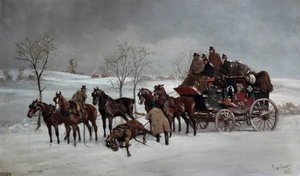
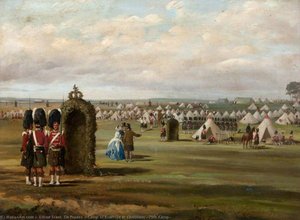
Alfred Frank de Prades’ oeuvre comprises numerous paintings depicting horses in various contexts—from ceremonial processions to sporting events—as well as portraits of military officers engaged in combat. Among his most celebrated achievements are “On the Heights near Boulogne,” “Fairplay,” and “Camp of Exercise at Chobham,” each reflecting his unwavering commitment to capturing the spirit of its subject matter with unparalleled artistry. His paintings reside in prestigious collections worldwide, including the National Army Museum, Walker Art Gallery, Bristol Museum & Art Gallery, and the Royal Collection—testaments to his enduring influence on art history. De Prades’ legacy extends beyond his individual artworks; he embodies the Victorian ideal of the artist as a conduit for noble pursuits—a figure who elevated equine art to new heights of expressive power and technical sophistication.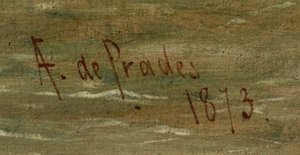
alfred frank de prades
1825 - 1885
Quick Facts
- Artistic Movement Or Style: Victorian Equestrian Art
- Artists Or Movements Influenced By This Artist: ['Victorian Painting']
- Artists Who Influenced This Artist: ['George Stubbs']
- Date Of Birth: March 24, 1825
- Date Of Death: July 7, 1885
- Full Name: Alfred Frank de Prades
- Nationality: French
- Notable Artworks:
- Horses Pulling a Flatboat Barge
- On the Heights Near Boulogne
- Fairplay
- Place Of Birth: Lunel, France
Related Articles

Demandes Commerciales
APS ofrece reproducciones de bellas artes y encargos personalizados desde 2004. Confían en nosotros corporaciones, hoteles y coleccionistas selectos para obras de arte de calidad museística, servicio discreto y soluciones artísticas completas. ¡Póngase en contacto con nosotros para obtener un presupuesto personalizado!

Sir Alfred Munnings' Masterpieces: 25 Paintings That Define Equine Art | ArtsDot
Explore 25 iconic Sir Alfred Munnings paintings! Discover the beauty of British Impressionism, equine art & rural England. Find museum-quality reproductions and elevate your home decor with ArtsDot. Explore the full collection online.

Goya's Masterpieces: Explore 25 Iconic Paintings & Art Prints | ArtsDot
Delve into the world of Francisco Goya with ArtsDot. Explore 25 iconic paintings – from 'The Third of May' to his haunting Black Paintings. Discover the stories, techniques & emotions behind these Spanish masterpieces. Find museum-quality art reproductions for your home at ArtsDot.com!

A riguardo di noi
Découvrez notre histoire ! Nous apportons l'art de classe mondiale dans votre vie grâce à une sélection experte, des créations personnalisées et des aperçus gratuits. Approuvé par les particuliers et les entreprises depuis 2000.

The Enduring Legacy of Oil on Canvas: Technique, History & Aesthetic Impact
Explore the rich history & techniques of oil painting – from Renaissance masters to Impressionism. Discover pigments, layering methods, and why this timeless medium endures. Expert insights for artists & art enthusiasts.