


 Preview
 Send
Send Share
Share
 Details

 Download
 Similars
 X-Ray
X-Ray Diaporama
 Stats
StatsPleasant Letter
 Oil On Canvas
- WallArt
- Contemporary Realism
 1860
1860 66.0 x 55.0 cm
 Hermitage Museum
 Read More
Purchase a high-resolution, enhanced digital image, far superior to the online preview.
Each file is meticulously prepared by our in-house specialists using advanced tools and expert manual retouching. We ensure every image has exceptional clarity, precise color accuracy, and fine detail.
The final file is delivered via email within 72 hours, optimized for immediate use in professional, editorial, and print environments. This is the same quality trusted by top-tier design studios, publishers, and galleries.
Digital Image
Download a high-resolution file for personal display, printing, and creative projects. ( Switch to Print Buy Hand Made Painting)
Included in Every Digital Image Order
Expert Digital Delivery, Guaranteed
When you choose ArtsDot.com, you're not just getting an image - you're receiving a professionally enhanced digital artwork, crafted with precision and backed by a satisfaction guarantee. Here's everything that comes with your order, automatically:

Fast Email Delivery
Your high-resolution digital image file will be emailed to you within 72 hours of ordering - ready for immediate use.

AI-Enhanced Digital File
Your artwork is professionally optimized using advanced AI tools and manual editing, ensuring maximum detail, clarity, and color accuracy.

Free Lifetime Re-Delivery
Accidentally deleted or lost your file? No worries - we'll resend it to you anytime, free of charge.

No Import Fees - Ever
Enjoy your artwork instantly with zero customs, duties, or delivery fees - digital downloads are always tax-free.

Color Accuracy Guarantee
We ensure your digital image reflects the original colors as closely as possible using professional tools and color management.

100-Day Satisfaction Guarantee
If you're not satisfied with your digital image, we'll revise it or refund 100% within 100 days - no questions asked.

100% Money-Back Guarantee
Not satisfied? Get a full refund within 100 days of receiving your digital file - no questions asked.

Bulk Order Discounts
Buy 3 images, save 10% - Buy 5, save 15% - Buy 10+, save 20%. Great for creative projects, galleries, and agencies.
A Glimpse of Parisian Life: Alfred Stevens’ “Pleasant Letter”
Alfred Stevens' "Pleasant Letter," painted circa 1860-67, is more than just a portrait; it’s a meticulously crafted window into the refined world of late 19th-century Paris. This exquisite work, currently residing in the collection of the State Hermitage Museum, captures a fleeting moment of domestic intimacy—a woman seated at a table, engrossed in a letter, while her companion observes with quiet attentiveness. Stevens, a master of realism and a keen observer of human psychology, elevates this seemingly simple scene into a study of social grace, subtle emotion, and the delicate balance between observation and participation.
The painting’s genesis lies firmly within Stevens' signature style: a deliberate departure from grand historical or mythological subjects. Instead, he focused on capturing the nuances of modern life—the “la vie moderne”—as it unfolded in fashionable Parisian interiors. This shift was revolutionary at the time, as it prioritized the portrayal of contemporary society and its inhabitants with an unprecedented level of detail and psychological insight. Influenced by the Dutch Masters – particularly Gerard ter Borch and Gabriel Metsu – Stevens meticulously rendered textures, light, and shadow, creating a palpable sense of realism that drew viewers into the scene.
The Composition: A Dance of Observation
The composition itself is remarkably balanced and restrained. The seated woman, dressed in a fashionable gown of muted tones, dominates the foreground, her gaze directed towards the letter before her. Her posture—relaxed yet attentive—suggests both engagement and contemplation. Her companion, positioned slightly behind and to the side, offers a counterpoint – a quiet observer, perhaps reflecting on the contents of the letter or simply enjoying the shared moment. The arrangement isn’t overtly dramatic; rather, it's a subtle choreography of figures within a carefully designed space.
Stevens masterfully utilizes light and color to enhance the scene’s atmosphere. A soft, diffused light illuminates the room, casting gentle shadows that define the forms and textures of the furniture and clothing. The palette is predominantly muted – browns, creams, and grays—reflecting the understated elegance of the Parisian bourgeois lifestyle. The use of a delicate rose-colored shawl draped over the woman’s shoulders adds a touch of warmth and visual interest, subtly drawing the eye to her face.
Symbolism and Social Commentary
Beyond its aesthetic qualities, “Pleasant Letter” carries layers of symbolic meaning. The act of reading a letter represents communication, connection, and perhaps even unspoken desires. It’s a moment of private reflection within the confines of domestic life—a world carefully constructed to project an image of refinement and social standing. The painting subtly critiques the artificiality of such displays, hinting at the complexities beneath the surface of polite society.
Furthermore, Stevens' choice of subject matter – a seemingly ordinary scene of everyday life – speaks to his broader artistic vision. He sought to elevate the commonplace, revealing beauty and significance in the details of modern existence. The painting’s popularity during its time reflected a growing interest in capturing the realities of contemporary society—a trend that would profoundly influence subsequent generations of artists.
A Legacy of Elegance
Alfred Stevens' “Pleasant Letter” remains a testament to his exceptional skill and artistic vision. It is a captivating portrait not only of two women but also of an era – the Belle Époque—characterized by its elegance, social complexities, and burgeoning modernity. Reproductions of this work offer a remarkable opportunity to experience the subtle beauty and psychological depth of Stevens’s art, bringing a touch of Parisian refinement into any space.
Related Artworks

Artist Biography
early life and training
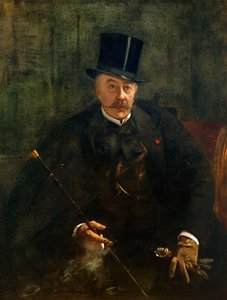
alfred émile léopold stevens, a renowned belgian painter, was born on may 11, 1823, in brussels. his family was deeply rooted in the visual arts, with his older brother joseph (1816–1892) and son léopold (1866–1935) being painters, while another brother arthur (1825–99) was an art dealer and critic.artistic career
stevens began his artistic journey at the académie royale des beaux-arts in brussels, where he studied under the guidance of françois navez, a neo-classical painter. in 1843, he moved to paris, joining his brother joseph, and was admitted to the école des beaux-arts. although it is disputed whether he became a student of jean auguste dominique ingres, stevens' early work, such as the pardon or absolution (hermitage, st. petersburg), signed and dated 1849, showcases his mastery of conventional naturalistic style, influenced by 17th-century dutch genre painting.rise to prominence
stevens' work was first publicly exhibited in 1851 at the brussels salon, earning him a third-class medal at the paris salon in 1853 and a second-class medal at the universal exposition in paris in 1855. his painting ce qu'on appelle le vagabondage (musée d'orsay, paris) caught the attention of napoleon iii, leading to a significant change in the treatment of the poor.notable works and legacy
- la dame en rose or woman in pink (musées royaux des beaux-arts de belgique, brussels), painted in 1866, exemplifies stevens' work during this period, combining a fashionably dressed woman with a detailed examination of japanese objects.
- stevens received the legion of honor (chevalier) from the french government in 1863 and was promoted to officer of the legion of honor in 1867.
Alfred Stevens
1823 - 1906 , Belgium
Quick Facts
- Artistic Movement Or Style: Academic Realism
- Artists Who Influenced This Artist:
- Jean Auguste Dominique Ingres
- Dutch Masters
- Date Of Birth: May 11, 1823
- Date Of Death: 1906
- Full Name: Alfred Émile Léopold Stevens
- Nationality: Belgian
- Notable Artworks:
- La Dame en Rose
- Visit to the Studio
- Dessin préparatoire au 'Panorama du siècle', 'L'Impératrice Joséphine et sa Cour
- Place Of Birth: Brussels, Belgium