 Preview
 Send
Send Share
Share
 Details

 Download
 Similars
 X-Ray
X-Ray Diaporama
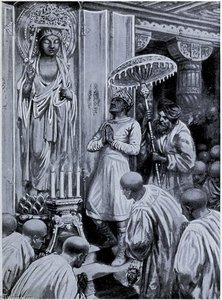
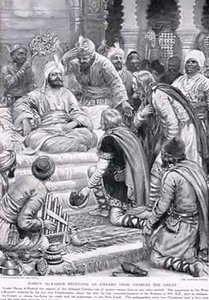
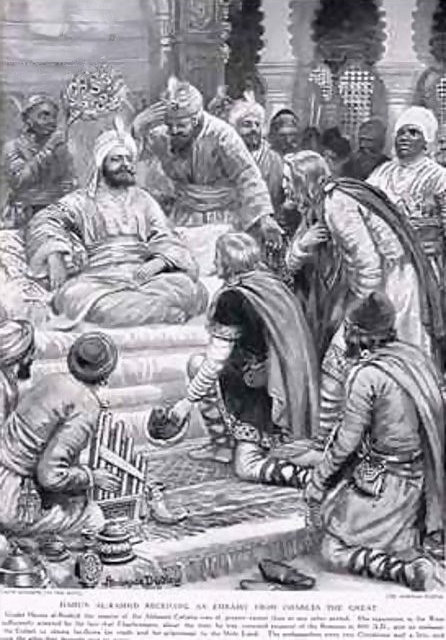
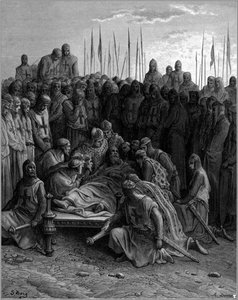
Harun al Rashid receiving an embassy from Charles the Great
 Read More
Hand Made Oil Reproduction
Hand-painted oil on canvas in your size and frame, made to order by our artists. ( Buy Print Buy Image)




































Pick from our preset sizes that match the artwork's original proportions.

You may enter your own dimensions to fit a specific frame or space. If your selected size does not match the original image's proportions, we will either crop the artwork or extend the painting with additional hand-painted elements. A digital mockup will be sent for your approval before production begins.
Please note that the on-screen preview does not reflect the actual cropping or extension. Only the mockup will accurately show the final composition.
While custom sizes are available, we recommend selecting a dimension from the predefined list to preserve the original proportions.
After order, ArtsDot.com team will email client for instructions and provide a mockup preview
Worldwide Delivery () in 3/4 weeks instead of standard 5 weeks. (21 August). No compromise on quality.

Free Worldwide Express Shipping

High-Quality Linen Canvas

Full Shipping Insurance

Customs Tax Refund Guarantee

True Color Matching Guarantee

60-Day Return Policy (Defects Only)

100% Money-Back Guarantee

Bulk Discount Offer
 Glass option is only available in size under 110 CM

Harun al Rashid receiving an embassy from Charles the Great
Reproduction Medium
Reproduction Size
-


Total Price
$ 613
Related Artworks





Artist Biography
Pierre Bonnard: A Painter of Intimate Light
Born in Fontenay-aux-Roses, a suburb just outside Paris, on October 3rd, 1867, Pierre Bonnard was not initially destined for the art world. His father, Eugène Bonnard, held a position within the French Ministry of War, and young Pierre was steered towards a legal career – he even earned a license in law. However, a deep-seated passion for drawing and watercolor, nurtured during his childhood and further encouraged by his family’s appreciation for artistic pursuits, ultimately led him to abandon his legal aspirations and embrace painting as his true vocation. This shift wasn't immediate; Bonnard spent several years working as a typesetter and decorator before dedicating himself fully to art in the late 1880s.
Early influences on Bonnard’s work were profoundly shaped by the Impressionists, particularly Claude Monet and Camille Pissarro. He initially sought to emulate their techniques of capturing fleeting moments of light and color, evident in his early landscapes and scenes of Parisian life. Yet, he quickly moved beyond mere imitation, developing a distinctive style characterized by bold, flattened forms, vibrant yet muted colors, and an emphasis on the subjective experience of perception rather than objective reality. This trajectory was significantly influenced by Paul Gauguin’s exploration of symbolism and emotional intensity in his paintings, as well as the decorative prints of Hokusai, whose masterful use of line and color captivated Bonnard's imagination.
The Nabis and a Revolutionary Palette
Bonnard’s artistic journey truly took shape with his involvement in the *Nabis* (meaning “prophets”), a group of avant-garde painters formed in 1888. The Nabis, including figures like Édouard Vuillard and Suzanne Valadon, sought to create a new form of art that transcended mere representation, aiming instead for an evocative expression of mood and feeling. They drew inspiration from Japanese prints, particularly the bold compositions and flattened perspectives of Hiroshige and Hokusai, incorporating these elements into their own work. Bonnard’s membership in the Nabis marked a crucial turning point, solidifying his commitment to exploring subjective experience and pushing the boundaries of traditional painting techniques.
A defining characteristic of Bonnard's style was his masterful manipulation of color. He eschewed the conventional use of complementary colors, instead employing a carefully orchestrated palette of muted tones—ochres, blues, greens, and pinks—to create a sense of atmosphere and intimacy. His paintings often depict domestic scenes – interiors filled with furniture, bathers, and family members – rendered in a dreamlike quality where background elements frequently dominate the foreground, creating a layered and complex visual experience. He wasn’t interested in depicting reality as it appeared; instead, he sought to capture the *feeling* of a space or moment.
Themes of Domesticity and Intimacy
Bonnard's oeuvre is overwhelmingly focused on intimate subjects—domestic interiors, portraits of family members, and scenes of everyday life. He frequently depicted his wife, Marthe, and their children in a series of paintings that offer glimpses into the quiet rhythms of their lives. These works are not characterized by grand narratives or dramatic events; rather, they capture fleeting moments of tenderness, humor, and shared experience. His approach was deeply personal, reflecting his own observations and emotions. He famously stated, "I paint what I see—not necessarily what is there.”
Despite the seemingly simple subject matter, Bonnard’s paintings are imbued with a remarkable sense of subtlety and nuance. His use of light and shadow creates a luminous quality that enhances the emotional impact of each scene. He often employed a technique known as *décomposition*, breaking down forms into their constituent parts and rearranging them in unexpected ways, creating a sense of disorientation and ambiguity. This approach challenged traditional notions of perspective and spatial representation, paving the way for later developments in modern art.
Legacy and Influence
Pierre Bonnard’s influence on 20th-century painting is considerable. His innovative use of color, his exploration of subjective experience, and his rejection of academic conventions paved the way for movements such as Fauvism and Expressionism. Artists like Henri Matisse and André Derain were deeply influenced by Bonnard's bold palette and expressive brushwork. His work continues to be celebrated for its beauty, intimacy, and profound emotional resonance.
Bonnard died in La Route de Serra Capeou on January 23rd, 1947, at the age of 79. His paintings remain a testament to his unique artistic vision—a celebration of light, color, and the quiet joys of everyday life. His legacy endures as one of the most important and beloved figures in French art.
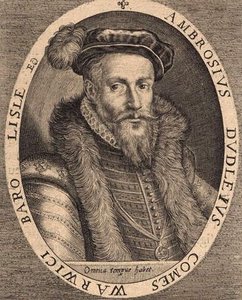
ambrose dudley
1867 - 1951 , United Kingdom
Quick Facts
- Artistic Movement Or Style: Post-Impressionism, Nabis
- Artists Or Movements Influenced By This Artist:
- Henri Matisse
- Modernism
- Artists Who Influenced This Artist:
- Paul Gauguin
- Hokusai
- Date Of Birth: 1867-10-03
- Date Of Death: 1947-01-23
- Full Name: Pierre Bonnard
- Nationality: French
- Notable Artworks:
- La Route de Serra Capeou
- Mont Sainte-Victoire
- The Large Format
- Place Of Birth: Fontenay-aux-Roses, France