 Preview
 Send
Send Share
Share
 Details

 Download
 Similars
 X-Ray
X-Ray Diaporama
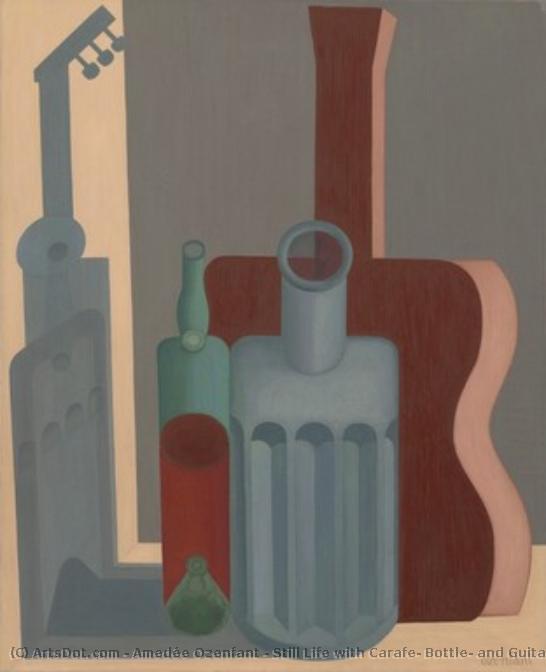
Still Life with Carafe, Bottle, and Guitar
 1919
1919 88.0 x 72.0 cm
 Read More
Hand Made Oil Reproduction
Hand-painted oil on canvas in your size and frame, made to order by our artists. ( Buy Print Buy Image)




































Pick from our preset sizes that match the artwork's original proportions.

You may enter your own dimensions to fit a specific frame or space. If your selected size does not match the original image's proportions, we will either crop the artwork or extend the painting with additional hand-painted elements. A digital mockup will be sent for your approval before production begins.
Please note that the on-screen preview does not reflect the actual cropping or extension. Only the mockup will accurately show the final composition.
While custom sizes are available, we recommend selecting a dimension from the predefined list to preserve the original proportions.
After order, ArtsDot.com team will email client for instructions and provide a mockup preview
Worldwide Delivery () in 3/4 weeks instead of standard 5 weeks. (26 August). No compromise on quality.

Free Worldwide Express Shipping

High-Quality Linen Canvas

Full Shipping Insurance

Customs Tax Refund Guarantee

True Color Matching Guarantee

60-Day Return Policy (Defects Only)

100% Money-Back Guarantee

Bulk Discount Offer
 Glass option is only available in size under 110 CM

Still Life with Carafe, Bottle, and Guitar
Reproduction Medium
Reproduction Size
-


Total Price
$ 263
Related Artworks





Artist Biography
Amédée Ozenfant: Architect of Geometric Abstraction
Amédée Ozenfant, a name inextricably linked to the dawn of Purism and the burgeoning world of modernist art, was more than just a painter; he was a visionary architect of form and color. Born in Saint-Quentin, France, in 1886, his journey from humble beginnings to international recognition is a testament to his intellectual rigor and unwavering commitment to a new aesthetic language. Ozenfant’s life intersected with some of the most influential figures of the early 20th century, notably Charles-Edouard Jeanneret – Le Corbusier – forging a collaborative partnership that profoundly shaped the course of modern art and architecture. His legacy lies not just in his distinctive paintings but also in his theoretical contributions to design and his pivotal role in establishing Purism as a distinct artistic movement.Early Influences and Artistic Training
Ozenfant’s early life was steeped in the traditions of rural France, yet he possessed an innate curiosity that propelled him towards Parisian art circles. He began painting at the age of fourteen, initially exploring watercolour and pastel techniques. His formal artistic training commenced in 1904 with a drawing course at the École Municipale de Dessin Quentin Delatour in Saint-Quentin, followed by studies at the Académie de la Palette under Jacques-Emile Blanche in 1907. This period exposed him to the principles of Impressionism and Post-Impressionism, laying the groundwork for his later explorations. Crucially, he sought mentorship from Maurice Pillard Verneuil and Charles Cottet, absorbing their insights into Parisian artistic practices. His travels between 1909 and 1913 – encompassing Russia, Italy, Belgium, and the Netherlands – were not merely vacations but intensive periods of study, exposing him to diverse cultural influences and architectural styles that would later inform his Purist aesthetic. These experiences fostered a desire for clarity and order, a reaction against what he perceived as the decorative excesses of the time.The Birth of Purism: Collaboration with Le Corbusier
Ozenfant’s most significant contribution to art history arrived through his collaboration with Charles-Edouard Jeanneret – Le Corbusier – in 1917. Together, they articulated the core tenets of Purism, a movement that sought to strip away the perceived clutter and emotionalism of Cubism, advocating instead for a reductive style based on geometric abstraction and architectural principles. Their seminal work, *Après le Cubisme* (1918), outlined this philosophy, emphasizing the importance of “pure” forms – simple shapes like rectangles, circles, and triangles – arranged in precise spatial relationships. This wasn’t merely an aesthetic choice; it was a deliberate attempt to align art with the rational order of modern industrial society. The first Purist exhibition, held at Galerie Thomas in 1917, showcased Ozenfant's pioneering works, establishing his position as a leading figure in this revolutionary movement. The subsequent journal *L’Esprit Nouveau* (1920-1925), co-edited by Ozenfant and Le Corbusier, further disseminated Purist ideas, solidifying its influence on artists and architects alike.Aesthetic Principles and Artistic Style
Ozenfant's paintings are characterized by a remarkable clarity of form and an almost mathematical precision. He rejected the subjective expressionism of earlier movements, opting instead for a detached, analytical approach to representation. His subjects – often still lifes featuring everyday objects like jugs, bottles, and guitars – were rendered with stark geometric shapes against plain backgrounds. Color played a crucial role, not as a means of emotional expression but as an integral element of the composition, used to define form and create spatial relationships. He meticulously studied the principles of color theory, employing a limited palette of primary colors and carefully calibrated values to achieve visual harmony. His work is often described as “architectural,” reflecting his deep admiration for Le Corbusier’s architectural theories – particularly the concept of ‘machine aesthetic,’ where industrial design was seen as inherently beautiful and rational.Legacy and Influence
Beyond his artistic output, Ozenfant exerted a profound influence on subsequent generations of artists and designers. His theoretical writings, notably *Art* (1928), articulated a comprehensive philosophy of modern art that extended beyond painting to encompass architecture, design, and even science. He championed the integration of these disciplines, arguing for a unified approach to creative expression. His establishment of the Académie Moderne in Paris and his later Academy in London served as centers for disseminating Purist principles and nurturing new talent. Ozenfant’s legacy extends far beyond the confines of the 20th century; his emphasis on clarity, order, and rational design continues to resonate with contemporary artists and designers seeking to create meaningful works within a rapidly changing world. His work remains a powerful example of how art can be used to articulate the values and aspirations of modernity.
amedée ozenfant
1886 - 1966
Quick Facts
- Artistic Movement Or Style:
- Purism
- Cubism
- Modernist Painting
- Artists Or Movements Influenced By This Artist:
- Le Corbusier
- Purism
- Artists Who Influenced This Artist:
- Jacques-Emile Blanche
- Maurice Pillard Verneuil
- Date Of Birth: 1886-04-15
- Date Of Death: 1966-05-04
- Full Name: Amédée Ozenfant
- Nationality: French
- Notable Artworks:
- Still Life with Carafe...
- Bouquet de Fleurs
- Place Of Birth: Saint-Quentin, France