 Preview
 Send
Send Share
Share
 Details

 Download
 Similars
 X-Ray
X-Ray Diaporama
Triumphs of Caesar 3


 Read More
Hand Made Oil Reproduction
Hand-painted oil on canvas in your size and frame, made to order by our artists. ( Buy Print Buy Image)




P118B $10

P118H $10

P118W $10

P438Z $10

P508JH $12

P508YH $12

P805H $10

P805Z $10

P919BZ $10

P919G $10

P919XJ $10

P959ZH $10

P968JZ $12

W106C $8

W218G $10

W218JH $8

W218Y $10

W307PJ $10

W316G $10

W316PJ $8

W316Y $10

W398PJ $8

W4111J $10

W500HY $15

W500JH $15

W692G $12

W849H $8

W940BG $15

W953PJ $8




Pick from our preset sizes that match the artwork's original proportions.

You may enter your own dimensions to fit a specific frame or space. If your selected size does not match the original image's proportions, we will either crop the artwork or extend the painting with additional hand-painted elements. A digital mockup will be sent for your approval before production begins.
Please note that the on-screen preview does not reflect the actual cropping or extension. Only the mockup will accurately show the final composition.
While custom sizes are available, we recommend selecting a dimension from the predefined list to preserve the original proportions.
After order, ArtsDot.com team will email client for instructions and provide a mockup preview
Worldwide Delivery () in 3/4 weeks instead of standard 5 weeks. (16 August). No compromise on quality.

Free Worldwide Express Shipping

High-Quality Linen Canvas

Full Shipping Insurance

Customs Tax Refund Guarantee

True Color Matching Guarantee

60-Day Return Policy (Defects Only)

100% Money-Back Guarantee

Bulk Discount Offer
 Glass option is only available in size under 110 CM

Triumphs of Caesar 3
Reproduction Medium
Reproduction Size
-


Total Price
$ 263
Artwork Description
A Grand Procession Through Time
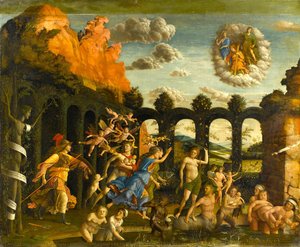
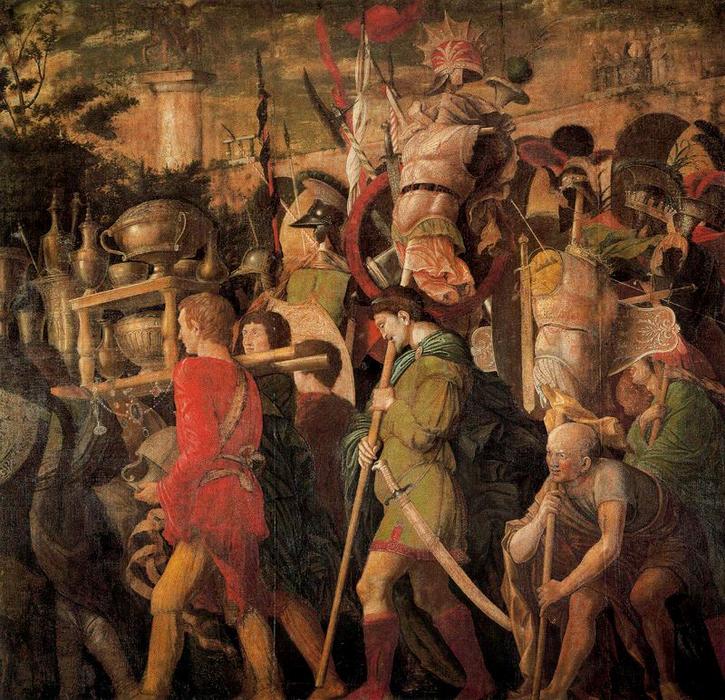
To step before Andrea Mantegna’s Triumphs of Caesar 3 is to be swept away from the modern world and thrust into the heart of a Roman victory parade. This masterpiece, part of a monumental series of nine canvases created between the mid-1480s and 1506, serves as a breathtaking window into the grandeur of antiquity. The scene captures a moment of intense movement and triumph, where the spoils of war are paraded through the streets of Rome. A young man, dressed in vibrant, colorful attire and wielding a halberd, leads the viewer’s eye into the composition, his gaze momentarily breaking the fourth wall to connect with us across the centuries. Behind him, a heavy cart groans under the weight of captured treasures—a towering, chaotic yet magnificent assembly of shields, weapons, and armor that speaks to the sheer scale of Caesar's conquests.
The emotional resonance of the work lies in its ability to balance the overwhelming chaos of war with the structured dignity of a formal ceremony. There is a palpable sense of weight and texture; one can almost feel the cold metallic sheen of the crescent-shaped shields and the heavy burden of the precious vessels being carried on wooden stretchers. As figures shoulder bowls heaped with golden coins, the painting evokes a sense of awe at the immense wealth and power flowing through the city. For the collector or designer, this piece offers more than just decoration; it provides a profound narrative of human ambition and the enduring allure of classical glory.
The Mastery of Renaissance Technique
Mantegna’s technical brilliance is nothing short of revolutionary, particularly in his use of egg tempera on canvas. This medium allowed him to achieve a level of sculptural precision that few of his contemporaries could match. By applying layers of translucent glazes, Mantegna achieved a luminous depth, capturing the intricate details of embossed metal, the soft folds of fabric, and the weathered surfaces of ancient weaponry. His mastery of linear perspective creates a sophisticated spatial illusion, drawing the viewer deep into the bustling Roman street, making the procession feel as though it is moving through the very room where the painting hangs.
The artist’s obsession with archaeological accuracy—a hallmark of his style—is evident in every meticulously rendered object. Every piece of armor and every decorative vase serves a dual purpose: they are both realistic artifacts of a lost era and symbolic elements that reinforce the theme of imperial triumph. This dedication to detail ensures that the painting remains a captivating subject for close inspection, rewarding the viewer with new discoveries upon every viewing. Whether placed in a grand gallery or as a focal point in a sophisticated interior, the work’s intricate textures and vibrant, controlled palette command attention and inspire a sense of historical wonder.
A Legacy of Classical Inspiration
Beyond its visual splendor, Triumphs of Caesar 3 is a profound testament to the Renaissance spirit of rebirth. Mantegna did not merely paint history; he sought to resurrect it. Influenced by his studies of Roman ruins and classical inscriptions, he crafted an environment that feels authentically ancient yet vibrantly alive. The painting functions as a bridge between the classical past and the humanistic present, celebrating the intellect, strength, and cultural richness of the Roman Empire.
For those seeking to infuse their spaces with character and intellectual depth, this reproduction offers an unparalleled opportunity. It is a piece that speaks to the connoisseur of history and the lover of fine art alike. The composition’s harmonious balance of movement and order makes it a versatile choice for high-end interior design, providing a sophisticated anchor for rooms that celebrate culture, heritage, and the timeless beauty of the Old Masters.
Related Artworks
Artist Biography
A Renaissance Forged in Antiquity: The Life and Art of Andrea Mantegna
Andrea Mantegna, born near Padua around 1431, stands as a pivotal figure bridging the Early and High Renaissances. His artistic journey wasn’t merely about adopting classical forms; it was an immersive excavation of antiquity, a passionate attempt to resurrect the spirit of Rome within the burgeoning Italian Renaissance. Unlike many contemporaries who drew inspiration from classical models, Mantegna possessed a unique fervor for archaeological accuracy. This obsession stemmed from his formative years under Francesco Squarcione, a painter and collector whose workshop functioned less as a traditional studio and more as an academy dedicated to the study of Roman ruins, sculptures, and inscriptions. It was within these walls, surrounded by fragments of a lost empire, that Mantegna’s artistic vision began to take shape—a vision characterized by sculptural forms, dramatic perspective, and an almost obsessive attention to detail. His early life remains somewhat shrouded in mystery; accounts suggest he was discovered as a promising apprentice, his innate talent recognized and nurtured by Squarcione despite humble origins. This unconventional beginning perhaps fueled Mantegna’s relentless pursuit of artistic mastery and his determination to forge a style distinctly his own.The Gonzaga Court and the Illusion of Reality
Mantegna's career truly blossomed when he entered the service of the Gonzaga family in Mantua, becoming court painter in 1488. This patronage provided him with an unprecedented level of artistic freedom and a platform to realize his most ambitious projects. The Gonzaga’s were not simply patrons; they were collaborators, commissioning works that pushed the boundaries of artistic innovation. It was during this period that Mantegna created what is arguably his masterpiece: the *Camera degli Sposi* (Bridal Chamber) frescoes in the Palazzo Ducale. This groundbreaking work transcends mere decoration; it's a complete illusionistic environment, seamlessly integrating architecture and painting to create an extended sense of space. The frescoes depict scenes from the life of the Gonzaga family, portraits that are remarkably lifelike and engaging, and a breathtaking *di sotto in sù* (seen from below) ceiling panel that creates the illusion of an open sky. This masterful manipulation of perspective wasn’t simply about technical skill; it was about creating a world within a room, blurring the lines between reality and representation. Beyond the *Camera degli Sposi*, Mantegna continued to produce works of exceptional quality for the Gonzaga court, including the monumental series *Triumphs of Caesar*. These paintings, inspired by Roman triumphal processions, are not merely historical depictions; they are elaborate allegories celebrating the power and prestige of the Gonzaga family, presented with a grandeur that rivals the imperial ambitions of ancient Rome.A Master of Perspective and Anatomical Precision
Mantegna’s artistic innovations extended far beyond illusionistic environments. He was a pioneer in the use of perspective, often employing techniques that went against conventional methods to achieve dramatic effects. Frequently, he adjusted the horizon line, creating a sense of monumentality and imposing scale. This technique, coupled with his meticulous attention to anatomical detail, gave his figures an unparalleled sense of weight and presence. He wasn’t content with simply representing the human form; he dissected it, studied its musculature, and rendered it with a precision that was revolutionary for his time. His mastery of *trompe-l'oeil* – creating illusions so convincing they deceive the eye – further enhanced this effect, blurring the boundaries between painting and reality. This dedication to anatomical accuracy wasn’t merely an exercise in technical skill; it reflected Mantegna’s deep engagement with classical sculpture and his desire to emulate the idealized forms of antiquity. He sought not just to depict the human body but to capture its inherent dignity and power. His influence on subsequent generations of artists, including Raphael and Michelangelo, is undeniable, as they built upon his foundations in perspective, anatomy, and composition.Legacy and Enduring Influence
Andrea Mantegna died in Mantua in 1506, leaving behind a legacy that continues to resonate with art historians and enthusiasts alike. His work represents a crucial turning point in the history of Renaissance art, bridging the gap between the Early and High Renaissance styles. He wasn’t simply an imitator of classical forms; he was an interpreter, adapting ancient motifs and techniques to create something entirely new and uniquely his own. His meticulous attention to detail, his mastery of perspective, and his profound engagement with classical antiquity established him as a leading figure of his time. Mantegna’s exploration of classical themes helped revive interest in ancient art and culture, paving the way for the artistic achievements of the High Renaissance. His influence can be seen in the works of countless artists who followed, from Raphael's graceful compositions to Michelangelo's powerful figures. Today, his paintings are housed in major museums around the world, including The National Gallery in London and the Pinacoteca di Brera in Milan, where they continue to inspire awe and admiration.- His innovative use of perspective continues to be studied by artists and art historians.
- His anatomical precision remains a benchmark for realistic representation.
- His dedication to classical themes helped shape the course of Renaissance art.
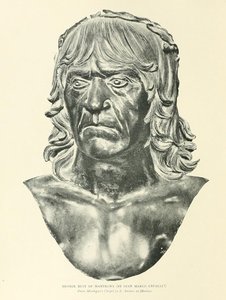
Andrea Mantegna
1431 - 1506 , Italy
Quick Facts
- Artistic Movement Or Style: Early Renaissance
- Artists Or Movements Influenced By This Artist:
- Raphael
- Michelangelo
- Artists Who Influenced This Artist:
- Donatello
- Jacopo Bellini
- Date Of Birth: 1431
- Date Of Death: 1506
- Full Name: Andrea Mantegna
- Nationality: Italian
- Notable Artworks:
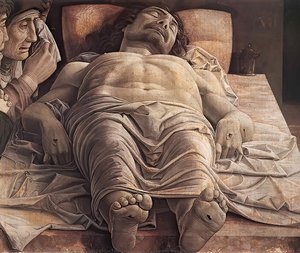
- Lamentation over the Dead Christ
- St. George and the Dragon
- Camera degli Sposi
- Triumphs of Caesar
- Place Of Birth: Padua, Italy
Related Articles
The Enduring Legacy of Classicism: Principles, Evolution & Influence in Western Art
Explore the enduring legacy of Classicism in Western art! Discover its historical context, key principles, iconic masterpieces & lasting influence. Learn about Renaissance and Neoclassical movements with ArtsDot.
Neo-Classicism's Greatest Hits: 10 Masterpieces for Your Home |
Journey through Neo-Classicism's finest! Explore 10 iconic masterpieces by David, Ingres & Canova. Discover art history, techniques & timeless beauty – perfect for inspiring your home decor. Find museum-quality reproductions at
Echoes of Antiquity: Exploring Themes & Techniques in Classical Art Masterpieces
Explore the timeless beauty & profound themes of Classical art! Discover Greek & Roman masterpieces, Neoclassical revivals, and the enduring influence on artistic movements. Expert insights & high-quality reproductions at ArtsDot.
Timeless Resonance: Exploring Classic Vibe in Art – A Historical & Aesthetic Analysis
Explore the rich history & enduring aesthetic of Classicism art! Discover key movements, iconic artists like Raphael & David, and its lasting influence on Western art. Deepen your appreciation today.
The Enduring Echo of Antiquity: Classical Ideals in Art from Renaissance to Modernism
Explore the lasting impact of classical ideals on art from the Renaissance to Modernism. Discover key movements, iconic artists & find museum-quality reproductions at ArtsDot.