

 Preview
 Send
Send Share
Share
 Details

 Download
 Similars
 X-Ray
X-Ray Diaporama
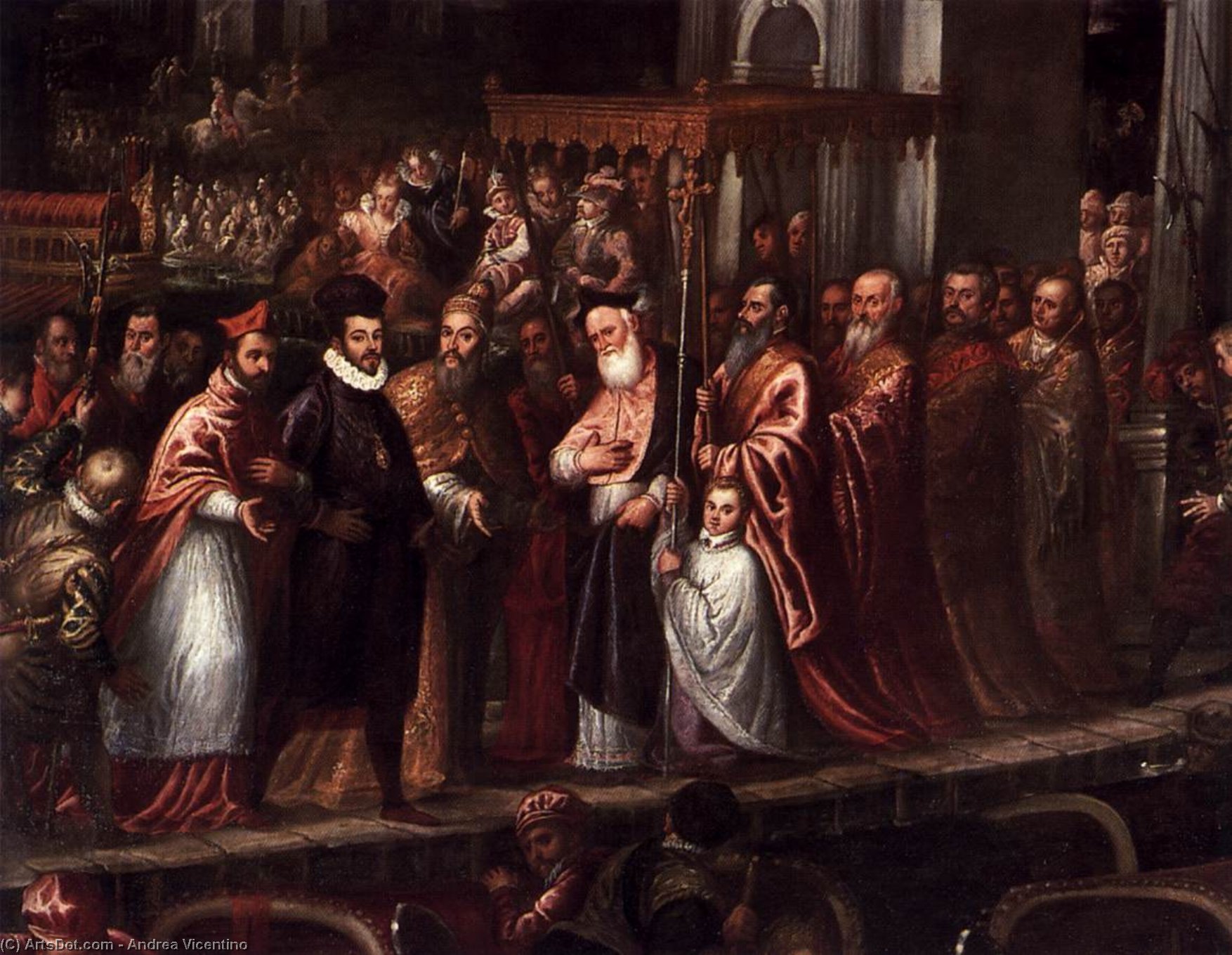
The Doge and the Patriarch Welcoming Henri III, King of France (detail)


 Read More
Purchase a high-resolution, enhanced digital image, far superior to the online preview.
Each file is meticulously prepared by our in-house specialists using advanced tools and expert manual retouching. We ensure every image has exceptional clarity, precise color accuracy, and fine detail.
The final file is delivered via email within 72 hours, optimized for immediate use in professional, editorial, and print environments. This is the same quality trusted by top-tier design studios, publishers, and galleries.
Digital Image
Download a high-resolution file for personal display, printing, and creative projects. ( Buy Print Buy Hand Made Painting)
Included in Every Digital Image Order
Expert Digital Delivery, Guaranteed
When you choose ArtsDot.com, you're not just getting an image - you're receiving a professionally enhanced digital artwork, crafted with precision and backed by a satisfaction guarantee. Here's everything that comes with your order, automatically:

Fast Email Delivery
Your high-resolution digital image file will be emailed to you within 72 hours of ordering - ready for immediate use.

AI-Enhanced Digital File
Your artwork is professionally optimized using advanced AI tools and manual editing, ensuring maximum detail, clarity, and color accuracy.

Free Lifetime Re-Delivery
Accidentally deleted or lost your file? No worries - we'll resend it to you anytime, free of charge.

No Import Fees - Ever
Enjoy your artwork instantly with zero customs, duties, or delivery fees - digital downloads are always tax-free.

Color Accuracy Guarantee
We ensure your digital image reflects the original colors as closely as possible using professional tools and color management.

60-Day Satisfaction Guarantee
If you're not satisfied with your digital image, we'll revise it or refund 100% within 60 days - no questions asked.

100% Money-Back Guarantee
Not satisfied? Get a full refund within 60 days of receiving your digital file - no questions asked.

Bulk Order Discounts
Buy 3 images, save 10% - Buy 5, save 15% - Buy 10+, save 20%. Great for creative projects, galleries, and agencies.
A Grand Convergence of Power and Piety
This captivating detail from Andrea Vicentino’s monumental work, The Doge and the Patriarch Welcoming Henri III, King of France, immediately draws the viewer into a moment thick with historical weight and ceremonial grandeur. One can almost feel the hushed reverence of the cathedral setting, suggested by the rich drapery and the formal arrangement of figures. At the heart of the composition stands a central figure, perhaps addressing the assembled nobility or clergy, his clasped hands suggesting both profound devotion and authoritative pronouncement. The scene is not merely a gathering; it is a carefully orchestrated tableau vivant, capturing the apex of political maneuvering veiled in the sacred mantle of religious ceremony. Vicentino masterfully frames this interaction, ensuring that every glance exchanged and every gesture made contributes to an overwhelming sense of occasion.
Mannerist Elegance and Venetian Mastery
Painted around 1595, this piece is a quintessential example of late Renaissance Mannerism filtered through the sophisticated lens of Venetian art. Andrea Vicentino, known for his command over complex compositions, embodies the period's characteristic elegance—a style that favors grace, elongated forms, and an intellectual complexity over pure naturalism. While the subject matter speaks to tangible historical events involving royalty and civic leaders, the execution elevates it into something timelessly dramatic. The handling of light across the voluminous fabrics and the subtle modeling of flesh reveal a painter deeply versed in the Venetian tradition, yet pushing its boundaries with Mannerist refinement.
Symbolism Woven into the Fabric
The inclusion of figures representing such powerful institutions—the Doge, the Patriarch, and a King—is inherently symbolic. The painting speaks to the delicate, often fraught, relationship between temporal power (represented by the monarchy and civic government) and spiritual authority (embodied by the Church). Every chair, every richly adorned garment, whispers tales of patronage, allegiance, and the shifting tides of political favor in late 16th-century Italy. For the collector or designer, this depth offers more than mere decoration; it provides a conversation piece steeped in layers of historical allegory.
Bringing History Home: Reproduction for Modern Spaces
To bring the majesty of Vicentino’s vision into your contemporary home is to invite a dialogue between eras. A high-quality reproduction allows you to possess this segment of history without the monumental scale or the passage of centuries. Imagine this scene anchoring a grand hall, lending an air of cultivated erudition and dramatic depth. The richness captured in the original oil on canvas—the deep jewel tones juxtaposed with luminous skin tones—translates beautifully into reproductions, offering an immediate focal point that speaks volumes about taste, culture, and appreciation for masterful historical artistry.
Related Artworks

Artist Biography
The Venetian Master of Mannerist Grandeur
Andrea Vicentino, a name that echoes through the corridors of the late Renaissance, stands as a pivotal figure in the Venetian artistic landscape. Born in the architecturally rich city of Vicenza around 1542, his early life was shaped by the profound traditions of the Maganza School. Under the watchful eye and expert tutelage of Giovanni Battista Maganza, Vicentino developed a command over monumental compositions and refined aesthetics that would later define his career. This formative period provided him with more than just technical skill; it instilled in him a deep understanding of how art could serve as a vessel for both civic pride and religious devotion.
As he matured, the artist’s identity became as fluid and vibrant as the Venetian art world itself. Known variously as Andrea Michieli or Michelli, his movement toward Venice in the mid-1570s marked a transformative era in his development. By 1583, he had officially registered with the Fraglia, the prestigious Venetian guild of painters. This affiliation was not merely a professional milestone but a gateway to the most influential circles of patronage in the Republic, allowing him to weave his brushstrokes into the very fabric of Venetian political and spiritual life.
A Legacy Written in the Palazzo Ducale
The true magnitude of Vicentino’s talent is perhaps best witnessed in his monumental collaborations within the Palazzo Ducale. Working alongside the legendary Tintoretto, Vicentino contributed to some of the most significant decorative programs of the era. His hand is visible in the grandeur of The Arrival of Henry III at Venice, a masterpiece located in the Sala delle Quattro Porte that captures the historical weight of the Habsburg monarch's visit. Through his work, the halls of the palace—including the Sala del Senato and Sala dello Scrutinio—were transformed into theatrical stages where history and myth converged.
His ability to navigate the complexities of Mannerism allowed him to master a style characterized by:
- Dramatic Composition: The use of elongated forms and intricate arrangements to create a sense of intellectual complexity.
- Luminous Coloration: A mastery of light and pigment that reflected the rich, atmospheric traditions of the Venetian school.
- Narrative Depth: An ability to blend historical accuracy with an almost cinematic sense of movement and emotion.
The Intersection of Devotion and Epic Drama
Beyond the political splendor of Venice, Vicentino’s oeuvre reached into the sacred heart of Italy. His ambitious undertaking at the Treviso Cathedral, the Madonna of the Rosary, serves as a testament to his capacity for profound religious expression. In this work, the artist moved away from the chaotic energy of battle to embrace a more intimate, devotional language, utilizing intricate detail and a soft, luminous glow to inspire piety in the faithful.
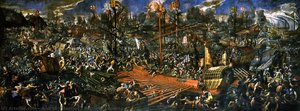
Yet, he was equally capable of capturing the visceral chaos of conflict. His 1603 depiction of the Battle of Lepanto remains one of his most evocative achievements. In this oil on canvas, the viewer is swept into a torrent of salt spray, gunpowder smoke, and the desperate cries of combatants. It is here that Vicentino’s Mannerist roots meet the raw energy of the late Renaissance, creating a visual echo of the clash between the Christian Holy League and the Ottoman fleet. Through his brush, the historical event transcends mere documentation to become an epic drama of human struggle and religious fervor.
Ultimately, the significance of Andrea Vicentino lies in his role as a bridge between eras. He carried the refined elegance of the Maganza tradition into the high-stakes, dramatic world of Venetian Mannerism, leaving behind a legacy of works that continue to command reverence for their technical brilliance and emotional resonance.
Andrea Vicentino
1542 - 1617 , Italy
Quick Facts
- Artistic Movement Or Style: Late Renaissance/Mannerist
- Artists Or Movements Influenced By This Artist: ['Tintoretto']
- Artists Who Influenced This Artist: ['Giovanni Battista Maganza']
- Date Of Birth: ca. 1542
- Date Of Death: ca. 1617
- Full Name: Andrea Vicentino
- Nationality: Italian
- Notable Artworks:
- Battle of Lepanto
- Virgin and Child entroned, with St Francis of Assisi, John the Baptist and a St. Bishop
- Place Of Birth: Vicenza, Italy

