

 Preview
 Send
Send Share
Share
 Details

 Download
 Similars
 X-Ray
X-Ray Diaporama
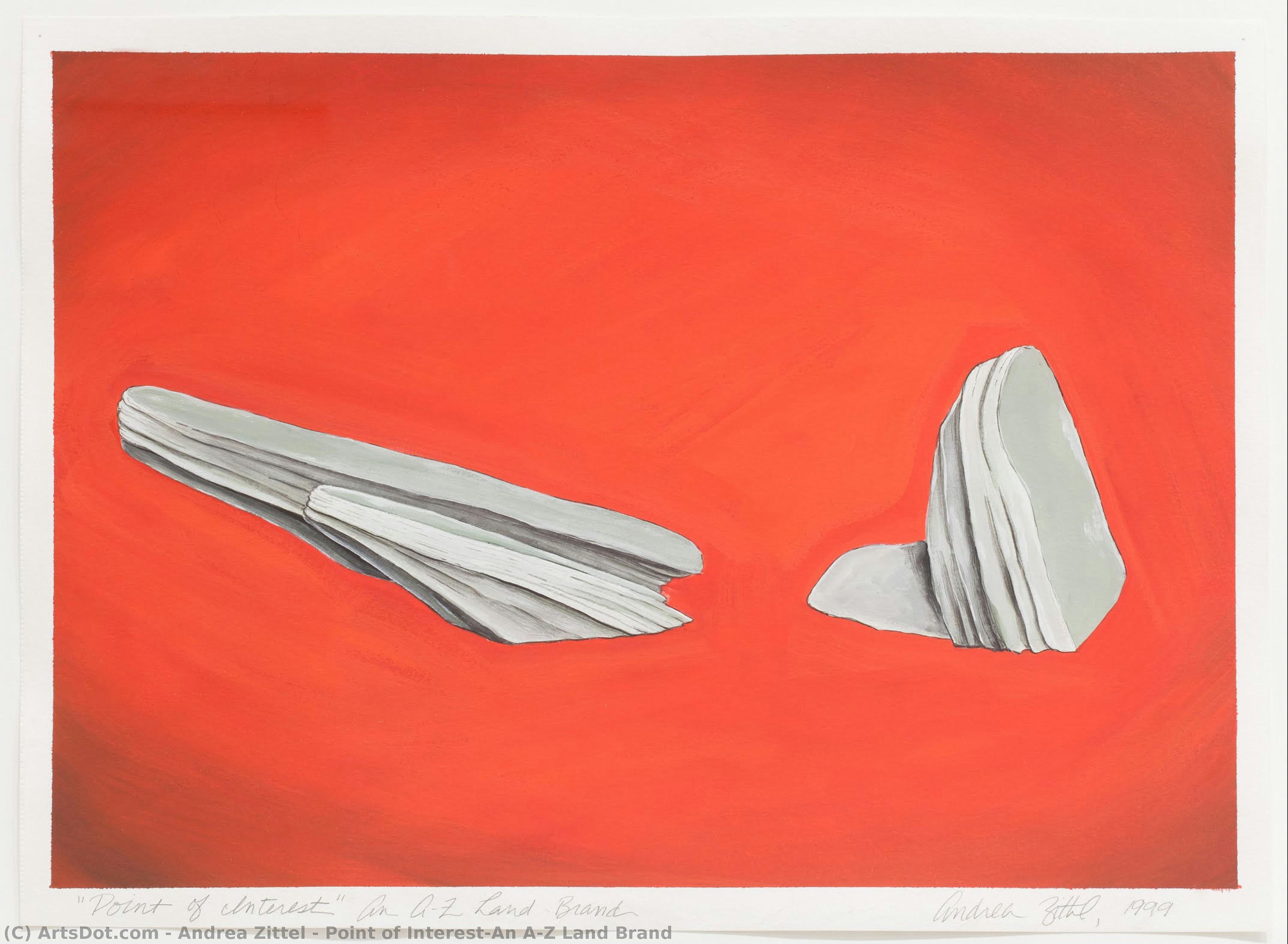
Point of Interest—An A-Z Land Brand
 Gouache
- WallArt
- Minimalist Sculpture
 1999
1999- Contemporary
 50.0 x 38.0 cm
 MOMA - Museum of Modern Art
 Read More
Purchase a high-resolution, enhanced digital image, far superior to the online preview.
Each file is meticulously prepared by our in-house specialists using advanced tools and expert manual retouching. We ensure every image has exceptional clarity, precise color accuracy, and fine detail.
The final file is delivered via email within 72 hours, optimized for immediate use in professional, editorial, and print environments. This is the same quality trusted by top-tier design studios, publishers, and galleries.
Digital Image
Download a high-resolution file for personal display, printing, and creative projects. ( Buy Print Buy Hand Made Painting)
Included in Every Digital Image Order
Expert Digital Delivery, Guaranteed
When you choose ArtsDot.com, you're not just getting an image - you're receiving a professionally enhanced digital artwork, crafted with precision and backed by a satisfaction guarantee. Here's everything that comes with your order, automatically:

Fast Email Delivery
Your high-resolution digital image file will be emailed to you within 72 hours of ordering - ready for immediate use.

AI-Enhanced Digital File
Your artwork is professionally optimized using advanced AI tools and manual editing, ensuring maximum detail, clarity, and color accuracy.

Free Lifetime Re-Delivery
Accidentally deleted or lost your file? No worries - we'll resend it to you anytime, free of charge.

No Import Fees - Ever
Enjoy your artwork instantly with zero customs, duties, or delivery fees - digital downloads are always tax-free.

Color Accuracy Guarantee
We ensure your digital image reflects the original colors as closely as possible using professional tools and color management.

60-Day Satisfaction Guarantee
If you're not satisfied with your digital image, we'll revise it or refund 100% within 60 days - no questions asked.

100% Money-Back Guarantee
Not satisfied? Get a full refund within 60 days of receiving your digital file - no questions asked.

Bulk Order Discounts
Buy 3 images, save 10% - Buy 5, save 15% - Buy 10+, save 20%. Great for creative projects, galleries, and agencies.
Collectible Description
Exploring Minimalism and Spatial Resonance: Andrea Zittel’s “Point of Interest—An A-Z Land Brand”
Andrea Zittel's "Point of Interest—An A-Z Land Brand," created in 1999, stands as a cornerstone of contemporary minimalist sculpture. More than just aesthetically pleasing rocks arranged on paper, it embodies Zittel’s profound investigation into how we inhabit space and what constitutes genuine experience – questions that continue to resonate with audiences today. The artwork's deceptively simple composition belies its complex conceptual framework, prompting viewers to contemplate the relationship between perception, materiality, and the very act of observation.A Singular Vision: Zittel’s Approach to Artistic Practice
Zittel distinguishes herself from conventional artistic traditions by prioritizing transformation—turning commonplace objects into immersive artworks that challenge established notions of gallery spaces. This ethos is powerfully exemplified in “wagon station,” her mobile living unit, which meticulously reimagines the boundaries between art, architecture, design and technology. Unlike many artists focused on grand gestures or elaborate narratives, Zittel seeks to subtly reshape daily life through carefully considered interventions, fostering a contemplative engagement with surroundings. Her work isn’t about proclaiming an idea; it's about prompting reflection—a deliberate rejection of didacticism in favor of experiential discovery.The Artwork: Gouache on Paper – A Study in Texture and Color
“Point of Interest” itself is executed in gouache on paper, a medium known for its opacity and ability to achieve rich, velvety hues. The artist employs two large rocks—one positioned on the left side of the canvas and another on the right—creating an asymmetrical arrangement that immediately draws attention. The red background serves as a striking counterpoint to the rocks’ muted tones, generating visual tension and enhancing the artwork's overall impact. Zittel’s meticulous layering technique ensures that each rock retains its textural qualities, capturing subtle variations in surface sheen and color – details that contribute significantly to the piece’s contemplative atmosphere.Historical Context: Minimalism and Conceptual Art
Zittel’s work aligns squarely with the broader movement of minimalism and conceptual art that emerged in the late 1960s and early 1970s. Rejecting representational imagery and focusing instead on fundamental geometric forms or concepts, artists like Donald Judd and Sol LeWitt sought to strip away superfluous ornamentation and explore the core principles of artistic expression. “Point of Interest” embodies this spirit by prioritizing materiality—the rocks themselves—over any explicit symbolic content. Instead, it invites viewers to consider the inherent qualities of the object and its relationship to its environment – a deliberate provocation against traditional aesthetic conventions.Symbolism Beyond Surface Appearance
While seemingly devoid of overt symbolism, “Point of Interest” operates on a deeper level, prompting contemplation about notions of presence and absence. The rocks’ positioning suggests an equilibrium between solidity and emptiness—a visual metaphor for Zittel's exploration of existential questions concerning the nature of being and experience. Furthermore, the red background can be interpreted as representing passion or urgency – contrasting elements that heighten the artwork’s emotional resonance. Ultimately, Zittel encourages viewers to engage in a dialogue with the piece itself, recognizing that art possesses the capacity to transcend literal interpretation and evoke profound psychological responses.A Legacy of Quiet Reflection
Andrea Zittel's “Point of Interest—An A-Z Land Brand” remains an enduring testament to minimalist sculpture’s ability to provoke thought and inspire contemplation. Its understated elegance and meticulous execution exemplify Zittel’s unwavering commitment to transforming everyday objects into immersive artworks – a legacy that continues to resonate with artists and collectors alike. The artwork's enduring appeal lies in its capacity to capture the essence of experience—a quiet invitation to consider our surroundings and grapple with fundamental questions about life itself.Related Artworks

Artist Biography
The Architecture of Existence: The Visionary World of Andrea Zittel
Andrea Zittel, born in Escondido, United States of America, in 1965, stands as a singular figure in contemporary art, recognized for her distinctive approach to artistic practice—a fusion of spatial exploration, sculptural experimentation, and a profound contemplation on the essence of existence. Her work delves into questions surrounding how we inhabit space and what imbues life with meaning, reflecting a core belief that art can fundamentally reshape our daily experiences. Rather than confining her creative output to the traditional confines of a canvas or a pedestal, Zittel has spent her career blurring the boundaries between fine art, functional design, and lived reality.
Zittel’s artistic journey began with an unwavering fascination for the intersection between art and everyday living. Reject and conventional notions of artistic creation, she prioritizes transforming utilitarian objects and environments into immersive artworks—a deliberate departure from traditional gallery settings. This ethos is powerfully embodied in her celebrated project “wagon station,” a mobile living unit meticulously designed to redefine the boundaries between architecture, design, and personal habitation. More than just a dwelling, it serves as a sculptural statement that interrogates our relationship with place and challenges us to reconsider conventional notions of comfort and convenience. Through works like the A-Z Escape Vehicle, she investigates how we inhabit space and imbues life with meaning, rejecting mass production in favor of experimental designs that challenge assumptions about individuality.
Minimalism, Materiality, and the Search for Meaning
Her artistic style is characterized by an uncompromising commitment to minimalism—a deliberate stripping away of extraneous elements to reveal the core materiality and form of her creations. This aesthetic aligns seamlessly with Zittel's exploration of sustainability and self-sufficiency, mirroring a broader cultural preoccupation with reconnecting with nature amidst urbanization. Her work often utilizes texture and form to evoke quiet contemplation; for instance, in pieces such as Lavender Corduroy Personal Panel, she presents minimalist fabric sculptures that reflect on the nuances of daily life and the human experience through a captivating study of tactile surfaces.
The influence of conceptual masters like Sol LeWitt and Agnes Martin is palpable in her work, particularly in her use of geometric abstraction to champion intellectual rigor and visual simplicity. Zittel’s ability to manipulate spatial perception is perhaps most striking in works such as Point of Interest—An A-Z Land Brand. In this gouache piece, the arrangement of large rocks against a bold red backdrop creates an illusion of floating, demonstrating her mastery over the psychological impact of composition and color. Her practice is not merely about looking at art, but about living within it, creating a dialogue between the viewer and the structural elements of their own environment.
Legacy and the Social Sculpture
Throughout her development, Zittel has expanded her reach through collaborations and large-scale installations that function as social sculptures. By engaging with themes of branding, land use, and personal autonomy, she creates a unique ecosystem where art becomes a tool for navigating the complexities of modern life. Her work continues to resonate within the contemporary landscape because it addresses the fundamental tension between our desire for stability and our need for mobility.
The historical significance of Andrea Zittel lies in her ability to transform the concept of the "art object" into an "artistic way of life." Her contributions can be summarized through several key pillars of her practice:
- Spatial Redefinition: The creation of mobile and modular living units that challenge traditional architectural norms.
- Conceptual Minimalism: A focus on the essential forms and materials that define our physical reality.
- Sustainable Living: An exploration of self-sufficiency and the reduction of unnecessary consumption through thoughtful design.
- Social Engagement: The use of art to interrogate social structures, mass production, and the way individuals claim their own space in the world.
As she continues to evolve her practice, Zittel remains a vital voice in the movement toward an integrated existence, where the distinction between the creator, the creation, and the inhabitant is beautifully and permanently dissolved.

andrea zittel
1965 - , United States of America
Quick Facts
- Artistic Movement Or Style: Minimalism
- Artists Or Movements Influenced By This Artist: ['Contemporary Art']
- Artists Who Influenced This Artist: ['Purvis Young']
- Date Of Birth: 1965
- Full Name: Andrea Zittel
- Nationality: American
- Notable Artworks:
- Sprawl I
- Lavender Corduroy Personal Panel
- Place Of Birth: Escondido, United States

