 Preview
 Send
Send Share
Share
 Details

 Download
 Similars
 X-Ray
X-Ray Diaporama
 Stats
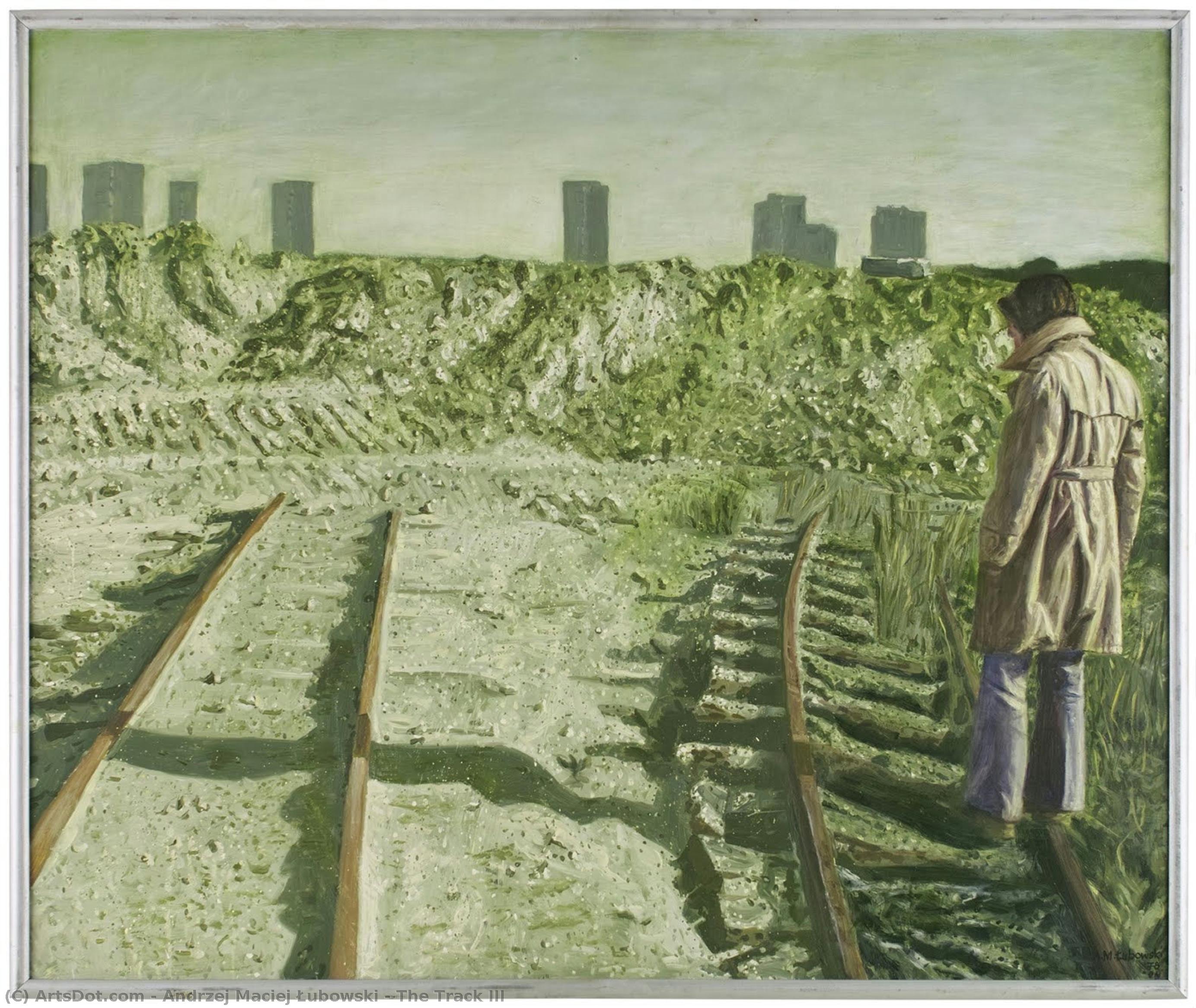
StatsThe Track III
 120.0 x 100.0 cm
 Centre of Contemporary Art Znaki Czasu
 Read More
Giclée / Art Print
Museum-quality giclée or canvas print with fast production and flexible finish options. ( Buy Hand Made Painting Switch to Digital Image)




































Pick from our preset sizes that match the artwork's original proportions.

You may enter your own dimensions to fit a specific frame or space. If your selected size does not match the original image's proportions, we will either crop the artwork or extend the image with a mirrored or solid-fill edge. A digital mockup will be sent for your approval before production begins.
Please note that the on-screen preview does not reflect the actual cropping or extension. Only the mockup will accurately show the final composition.
While custom sizes are available, we recommend selecting a dimension from the predefined list to preserve the original proportions.
Worldwide Delivery () in 2 weeks instead of standard 4/5 weeks. (8 September)

Free Worldwide Express Shipping

High-Quality Linen Canvas

Full Shipping Insurance

Customs Tax Refund Guarantee

True Color Matching Guarantee

100-Day Return Policy (Defects Only)

100% Money-Back Guarantee

Bulk Discount Offer
 Glass option is only available in size under 110 CM

The Track III
Giclée / Art Print
Reproduction Size
-


Total Price
$ 63
Related Artworks









Artist Biography
A Life Immersed in Polish Realism: Andrzej Maciej Łubowski
Andrzej Maciej Łubowski, born in Poznań, Poland, on October 6, 1946, stands as a significant figure within the landscape of contemporary Polish painting. His artistic journey began with formal training at the Academy of Fine Arts in Warsaw, where he earned his diploma in 1971 under the tutelage of Stefan Gierowski, also specializing in mural painting. This foundational education instilled not only technical skill but also a deep engagement with the traditions of representational art—a commitment that would define his career. Upon completing his studies, Łubowski returned to Poznań, becoming an active participant in the city’s vibrant artistic community and eventually establishing himself as a respected professor of fine arts. His dedication extends beyond his own practice; he served as director of the Galeria u Jezuitów from 2008 to 2012, further solidifying his role as an animator and advocate for art within Poland.Evolution of a Visual Language: From Symbolism to Panoramic Visions
Łubowski’s artistic development has been marked by a series of compelling thematic explorations. His early work in the 1980s leaned towards symbolic imagery, hinting at deeper societal and personal concerns. This phase transitioned into the 1990s with ambitious painting installations—large-scale works constructed from fragmented portraits, sliced vertically and combined with concrete blocks (his “Decompositions”). These pieces were not merely visual statements but explorations of identity, fragmentation, and the weight of history. However, it was in 1999 that Łubowski embarked on a particularly significant trajectory: the creation of ‘Broken Images’ and ‘Double Objects’. These works, initially featuring fractured faces, evolved into monumental “Panoramas” when paired with backgrounds depicting excavated earth—a powerful metaphor for uncovering hidden truths and confronting the complexities of the Polish landscape. The 2008 series, "Pressures," continued this exploration of layered meaning and psychological depth. Simultaneously, since 2007, Łubowski has pursued a parallel series focusing on figures positioned in light, set against windows or glass doors—introspective studies that delve into the human condition with remarkable sensitivity.Technique and Symbolism: A Realistic Approach
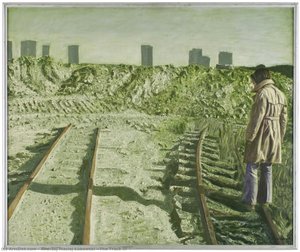
Łubowski’s art is fundamentally rooted in realism, yet it transcends mere imitation. He employs photography as a crucial starting point for his paintings, meticulously translating images onto canvas with exceptional skill. This photographic basis lends a striking clarity to his work, but it's the artist’s manipulation of light, shadow, and color that imbues his scenes with emotional resonance. The greys and muted tones often dominate his palette, creating an atmosphere of melancholy and contemplation. His landscapes are not idyllic vistas; they are frequently unsettling—disturbed by construction, marked by decay, or imbued with a sense of isolation. The recurring motif of railway tracks, as seen in works like “The Track III,” is particularly potent. These severed lines symbolize broken connections, lost paths, and the futility of progress. The lone figures within his compositions often appear introspective, confronting a bleak reality—a visual echo of Friedrich’s Romantic wanderers but grounded in the specific context of post-war Poland.Recognition and Legacy: A Member of the Artistic Community
Throughout his career, Andrzej Maciej Łubowski has received numerous accolades, including the Gloria Artis Medal for Meritorious Culture in 2010. He is an active member of the Związek Polskich Artystów Plastyków (ZPAP), the Polish Artists’ Union, and continues to exhibit extensively both within Poland and internationally. His works are held in public and private collections across the country, testament to his enduring impact on the art scene. Beyond his individual achievements, Łubowski's influence lies in his commitment to education—having served as a professor at various institutions including the Higher School of Social Skills in Poznań and the Warsaw Academy of Fine Arts, and currently at the Faculty of Architecture of the Poznan University of Technology—and his dedication to fostering artistic dialogue. He is not simply a painter but a vital force within Polish art, shaping generations of artists and prompting viewers to confront the complexities of their world with honesty and introspection.Historical Significance: Reflecting Poland’s Transformation
Łubowski's work offers a compelling visual chronicle of Poland’s transformation in the latter half of the 20th century and beyond. His paintings are not overtly political, but they subtly reflect the anxieties, disillusionments, and hopes of a nation grappling with its past and forging a new identity. The landscapes he depicts—often scarred by development or haunted by remnants of history—serve as metaphors for the broader societal changes taking place. His focus on the individual’s relationship to their environment speaks to universal themes of alienation and belonging, but it is his grounding in the specific context of Poland that gives his work its unique power. He captures a sense of *ducha czasu* – the spirit of the times—with a quiet intensity, making him an important voice in understanding the complexities of contemporary Polish culture and art.
andrzej maciej łubowski
1946 - , Poland
Quick Facts
- Artistic Movement Or Style: Realistic Painting
- Date Of Birth: October 6, 1946
- Full Name: Andrzej Maciej Łubowski
- Nationality: Polish
- Notable Artworks: ['The Track III']
- Place Of Birth: Poznań, Poland