

 Preview
 Send
Send Share
Share
 Details

 Download
 Similars
 X-Ray
X-Ray Diaporama
History and Fame


 Read More
Giclée / Art Print
Museum-quality giclée or canvas print with fast production and flexible finish options. ( Buy Hand Made Painting Buy Image)




































Pick from our preset sizes that match the artwork's original proportions.

You may enter your own dimensions to fit a specific frame or space. If your selected size does not match the original image's proportions, we will either crop the artwork or extend the image with a mirrored or solid-fill edge. A digital mockup will be sent for your approval before production begins.
Please note that the on-screen preview does not reflect the actual cropping or extension. Only the mockup will accurately show the final composition.
While custom sizes are available, we recommend selecting a dimension from the predefined list to preserve the original proportions.
Worldwide Delivery () in 2 weeks instead of standard 4/5 weeks. (25 August)

Free Worldwide Express Shipping

High-Quality Linen Canvas

Full Shipping Insurance

Customs Tax Refund Guarantee

True Color Matching Guarantee

60-Day Return Policy (Defects Only)

100% Money-Back Guarantee

Bulk Discount Offer
 Glass option is only available in size under 110 CM

History and Fame
Giclée / Art Print
Reproduction Size
-


Total Price
$ 63
Related Artworks



Artist Biography
A Sculptor Haunted by Beauty and Tragedy
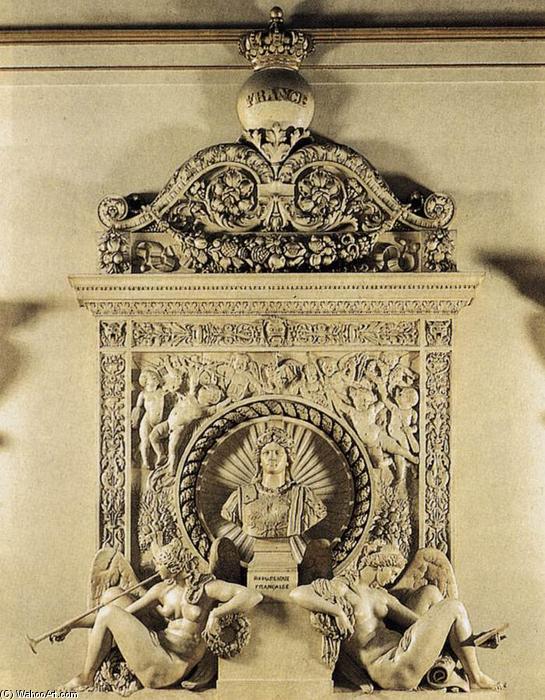
Antonin Marie Moine stands as a poignant figure in the Romantic landscape of French sculpture, a creator whose life and work were defined by a profound sensitivity to form and an underlying sense of melancholy. Born in Saint-Étienne in 1796, his artistic journey did not begin with the chisel, but rather with the brush. In his early years, Moine immersed himself in the tradition of landscape painting, a genre that allowed him to explore the delicate interplay of light and nature—a fascination deeply rooted in the Romantic era's obsession with the natural world. However, this initial pursuit eventually gave way to a more tactile medium. He found within sculpture a way to give permanent, physical weight to the ephemeral beauty he had once only captured in pigment, transitioning from the fleeting shadows of landscapes to the enduring presence of stone and bronze.
The foundation of Moine’s technical mastery was laid in Lyon, where he studied under the esteemed Pierre Révoil. Immersed in the stylistic principles of the École Lyonnaise de Beaux-Arts, Moine developed a meticulous attention to detail and a deep reverence for classical forms. This rigorous training instilled in him an ability to balance the emotional intensity characteristic of Romanticism with the disciplined grace of antiquity. His emergence on the Parisian stage was nothing short of spectacular; his debut at the Salon in 1833 captured the imagination of the art world, particularly through his portrait of Queen Mary. This work, celebrated for its masterful handling of drapery and its expressive realism, established him as a rising star capable of breathing life into cold materials.
Monumental Visions and the Place de la Concorde
Moine’s most enduring legacy is etched into the very fabric of Paris itself. Between 1835 and 1840, he participated in one of the most ambitious urban beautification projects of the nineteenth century: the embellishment of the Place de la Concorde. Working alongside talented contemporaries such as Louis-Parfait Merlieux and Jean-Jacques Elshecht, Moine contributed to the creation of the monumental fountains that still grace the square today. Under the architectural guidance of Jacques-Ignace Hittorff, Moine helped bring to life the Fontaine des Mers and the Fontana dei Quattro Fiumi.
It was within these grand, water-swept structures that Moine’s sculptural prowess truly shone. He is specifically remembered for his creation of the Néréides—the sea nymphs of classical mythology—which adorn the fountains. These figures were meticulously crafted to embody a sense of serene grace and fluid movement, mirroring the rhythmic ebb and flow of the water surrounding them. Through these sculptures, Moine achieved a rare synthesis of mythological grandeur and delicate human emotion, contributing to a public art program that sought to elevate the spirit of the city through classical beauty.
A Legacy Etched in Stone
Despite his professional triumphs and the monumental scale of his contributions to French public art, Moine’s personal narrative was marked by a profound tragedy. The same sensitivity that allowed him to capture the grace of the Néréides perhaps rendered him vulnerable to the weight of his own existence. His life came to a sudden and sorrowful end in Paris on March 18, 1849, when he took his own life. This tragic conclusion cast a somber shadow over his achievements, leaving behind a body of work that many view through a lens of bittersweet beauty.
Today, the historical significance of Antonin Marie Moine remains undiminished. His influence persists not only in the stone figures that continue to watch over the Place de la Concorde but also in the way he bridged the gap between the observational nature of landscape painting and the structural permanence of sculpture. His memory is honored in his birthplace, where a square bears his name, and his artistic spirit lives on through the collections of prestigious institutions, such as the musée national des châteaux de Versailles et de Trianon, which preserves a portrait of him from his early Salon success. Moine remains a quintessential Romantic artist: a man who sought to capture the eternal within the ephemeral.
Antonin Marie Moine
1796 - 1849 , France
Quick Facts
- Artistic Movement Or Style: Romantic Sculpture
- Artists Or Movements Influenced By This Artist: Anne-Louis Girodet
- Artists Who Influenced This Artist: Pierre Révoil
- Date Of Birth: June 30, 1796
- Full Name: Antonin Marie Moine
- Nationality: French
- Notable Artworks:
- Fontaine des Mers
- Néréides
- Place Of Birth: Saint-Étienne, France

