 Preview
 Send
Send Share
Share
 Details

 Download
 Similars
 X-Ray
X-Ray Diaporama
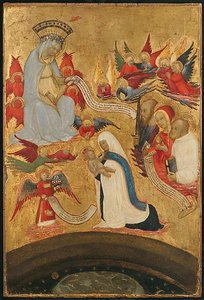
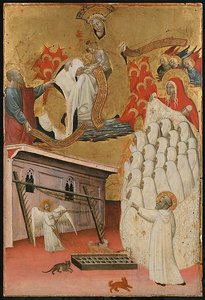
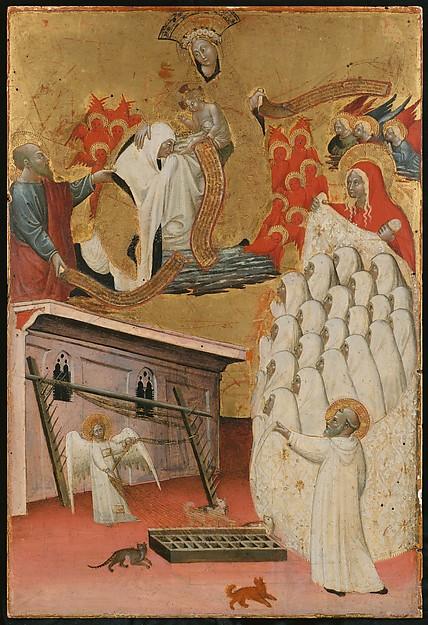
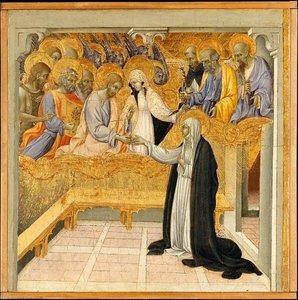
Santa Francesca Romana Clothed by the Virgin
 1445
1445 55.0 x 38.0 cm
 Read More
Hand Made Oil Reproduction
Hand-painted oil on canvas in your size and frame, made to order by our artists. ( Buy Print Buy Image)




































Pick from our preset sizes that match the artwork's original proportions.

You may enter your own dimensions to fit a specific frame or space. If your selected size does not match the original image's proportions, we will either crop the artwork or extend the painting with additional hand-painted elements. A digital mockup will be sent for your approval before production begins.
Please note that the on-screen preview does not reflect the actual cropping or extension. Only the mockup will accurately show the final composition.
While custom sizes are available, we recommend selecting a dimension from the predefined list to preserve the original proportions.
After order, ArtsDot.com team will email client for instructions and provide a mockup preview
Worldwide Delivery () in 3/4 weeks instead of standard 5 weeks. (27 August). No compromise on quality.

Free Worldwide Express Shipping

High-Quality Linen Canvas

Full Shipping Insurance

Customs Tax Refund Guarantee

True Color Matching Guarantee

60-Day Return Policy (Defects Only)

100% Money-Back Guarantee

Bulk Discount Offer
 Glass option is only available in size under 110 CM

Santa Francesca Romana Clothed by the Virgin
Reproduction Medium
Reproduction Size
-


Total Price
$ 263
Related Artworks







Artist Biography
Antonio del Massaro da Viterbo: A Master of Roman and Lazio Frescoes
Antonio del Massaro, often referred to as Antonio da Viterbo or “Il Pastura,” stands as a pivotal figure in the late 15th-century Italian art scene. Born around 1450 in Viterbo and tragically passing away in 1516, his career spanned across Rome, Orvieto, and ultimately solidified his reputation within his native Lazio region. Despite a somewhat obscured biography – largely absent from Vasari’s influential *Lives of the Artists* – del Massaro's work reveals a unique artistic voice blending late Gothic influences with emerging Renaissance sensibilities, making him a significant bridge between these two stylistic periods. His legacy is particularly celebrated for his masterful frescoes, imbued with religious fervor and intricate detail, which continue to captivate viewers today.Early Life and Artistic Beginnings in Rome
The earliest documented appearance of del Massaro’s name emerges in December 1478, when he participated in the establishment of the “Foundation of Art and University of San Luca dei Pittori” in Rome. This event suggests an early period spent in the Roman artistic milieu, a city brimming with patronage and innovation during this era. While specific details regarding his time in Rome remain somewhat elusive – historical records are sparse – it’s believed he honed his skills assisting renowned masters like Pinturicchio. His involvement in decorating the Borgia Apartment within the Vatican Palace is particularly noteworthy, offering invaluable insight into his developing style and technical proficiency. These early commissions exposed him to the grandeur of papal patronage and provided a crucial foundation for his future endeavors. The influence of Pinturicchio’s delicate color palettes and meticulous detailing is readily apparent in del Massaro's subsequent work.Return to Viterbo and Regional Influence
Returning to his birthplace, Viterbo, around 1504, del Massaro quickly established himself as the most prominent painter of the region. He embraced a distinctly local style, deeply rooted in the traditions of Lazio while simultaneously incorporating Renaissance advancements. A prime example of this is the *Presepio con i Santi Giovanni Battista e Bartolomeo* (Nativity Scene with Saints John the Baptist and Bartholomew), now housed in the Museo Civico di Viterbo. This work showcases his ability to depict religious figures with a palpable sense of emotion and narrative depth, reflecting the prevalent devotional practices of the time. Further solidifying this regional influence was his involvement in restoring frescoes originally painted by Ugolino di Prete Ilario for the Orvieto Cathedral – a project that allowed him to build upon the foundations laid by Pinturicchio and contribute to the cathedral’s evolving artistic program.Key Works and Artistic Style
Del Massaro's oeuvre is characterized by a remarkable versatility, encompassing tempera panels, frescoes, and decorative elements. His work frequently features biblical scenes rendered with a captivating blend of realism and symbolic representation. The *Annunciation*, *Visitation*, *Presentation to the Temple*, and *Flight into Egypt* – all found within the magnificent cathedral of Orvieto – exemplify his skill in portraying complex narratives with grace and precision. His fresco cycle for the chancel of the Tarquinia Cathedral, commissioned by the Vitelleschi family, demonstrates a sophisticated understanding of perspective and spatial arrangement. Notably, his work often exhibits elongated figures and hands, a stylistic quirk that has been interpreted as potentially influenced by Flemish art, though this remains a subject of scholarly debate. The *San Terenziano, San Rocco e San Sebastiano* (Saint Terence, Saint Roch, and Saint Sebastian), conserved in the church of Santa Maria a Capranica, reveals his ability to imbue saints with a sense of human vulnerability and spiritual intensity.Legacy and Historical Significance
Following the death of Lorenzo da Viterbo, del Massaro became the most celebrated painter of Viterbo, leaving an indelible mark on the region’s artistic landscape. His contributions to the decoration of the Chigi Palace aedicule – featuring a Madonna and Child – further cemented his reputation as a master craftsman. Despite being overlooked by Vasari, del Massaro's work gained renewed recognition in the 19th century, with scholars like E. Steinmann recognizing his importance within the broader context of Italian Renaissance art. Today, his frescoes continue to be studied for their technical brilliance and emotional resonance, offering valuable insights into the artistic currents of late 15th-century Italy and solidifying his place as a significant, though often underappreciated, master of the era. His work serves as a testament to the vibrant artistic scene flourishing in the Lazio region during this transformative period.
antonio del massaro da viterbo
1450 - 1516
Quick Facts
- Artistic Movement Or Style: Late Gothic, Lazio School
- Artists Or Movements Influenced By This Artist:
- Antoniazzo Romano
- None specified
- Artists Who Influenced This Artist:
- Luca Signorelli
- Perugino
- Pinturicchio
- Date Of Birth: c. 1450
- Date Of Death: 1516
- Full Name: Antonio del Massaro da Viterbo
- Nationality: Italian
- Notable Artworks:
- Presepio con i Santi Giovanni Battista e Bartolomeo
- San Terenziano, San Rocco e San Sebastiano
- Santi Giovanni Battista, Girolamo e Lorenzo
- Place Of Birth: Viterbo, Italy