

 Preview
 Send
Send Share
Share
 Details

 Download
 Similars
 X-Ray
X-Ray Diaporama
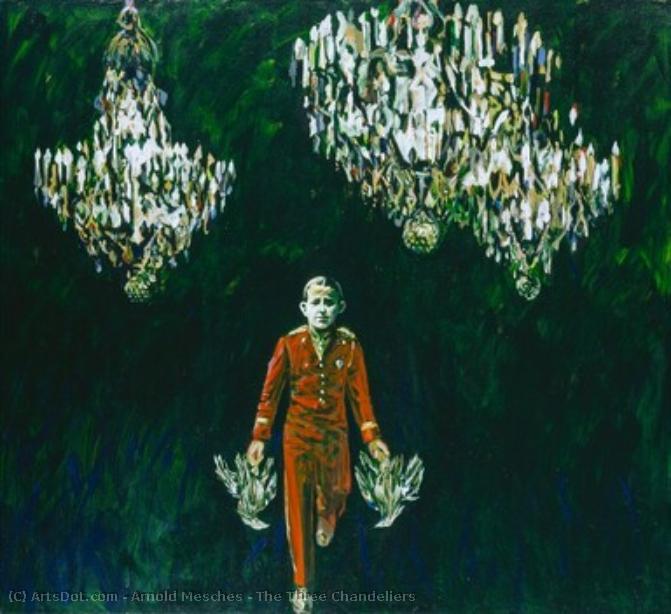
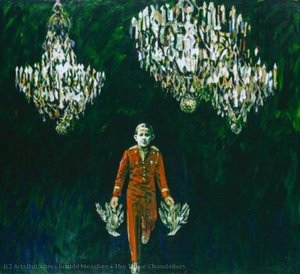
The Three Chandeliers
 1987
1987 203.0 x 224.0 cm
 Read More
Hand Made Oil Reproduction
Hand-painted oil on canvas in your size and frame, made to order by our artists. ( Buy Print Buy Image)




































Pick from our preset sizes that match the artwork's original proportions.

You may enter your own dimensions to fit a specific frame or space. If your selected size does not match the original image's proportions, we will either crop the artwork or extend the painting with additional hand-painted elements. A digital mockup will be sent for your approval before production begins.
Please note that the on-screen preview does not reflect the actual cropping or extension. Only the mockup will accurately show the final composition.
While custom sizes are available, we recommend selecting a dimension from the predefined list to preserve the original proportions.
After order, ArtsDot.com team will email client for instructions and provide a mockup preview
Worldwide Delivery () in 3/4 weeks instead of standard 5 weeks. (7 September). No compromise on quality.

Free Worldwide Express Shipping

High-Quality Linen Canvas

Full Shipping Insurance

Customs Tax Refund Guarantee

True Color Matching Guarantee

100-Day Return Policy (Defects Only)

100% Money-Back Guarantee

Bulk Discount Offer
 Glass option is only available in size under 110 CM

The Three Chandeliers
Reproduction Medium
Reproduction Size
-


Total Price
$ 263
Related Artworks






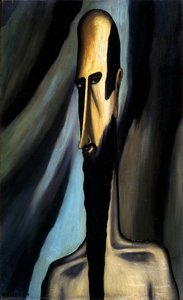
Artist Biography
The Archival Soul: The Life and Vision of Arnold Mesches
Born in the Bronx in 1923, Arnold Mesches emerged as a singular force in American visual art, weaving the threads of personal surveillance into the very fabric of his creative output. His journey, which took him from the formative years in Buffalo to the vibrant artistic landscape of Los Angeles in 1943, was marked by an early encounter with the heavy hand of institutional scrutiny. As a student at the Art Center School on scholarship, Mesches was navigating a world of burgeoning modernism when, in 1945, the FBI initiated a file on him, labeling him a subversive element. This intrusion of the state into his private existence did not merely shadow his life; it became the primary medium through which he communicated with the world.
The essence of Mesches’s artistry lies in his ability to transform the cold, clinical nature of bureaucracy into something deeply visceral and hauntingly beautiful. He mastered a technique of dense, layered collage that functioned as a form of visual archaeology. By meticulously assembling photocopies of government documents, news clippings from the era, magazine cutouts, and even his own handwritten scripts, he created works that felt like living, breathing historical artifacts. His compositions were not merely pictures but complex stratigraphies of memory and political tension, where the ink of an FBI report might bleed into the vibrant colors of a 1950s advertisement.
Shadows of the Cold War and Artistic Lineage
The atmosphere of the McCarthy era provided the psychological backdrop for Mesches’s most profound explorations. During this period of intense paranoia and ideological conflict, his work became a provocative interrogation of power and surveillance. He drew significant inspiration from the raw emotionality of Expressionism and the dreamlike, fragmented logic of Surrealism. The influence of masters such as Ernst Kädle and Franz Kline is palpable in his commitment to exploring psychological depths and confronting societal realities through symbolic, often jarring, imagery.
His most celebrated achievement, the monumental The FBI Files project, stands as a testament to his resilience. Spanning decades, this ambitious undertaking saw him reconstructing his own history through the very documents intended to suppress it. In these works, the tension between the individual and the state is palpable; the paper itself carries the weight of the surveillance it records. Through this process, Mesches turned the tools of political repression into instruments of artistic liberation, ensuring that the voices silenced by bureaucracy could find a permanent, textured resonance in the halls of art history.
Legacy and Enduring Impact
Beyond his personal struggles, Mesches’s career was defined by an unwavering dedication to teaching and a prolific exhibition record that spanned over 125 solo shows. His later years, spent teaching at prestigious institutions such as New York University, Rutgers, and the University of Florida, allowed him to pass on his rigorous observational approach to new generations. His life, much like his art, was a complex tapestry of personal intimacy and public engagement, famously intertwined with the life of the novelist Jill Ciment.
The historical significance of Arnold Mesches resides in his ability to bridge the gap between personal biography and global history. His work remains a vital touchstone for understanding the anxieties of the mid-century American experience. Today, his pieces are held in some of the world's most esteemed collections, including:
- The Metropolitan Museum of Art
- The Museum of Modern Art (MoMA)
- The Los Angeles County Museum of Art (LACMA)
- The Brooklyn Museum
- The Museum of Modern Art, Sydney
Through his layered collages, Mesches ensured that the fragments of a fractured era—the news, the files, and the photographs—would never be lost to time, but would instead remain eternally suspended in a state of profound, artistic reflection.
Arnold Mesches
1923 - 2016 , United States of America
Quick Facts
- Artistic Movement Or Style: Expressionist Collage
- Artists Or Movements Influenced By This Artist: ['Cold War Art']
- Artists Who Influenced This Artist: ['Joseph McCarthy']
- Date Of Birth: August 11, 1923
- Date Of Death: November 5, 2016
- Full Name: Arnold Mesches
- Nationality: American
- Notable Artworks: ['The Three Chandeliers']
- Place Of Birth: The Bronx, United States of America