 Preview
 Send
Send Share
Share
 Details

 Download
 Similars
 X-Ray
X-Ray Diaporama
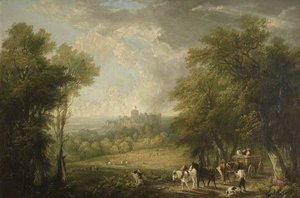
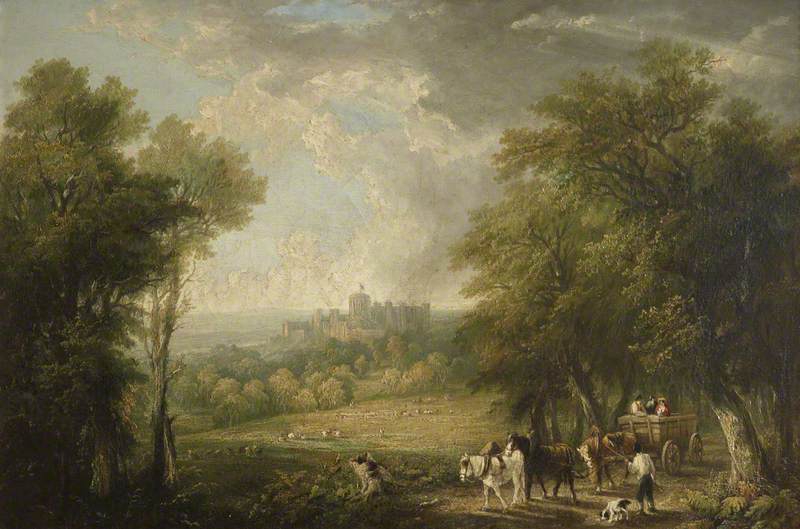
View of Windsor from the Forest with Travellers in a Horse Drawn Cart
 1850
1850 39.0 x 60.0 cm
 National Trust
 Read More
Hand Made Oil Reproduction
Hand-painted oil on canvas in your size and frame, made to order by our artists. ( Buy Print Buy Image)




































Pick from our preset sizes that match the artwork's original proportions.

You may enter your own dimensions to fit a specific frame or space. If your selected size does not match the original image's proportions, we will either crop the artwork or extend the painting with additional hand-painted elements. A digital mockup will be sent for your approval before production begins.
Please note that the on-screen preview does not reflect the actual cropping or extension. Only the mockup will accurately show the final composition.
While custom sizes are available, we recommend selecting a dimension from the predefined list to preserve the original proportions.
After order, ArtsDot.com team will email client for instructions and provide a mockup preview
Worldwide Delivery () in 3/4 weeks instead of standard 5 weeks. (26 August). No compromise on quality.

Free Worldwide Express Shipping

High-Quality Linen Canvas

Full Shipping Insurance

Customs Tax Refund Guarantee

True Color Matching Guarantee

60-Day Return Policy (Defects Only)

100% Money-Back Guarantee

Bulk Discount Offer
 Glass option is only available in size under 110 CM

View of Windsor from the Forest with Travellers in a Horse Drawn Cart
Reproduction Medium
Reproduction Size
-


Total Price
$ 263
Related Artworks









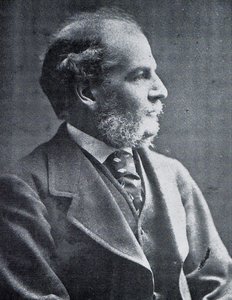
Artist Biography
The Legacy of Arthur James Stark: A Master of Animal and Landscape
Born into a world steeped in artistic tradition, Arthur James Stark emerged as a distinctive voice within the celebrated Norwich School of painters. The son of the renowned landscape artist James Stark, his very beginnings in Beaufort Row, Chelsea, were marked by an early immersion in the nuances of light and form. From his earliest years, his father served not only as a parent but as a primary mentor, fostering an artistic aptitude that would eventually allow him to stand alongside the greats of his era. This intimate connection to his lineage provided a foundation of technical rigor, yet it also set the stage for a career defined by a delicate balance between inherited tradition and personal innovation.
The formative years of Stark’s life were spent wandering through the picturesque landscapes that would later become his most cherished subjects. During his youth in Windsor, he sought specialized instruction under Edmund Bristow, an intimate family friend, focusing specifically on the complexities of animal painting. This period was transformative; it instilled in him a profound affection for the Thames Valley, a region whose rolling hills and tranquil waters provided the soul of his later compositions. His early training allowed him to capture the vitality of living creatures with a precision that earned him respect within the prestigious halls of the Royal Academy and the British Institution as early as 1848.
Evolution of Style and Subject Matter
As his career progressed, Stark’s work underwent a fascinating metamorphosis. While his initial approach mirrored the minute, meticulous touch characteristic of his father’s influence, he gradually moved toward a more liberated and individualistic style. He became a master of capturing the quiet, rhythmic beauty of English rural life. His canvases often breathed with the warmth of homely scenes—the industrious energy of haymaking, the seasonal toil of harvesting, and the peaceful chaos of the farmyard. Through his eyes, the mundane aspects of country living were elevated to subjects of profound dignity and charm.
Beyond the pastoral, Stark’s prowess in animal painting remained a cornerstone of his identity. He famously honed his skills by painting within the stables of local carriers and at the legendary Tattersall's, where he perfected the anatomy and movement of horses. This dedication to realism was so pronounced that in 1874, he famously declined a prestigious appointment as an animal painter to Queen Victoria, fearing such a formal role might stifle his creative evolution. His ability to blend the rugged reality of animals with the soft, atmospheric landscapes of Surrey, Norfolk, and the Thames Valley created a unique aesthetic tension that was entirely his own.
A Life Dedicated to the Canvas
The later years of Stark’s life were characterized by a serene devotion to his craft. After years of teaching art in London, he retired to Nutfield, Surrey, in 1886, a move that allowed him to dedicate himself exclusively to painting. This period of seclusion and focus allowed for a deepening of his artistic expression, far removed from the pressures of the metropolitan art scene. He continued to work with unwavering passion until only days before his passing in October 1902.
The historical significance of Arthur James Stark lies in his role as one of the final luminaries of the Norwich School. While he carried the torch of his father's legacy, he refused to be a mere shadow, instead injecting a sense of modern abandon and individual spirit into the tradition. His contributions to British art remain a testament to the enduring beauty of the English landscape and the soulful depiction of the natural world:
- Technical Mastery: A seamless transition from the fine, detailed strokes of his youth to a more expressive, fluid technique in maturity.
- Thematic Depth: An unparalleled ability to find majesty in the everyday, from the movement of a horse to the stillness of a water mill.
- Regional Connection: His profound documentation of the Thames Valley and Surrey landscapes, preserving a vanished era of English pastoral life.
Quick Facts
- Artistic Movement Or Style: World Goes Pop
- Artists Or Movements Influenced By This Artist: ['Influences include various pop art figures']
- Artists Who Influenced This Artist: ['Influenced by diverse artists within the World Goes Pop movement']
- Date Of Death: Living
- Notable Artworks: ['Various works featured in The World Goes Pop exhibition']
- Place Of Birth: WahooArt