Preview
 Send
Send Share
Share
 Details

 Download
 Similars
 X-Ray
X-Ray Diaporama
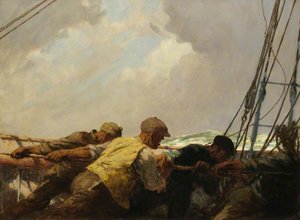
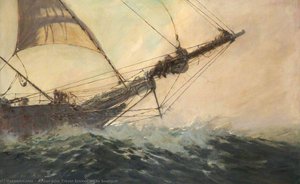
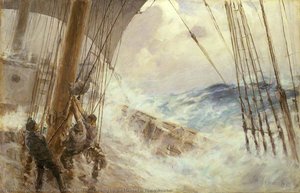
Clewing Up the Mainsail in Heavy Weather
 1925
1925 66.0 x 102.0 cm
 Read More
Giclée / Art Print
Museum-quality giclée or canvas print with fast production and flexible finish options. ( Buy Hand Made Painting Buy Image)




































Pick from our preset sizes that match the artwork's original proportions.

You may enter your own dimensions to fit a specific frame or space. If your selected size does not match the original image's proportions, we will either crop the artwork or extend the image with a mirrored or solid-fill edge. A digital mockup will be sent for your approval before production begins.
Please note that the on-screen preview does not reflect the actual cropping or extension. Only the mockup will accurately show the final composition.
While custom sizes are available, we recommend selecting a dimension from the predefined list to preserve the original proportions.
Worldwide Delivery () in 2 weeks instead of standard 4/5 weeks. (28 August)

Free Worldwide Express Shipping

High-Quality Linen Canvas

Full Shipping Insurance

Customs Tax Refund Guarantee

True Color Matching Guarantee

60-Day Return Policy (Defects Only)

100% Money-Back Guarantee

Bulk Discount Offer
 Glass option is only available in size under 110 CM

Clewing Up the Mainsail in Heavy Weather
Giclée / Art Print
Reproduction Size
-


Total Price
$ 63
Related Artworks









Artist Biography
Early Life and Artistic Foundations
Arthur John Trevor Briscoe, born in Chester in 1873, emerged from a background that initially seemed distant from the world of art. His father, John Briscoe, was a cotton broker, a life steeped in commerce rather than canvas and paint. However, the seeds of artistic inclination were sown early, nurtured by a family move to Plas Newydd in Denbighshire during his adolescence. It was here that young Arthur began formal studies at the prestigious Slade School of Fine Art in London, laying the groundwork for a career dedicated to capturing the beauty and drama of maritime life. The Slade, under the tutelage of figures like Henry Tonks and Frederick Brown, instilled in him a rigorous approach to observation and technique, but Briscoe’s artistic journey didn't end there; he further honed his skills at the Académie Julian in Paris, immersing himself in the vibrant atmosphere of the European art scene. This period was crucial, exposing him to diverse styles and approaches that would later inform his unique aesthetic vision.A Life Dedicated to the Sea
Briscoe’s artistic focus quickly crystallized around marine painting, specifically sailing ships and coastal scenes. He wasn't merely depicting vessels; he sought to convey the very essence of life at sea – the interplay of light on water, the power of the elements, and the human connection to the ocean. His early exhibitions in 1906 at the Modern Gallery on Bond Street marked a significant step, showcasing thirty-five watercolors that immediately garnered attention for their delicate precision and atmospheric quality. He became a regular exhibitor at prominent venues like the Glasgow Institute of the Fine Arts, the Royal Academy, and the Royal Society of British Artists, steadily building a reputation as a skilled and sensitive interpreter of maritime subjects. A pivotal moment in his career came in 1922 when he was invited to join the crew of a Polish sail-training ship on its voyage from Rotherhithe to Genoa. This wasn’t simply a journey for artistic inspiration; it was an immersive experience that allowed him to intimately understand the rhythms and realities of seafaring life. He meticulously sketched every aspect of the voyage, later transforming these observations into evocative etchings – a medium he mastered with remarkable finesse.Style and Influences
Briscoe’s style is often described as a compelling blend of accuracy and impressionism. While his paintings demonstrate a keen attention to detail—the rigging of ships, the architecture of coastal towns—they are never overly precise or academic. Instead, he employed a loose brushstroke and a sensitive use of color to capture the fleeting effects of light and atmosphere. He wasn’t striving for photographic realism but rather an emotional resonance with the subject matter. The influence of J.M.W. Turner is subtly present in his handling of light and weather, while echoes of Whistler can be seen in his tonal harmonies and emphasis on mood. However, Briscoe developed a distinctly personal voice, characterized by a quiet lyricism and a deep respect for the natural world. His etchings, in particular, showcase his mastery of line and texture, creating images that are both visually striking and emotionally evocative. He possessed an exceptional ability to translate the complexities of maritime scenes into elegant and accessible compositions.Legacy and Historical Significance
Arthur John Trevor Briscoe’s work offers a valuable glimpse into a bygone era of sailing and seafaring. His paintings and etchings are not simply historical documents; they are poetic interpretations that capture the romance, adventure, and inherent challenges of life at sea. He documented a world rapidly changing with the advent of steam power, preserving the beauty of traditional sailing vessels for posterity. Today, his works are held in prestigious collections such as the National Gallery of Art in Washington D.C., the Cleveland Museum of Art, and the National Maritime Museum in Greenwich, testament to their enduring artistic merit and historical significance.- His paintings provide a visual record of sailing ships.
- He captured the essence of maritime life with sensitivity.
- Briscoe’s etchings are celebrated for their technical skill.

Quick Facts
- Artistic Movement Or Style: Marine painting, Impressionism
- Artists Who Influenced This Artist:
- Henry Tonks
- Frederick Brown
- Date Of Birth: 1873
- Date Of Death: 1943
- Full Name: Arthur John Trevor Briscoe
- Nationality: British
- Place Of Birth: Chester, England