 Preview
 Send
Send Share
Share
 Details

 Download
 Similars
 X-Ray
X-Ray Diaporama
 Stats
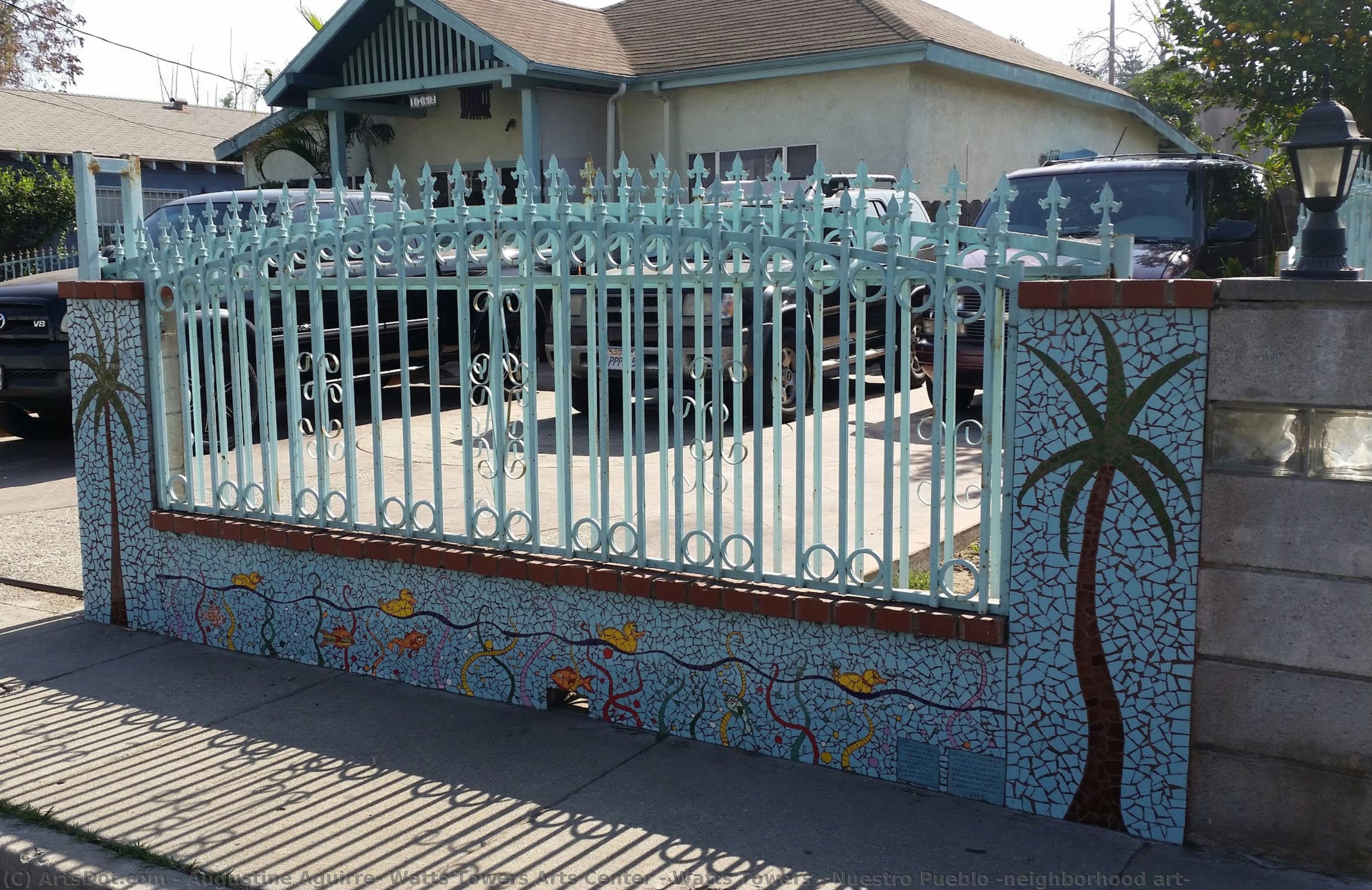
StatsWatts Towers / Nuestro Pueblo (neighborhood art)


 Read More
Giclée / Art Print
Museum-quality giclée or canvas print with fast production and flexible finish options. ( Buy Hand Made Painting Switch to Digital Image)




































Pick from our preset sizes that match the artwork's original proportions.

You may enter your own dimensions to fit a specific frame or space. If your selected size does not match the original image's proportions, we will either crop the artwork or extend the image with a mirrored or solid-fill edge. A digital mockup will be sent for your approval before production begins.
Please note that the on-screen preview does not reflect the actual cropping or extension. Only the mockup will accurately show the final composition.
While custom sizes are available, we recommend selecting a dimension from the predefined list to preserve the original proportions.
Worldwide Delivery () in 2 weeks instead of standard 4/5 weeks. (8 September)

Free Worldwide Express Shipping

High-Quality Linen Canvas

Full Shipping Insurance

Customs Tax Refund Guarantee

True Color Matching Guarantee

100-Day Return Policy (Defects Only)

100% Money-Back Guarantee

Bulk Discount Offer
 Glass option is only available in size under 110 CM

Watts Towers / Nuestro Pueblo (neighborhood art)
Giclée / Art Print
Reproduction Size
-


Total Price
$ 63
Related Artworks








Artist Biography
Robert Delaunay: A Pioneer of Color and Rhythm
Robert Delaunay, born Robert-Victor-Felix Delaunay in Paris on April 12, 1885, stands as a pivotal figure in the evolution of modern art. His journey from theatrical design to groundbreaking abstraction reflects a relentless pursuit of capturing the essence of light, movement, and emotion through color and geometric form. Initially apprenticed to a theatrical designer, Delaunay’s artistic inclinations soon led him to painting, profoundly influenced by the burgeoning movements of Neo-Impressionism and Cubism. This early exposure laid the groundwork for his distinctive style – one characterized by vibrant hues, dynamic rhythms, and an exploration of spatial relationships that would ultimately define his legacy as a founder of Orphism.Early Influences and the Rise of Orphism
Delaunay’s artistic development was inextricably linked to his marriage to Sonia Terk in 1910, who became not only his wife but also his crucial collaborator and fellow artist. Together, they embarked on a radical exploration of color theory, moving beyond the muted palettes of traditional painting. Inspired by Paul Signac's Neo-Impressionism, which emphasized the scientific study of light and color, Delaunay and Sonia developed their own unique approach – Orphism. This movement sought to liberate color from its representational function, using it instead as an independent expressive element. They employed a technique of “simultaneous contrast,” applying pure, unmixed colors side-by-side to create optical effects that intensified the perception of each hue. Their canvases became pulsating fields of vibrant reds, yellows, blues, and greens, arranged in dynamic rhythms reminiscent of musical scores – hence the name "Orphism," referencing the Greek god of music and art.Key Works and Artistic Evolution
Delaunay’s artistic output spanned several decades, evolving alongside his theoretical explorations. Early works like “Saint-Séverin” (1914-15) demonstrate a careful balance between architectural representation and the burgeoning abstraction of color fields. Later, he moved towards increasingly abstract compositions, particularly during the 1930s, creating monumental panels and reliefs that utilized circular discs and rhythmic patterns. These works, often executed with assistants, were intended to evoke a sense of movement and energy, reflecting Delaunay’s fascination with both visual and auditory experiences. Notable pieces from this period include “Endless Rhythm” (1932) and the large-scale panels for the Aeronautics pavilion at the 1937 Paris International Exhibition, which showcased his mastery of color and spatial arrangement. His work during World War II saw him exploring themes of light and spirituality, often incorporating religious imagery within his abstract compositions.Connections to Cubism and Beyond
While Delaunay’s Orphism is often considered a distinct movement, it shares significant connections with Cubism. Like the Cubists, he deconstructed forms into geometric shapes and explored multiple perspectives simultaneously. However, unlike the Cubists' focus on representing objects realistically through fragmented forms, Delaunay prioritized color and rhythm as primary expressive elements. His work also influenced other artists, including Piet Mondrian, who adopted a more austere approach to abstraction based on Delaunay’s principles of pure color and geometric harmony. Furthermore, his exploration of light and its effects resonated with the principles of Simultanism, championed by František Kupka, another key figure in early 20th-century abstract art.Legacy and Historical Significance
Robert Delaunay’s contribution to modern art is undeniable. He not only developed a groundbreaking visual language based on color and rhythm but also challenged conventional notions of representation and artistic expression. His work paved the way for later developments in Abstract Expressionism and Color Field painting, demonstrating the power of color as an independent artistic force. His legacy extends beyond his paintings; he was a passionate theorist who actively promoted his ideas through writings and lectures, shaping the discourse around abstract art. Today, Delaunay’s works are held in major museums worldwide, including the Tate Gallery in London and the Musée d'Art Moderne de la Ville de Paris, solidifying his place as one of the most important figures in the history of 20th-century art. He died in Montpellier on October 25, 1941, leaving behind a vibrant and influential body of work that continues to inspire artists and viewers alike.
augustine aguirre, watts towers arts center
1941 - , United States of America
Quick Facts
- Artistic Movement Or Style:
- Divisionism
- Cubism
- Orphic Cubism
- Simultanism
- Artists Or Movements Influenced By This Artist:
- Klee
- Marc
- Apolinaire
- Artists Who Influenced This Artist:
- Neo-Impressionism
- Cézanne
- Date Of Birth: 1885-04-12
- Date Of Death: 1941-10-25
- Full Name: Robert Delaunay
- Nationality: French
- Notable Artworks:
- Endless Rhythm
- The Eiffel Tower
- City
- Place Of Birth: Paris, France