 Preview
 Send
Send Share
Share
 Details

 Download
 Similars
 X-Ray
X-Ray Diaporama
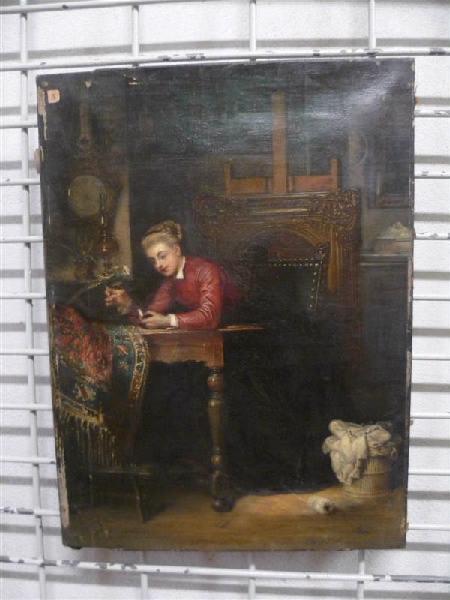
Jeune femme agaçant une perruche
 Read More
Hand Made Oil Reproduction
Hand-painted oil on canvas in your size and frame, made to order by our artists. ( Buy Print Buy Image)




































Pick from our preset sizes that match the artwork's original proportions.

You may enter your own dimensions to fit a specific frame or space. If your selected size does not match the original image's proportions, we will either crop the artwork or extend the painting with additional hand-painted elements. A digital mockup will be sent for your approval before production begins.
Please note that the on-screen preview does not reflect the actual cropping or extension. Only the mockup will accurately show the final composition.
While custom sizes are available, we recommend selecting a dimension from the predefined list to preserve the original proportions.
After order, ArtsDot.com team will email client for instructions and provide a mockup preview
Worldwide Delivery () in 3/4 weeks instead of standard 5 weeks. (1 September). No compromise on quality.

Free Worldwide Express Shipping

High-Quality Linen Canvas

Full Shipping Insurance

Customs Tax Refund Guarantee

True Color Matching Guarantee

60-Day Return Policy (Defects Only)

100% Money-Back Guarantee

Bulk Discount Offer
 Glass option is only available in size under 110 CM

Jeune femme agaçant une perruche
Reproduction Medium
Reproduction Size
-


Total Price
$ 263
Related Artworks







Artist Biography
A Visionary of Light and Legend: The Life of Aze Valère Adolphe Louis
In the vibrant tapestry of nineteenth-century French art, few threads are as intricately woven as those left by Aze Valère Adolphe Louis. Born in Paris on March 4, 1823, Louis emerged from a world where the rigid structures of academic tradition were beginning to tremble under the weight of new, sensory-driven movements. His early years were shaped by the rigorous mentorship of the esteemed history painter Joseph-Nicolas Robert-Fleury, an influence that instilled in him a profound respect for narrative depth and compositional precision. Yet, while his training anchored him in the grand traditions of historical storytelling, his soul possessed an unquenchable thirst for the ephemeral—the way light dances across a desert dune or how twilight softens the edges of a Parisian landscape.
As his artistry matured, Louis began to transcend the boundaries of his classical education, moving toward a style that bridged the gap between Romantic idealism and the burgeoning luminosity of Impressionism. He did not merely paint subjects; he captured atmospheres. This evolution was most profoundly realized through his deep fascination with the Orient. His travels in 1859 served as a transformative catalyst, leading him on expeditions through the sun-drenched landscapes of Egypt and the evocative streets of Istanbul. Through his eyes, the ancient monuments of Upper Egypt were not just stone and sand, but living entities bathed in a palette of luminous golds and deep, expressive shadows.
The Orientalist Spirit and the Mastery of Landscape
Louis’s contribution to the Orientalist movement remains his most enduring legacy. Unlike many of his contemporaries who approached distant lands through a lens of mere exoticism, Louis brought a nuanced, almost ethnographic sensitivity to his work. His explorations of Algeria allowed him to document the rugged, breathtaking beauty of Berber villages and the quiet majesty of expansive olive groves. In these works, one finds a masterful command of texture and tone; he utilized oils, watercolors, and pencil with equal dexterity to render the subtle variations of light that define the North African terrain.
His oeuvre is characterized by a remarkable duality: the ability to pivot from the grand, dramatic scale of historical scenes to the intimate, quiet beauty of a landscape study. Some of his most celebrated achievements include:
- Historical Narratives: Works such as "Philip II Meeting with his Son, Don Carlos" and "Diana Surprised by Endymion" showcase his ability to breathe life into legend and classical myth.
- Orientalist Landscapes: His evocative depictions of Algeria and Egypt, which captured the soul of the landscape through a romanticized yet deeply observant lens.
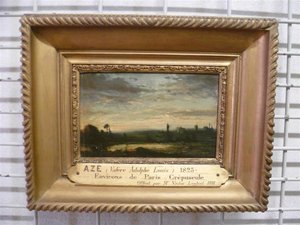
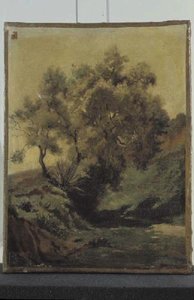
- Atmospheric Studies: Pieces like "Environs de Paris, crépuscule" demonstrate his skill in capturing the fleeting, melancholic beauty of the French twilight.
A Lasting Legacy in the Parisian Canon
The significance of Aze Valère Adolphe Louis lies in his role as a stylistic bridge. He stood at the crossroads of eras, maintaining the narrative integrity of the historical tradition while embracing the atmospheric freedom that would soon define modern art. His work serves as a visual diary of a century in transition, documenting both the familiar streets of Paris and the far-flung reaches of the Ottoman Empire and North Africa.
When he passed away in Paris on March 19, 1884, he left behind a body of work that continues to enchant collectors and historians alike. His burial in the Cimetière Montmartre, alongside his wife Blanche-Marie Léger, marks the final resting place of an artist who spent his life chasing the light. Today, his paintings remain vital windows into the nineteenth-century imagination, reminding us of a time when art sought to unite the grandeur of the past with the breathtaking reality of the present.
Quick Facts
- Artistic Movement Or Style: Orientalist
- Artists Or Movements Influenced By This Artist: Romanticism
- Artists Who Influenced This Artist: Joseph-Nicolas Robert-Fleury
- Date Of Birth: March 4, 1823
- Full Name: Aze Valère Adolphe Louis
- Nationality: French
- Notable Artworks:
- Diana Surprised by Endymion
- Louix XI chez son orfèvre
- Jeune femme agaçant une perruche
- Place Of Birth: Paris, France