 Preview
 Send
Send Share
Share
 Details

 Download
 Similars
 X-Ray
X-Ray Diaporama
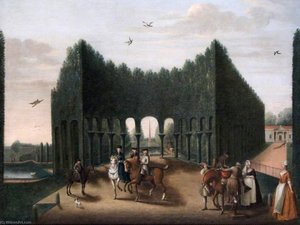
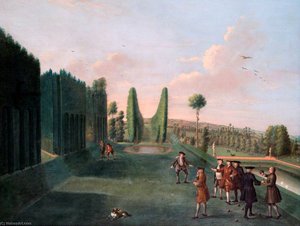
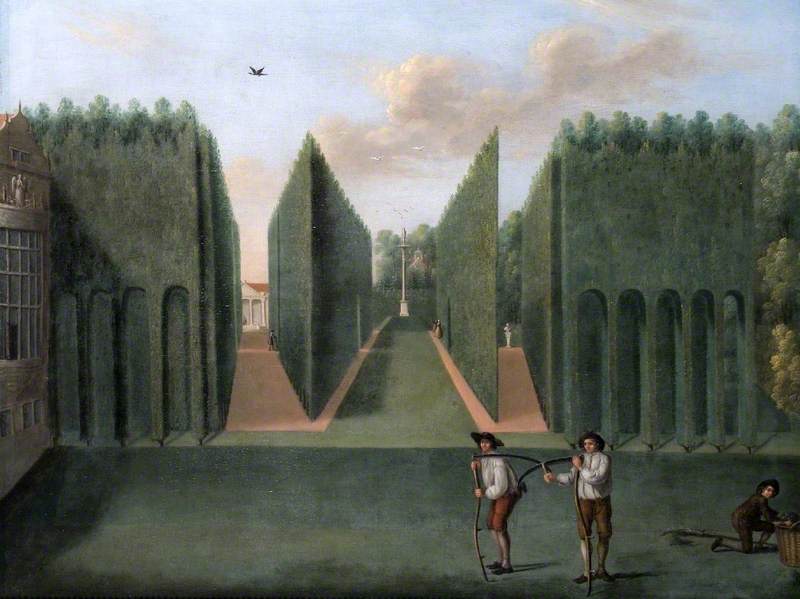
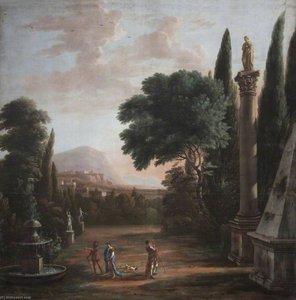
The Topiary Arcades and George II Column, Hartwell House, Buckinghamshire
 1738
1738 69.0 x 90.0 cm
 Read More
Hand Made Oil Reproduction
Hand-painted oil on canvas in your size and frame, made to order by our artists. ( Buy Print Buy Image)




































Pick from our preset sizes that match the artwork's original proportions.

You may enter your own dimensions to fit a specific frame or space. If your selected size does not match the original image's proportions, we will either crop the artwork or extend the painting with additional hand-painted elements. A digital mockup will be sent for your approval before production begins.
Please note that the on-screen preview does not reflect the actual cropping or extension. Only the mockup will accurately show the final composition.
While custom sizes are available, we recommend selecting a dimension from the predefined list to preserve the original proportions.
After order, ArtsDot.com team will email client for instructions and provide a mockup preview
Worldwide Delivery () in 3/4 weeks instead of standard 5 weeks. (26 August). No compromise on quality.

Free Worldwide Express Shipping

High-Quality Linen Canvas

Full Shipping Insurance

Customs Tax Refund Guarantee

True Color Matching Guarantee

60-Day Return Policy (Defects Only)

100% Money-Back Guarantee

Bulk Discount Offer
 Glass option is only available in size under 110 CM

The Topiary Arcades and George II Column, Hartwell House, Buckinghamshire
Reproduction Medium
Reproduction Size
-


Total Price
$ 263
Related Artworks








Artist Biography
A Baroque Visionary of the English Landscape
The annals of eighteenth-century British art are often defined by grand movements and sweeping transformations, yet few figures capture the intimate intersection of aristocratic grandeur and topographical precision as elegantly as Balthasar Nebot. Though the biographical shadows surrounding his life remain deep—records of his early years are as fragmented as a weathered canvas—his presence in the London art scene during the mid-1700s was unmistakable. Born in Spain, Nebot brought a continental sensibility to the British Isles, arriving in London around 1729 or 1730. This period marked the beginning of a career that would weave together the meticulousness of Dutch-inspired detail with the burgeoning Baroque aesthetic of England, creating a visual legacy that documented the very soul of the English estate.
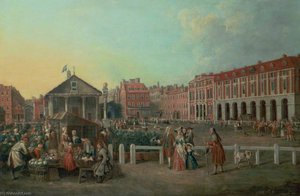
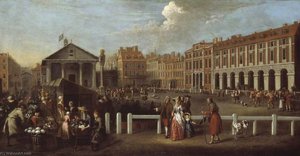
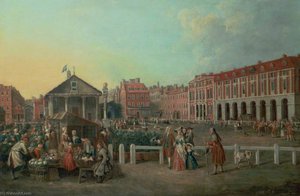
Nebot’s life in London was one deeply embedded in the cultural and intellectual fabric of the city. His marriage in the late 1720s established a domestic foundation within the vibrant district of Covent Garden, an area where his reputation as both a painter and an engraver flourished. He was not merely a chronicler of scenery but a participant in the era's artistic discourse, producing prints that circulated through the intellectual circles of the capital. His ability to translate the bustling energy of urban life into static, evocative imagery is perhaps best exemplified by his 1737 masterpiece, Covent Garden Market. In this work, the viewer is transported to a world of sensory abundance, where the rhythmic chaos of horses, dogs, and market stalls creates a vibrant tapestry of daily London existence, captured with an eye for both movement and atmospheric depth.
The Verdant Legacy of Hartwell House
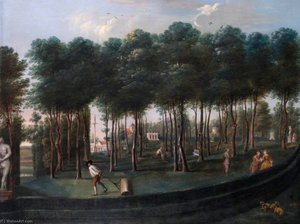
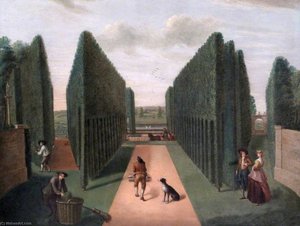
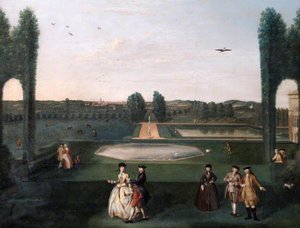
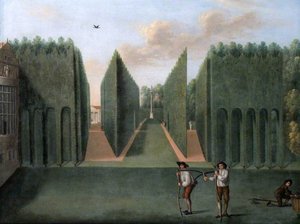
While his urban scenes offered a window into the heart of London, Nebot’s most enduring contribution to art history lies in his profound connection to the English landscape, specifically the formal gardens of Hartwell House. Commissioned by Sir Thomas Lee, Nebot undertook an ambitious series of eight canvases that serve as a definitive visual record of the newly constructed gardens in Buckinghamshire. These paintings are far more than mere topographical maps; they are poetic celebrations of order, symmetry, and the triumph of human design over nature. Through his brush, the manicured topiary, winding canals, and classical temples become stages for an aristocratic drama of leisure and prestige.
In works such as The Long Canal and Gibbs Temple and The Allees and Arcades, Nebot demonstrates a masterful command of perspective and light. He drew significant inspiration from the Dutch Golden Age, particularly the compositional rigor of painters like Peter Angelis, to imbue his landscapes with a sense of profound stillness and structural clarity. His technique allowed him to capture the delicate textures of plant life alongside the cold, hard lines of architectural elements like obelisks and exhedra. This duality—the organic meeting the geometric—reflects the very essence of the Italianate garden style that was then captivating the English elite. Each canvas acts as a time capsule, preserving the horticultural aspirations and the aesthetic ideals of an era defined by the pursuit of classical perfection.
Artistic Versatility and Historical Significance
Beyond the sweeping vistas of estate landscapes, Nebot’s artistic range extended into the realms of portraiture and even scientific inquiry, revealing a polymathic intellect. His talent for capturing character led to notable portrait commissions, including a depiction of Thomas Coram, the visionary founder of the Foundling Hospital. This ability to pivot from the grand scale of landscape to the intimate psychological depth of a portrait underscores his versatility as a practitioner of the Baroque style. Furthermore, his foray into anatomical studies—collaborating with the renowned anatomist William Hunter on detailed drawings of the female pelvis—highlights a fascinating intersection between fine art and the burgeoning scientific advancements of the Enlightenment.
The historical significance of Balthasar Nebot lies in his role as a bridge between traditions. He brought a Spanish-inflected passion and a Dutch-inspired precision to an English landscape that was undergoing a radical transformation. Though his life ended in 1786, leaving behind a fragmented biography, his visual output remains a vital cornerstone for understanding the mid-eighteenth century. Through his meticulous documentation of both the bustling streets of Covent Garden and the serene, structured beauty of Hartwell House, Nebot ensured that the fleeting grandeur of the Baroque age would be etched permanently into the history of art.
balthasar nebot
1700 - 1786
Quick Facts
- Artistic Movement Or Style: Baroque Landscape Painting
- Artists Or Movements Influenced By This Artist: ['Dutch Golden Age']
- Artists Who Influenced This Artist: ['Peter Angelis']
- Date Of Death: 1786
- Full Name: Balthasar Nebot
- Nationality: Spanish
- Notable Artworks:
- The Allees and Arcades behind Hartwell House, Buckinghamshire
- The Long Canal and Gibbs Temple, Hartwell House, Buckinghamshire
- Covent Garden Market
- Place Of Birth: Madrid, Spain