 Preview
 Send
Send Share
Share
 Details

 Download
 Similars
 X-Ray
X-Ray Diaporama
 Stats
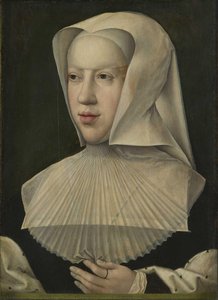
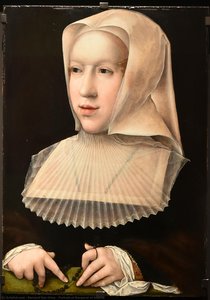
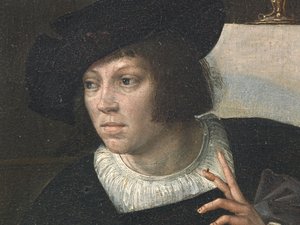
StatsPortrait of Margaret of Austria, Duchess of Savoy


 Read More
Hand Made Oil Reproduction
Hand-painted oil on canvas in your size and frame, made to order by our artists. ( Switch to Print Switch to Digital Image)




P118B $10

P118H $10

P118W $10

P438Z $10

P508JH $12

P508YH $12

P805H $10

P805Z $10

P919BZ $10

P919G $10

P919XJ $10

P959ZH $10

P968JZ $12

W106C $8

W218G $10

W218JH $8

W218Y $10

W307PJ $10

W316G $10

W316PJ $8

W316Y $10

W398PJ $8

W4111J $10

W500HY $15

W500JH $15

W692G $12

W849H $8

W940BG $15

W953PJ $8




Pick from our preset sizes that match the artwork's original proportions.

You may enter your own dimensions to fit a specific frame or space. If your selected size does not match the original image's proportions, we will either crop the artwork or extend the painting with additional hand-painted elements. A digital mockup will be sent for your approval before production begins.
Please note that the on-screen preview does not reflect the actual cropping or extension. Only the mockup will accurately show the final composition.
While custom sizes are available, we recommend selecting a dimension from the predefined list to preserve the original proportions.
After order, ArtsDot.com team will email client for instructions and provide a mockup preview
Worldwide Delivery () in 3/4 weeks instead of standard 5 weeks. (8 September). No compromise on quality.

Free Worldwide Express Shipping

High-Quality Linen Canvas

Full Shipping Insurance

Customs Tax Refund Guarantee

True Color Matching Guarantee

100-Day Return Policy (Defects Only)

100% Money-Back Guarantee

Bulk Discount Offer
 Glass option is only available in size under 110 CM

Portrait of Margaret of Austria, Duchess of Savoy
Reproduction Medium
Reproduction Size
-


Total Price
$ 263
Portrait of Margaret of Austria, Duchess of Savoy – A Masterpiece of Northern Renaissance Elegance
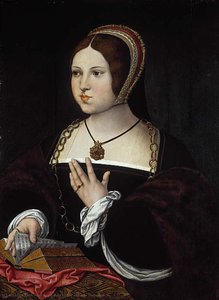
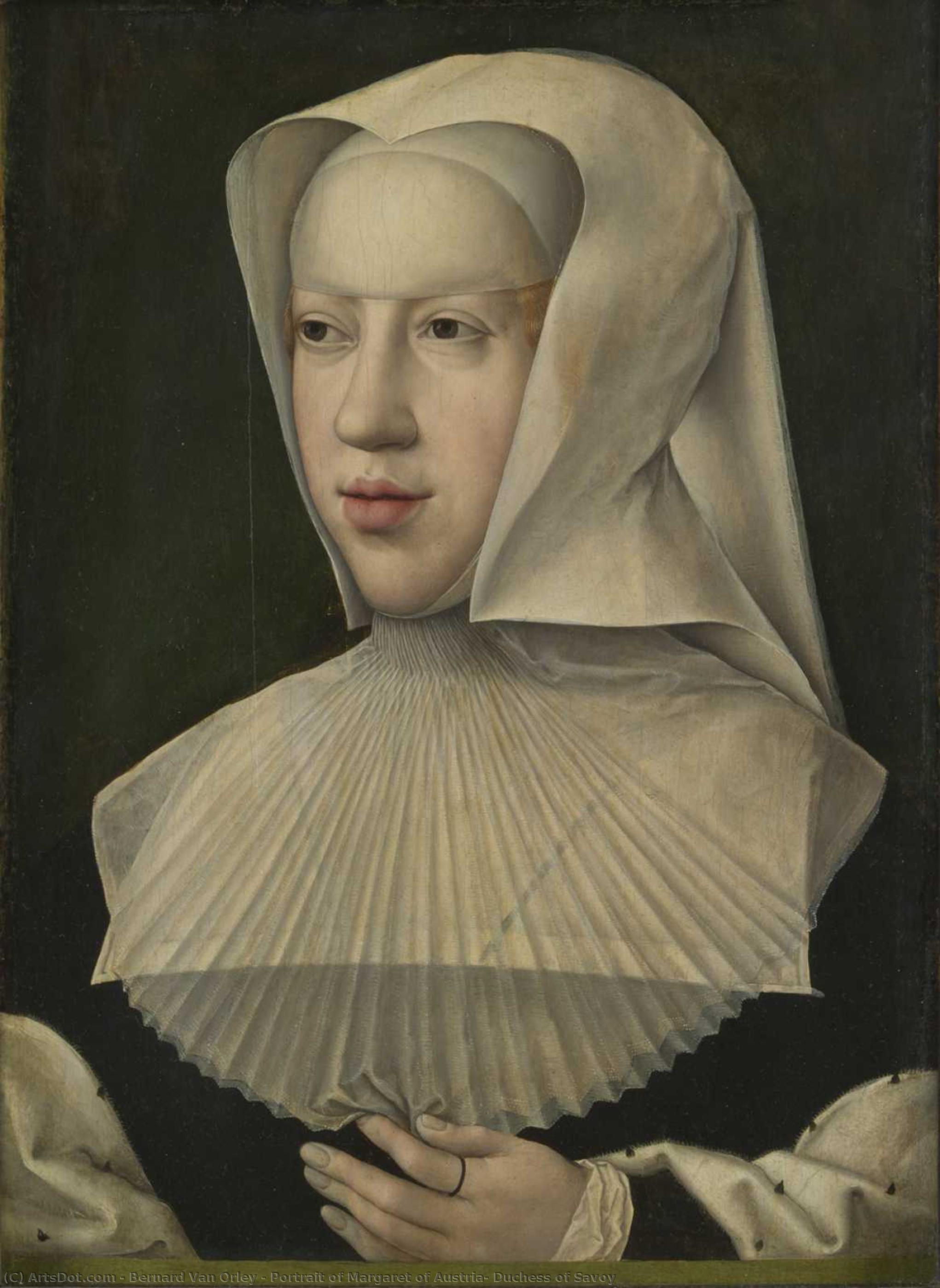
The artwork before us is “Portrait of Margaret of Austria, Duchess of Savoy,” executed around 1520 by Barend or Barent van Orley, a Flemish Renaissance master whose oeuvre embodies the refined sensibilities of his era. This half-length portrait transcends mere representation; it’s an exquisitely crafted distillation of humanist ideals and artistic innovation—a testament to Van Orley's skill in capturing both physical likeness and psychological nuance. ### Composition and Style – Symmetry and Formal Grace The composition adheres to a classical pyramidal structure, placing Margaret’s face centrally against a muted brown background that serves as a grounding element. The artist skillfully employs symmetry, mirroring the positioning of her gaze directly across from the viewer—a technique designed not only for visual balance but also to establish an intimate connection between subject and observer. This deliberate arrangement speaks to the prevailing artistic conventions of the Northern Renaissance, prioritizing clarity and order while simultaneously conveying dignity and composure. Van Orley’s style is characterized by meticulous detail and a masterful command of chiaroscuro—the dramatic interplay of light and shadow—which sculpts Margaret's features with remarkable precision. ### Color Palette and Texture – Subtle Luminosity and Delicate Detail Dominating the palette are shades of ivory, cream, and pale yellow adorning Margaret’s gown and headdress, contrasted against the darker backdrop. These hues evoke a sense of aristocratic refinement and subtly illuminate her complexion, highlighting delicate skin tones and conveying an aura of serenity. Furthermore, Van Orley's technique—characterized by painstaking brushwork—captures textures with astonishing accuracy. The smooth surface of Margaret’s skin contrasts sharply with the crispness of the lace edging her gown and headdress, demonstrating a profound understanding of material properties. Cross-hatching and hatching techniques are employed to create shading and texture throughout the portrait, adding depth and dimensionality to the image—a hallmark of Northern Renaissance painting. ### Symbolism – Status, Grace, and Reserved Power Beyond its aesthetic beauty, “Portrait of Margaret of Austria” is laden with symbolic significance. The elaborate ruff and headdress serve as emblems of Margaret’s elevated social standing and wealth, reflecting the values of the Burgundian court during Van Orley's lifetime. Her clasped hands convey modesty and grace—a gesture that speaks to the humanist preoccupation with virtue and moral contemplation. Margaret’s gaze directs towards the viewer, projecting an image of quiet strength and unwavering dignity—a visual representation of inner resilience amidst external pressures. ### Historical Context – The Romanist Movement and Artistic Legacy Created during the Romanist movement—a trend championed by Raphael's influence—the portrait exemplifies the artistic fervor of its time. Artists like Van Orley sought to emulate the idealized beauty and harmonious proportions celebrated in classical art, adapting Italian Renaissance principles to Flemish sensibilities. “Portrait of Margaret of Austria” stands as a cornerstone of Northern Renaissance portraiture, securing Van Orley’s place among the most influential painters of his generation—a legacy that continues to inspire admiration for its technical brilliance and profound psychological insight. ### Medium & Technique – Oil Painting on Panel - A Testament to Craftsmanship The artwork is executed in oil paint on a wooden panel, utilizing glazing techniques to achieve subtle color transitions and luminosity. This meticulous approach underscores Van Orley’s dedication to craftsmanship—a commitment to mastering the medium and conveying its inherent qualities with exceptional artistry. The artist's careful attention to detail ensures that every nuance of Margaret’s appearance is faithfully reproduced, cementing “Portrait of Margaret of Austria” as a timeless masterpiece of Northern Renaissance art.Related Artworks
Artist Biography
The Renaissance Soul of Brussels
In the heart of a burgeoning Brussels, where the scent of damp wool and the rhythmic clatter of looms defined the urban landscape, Barend van Orley emerged as a titan of the Flemish Renaissance. Born into an era of profound artistic transition, his very lineage was woven into the fabric of the arts; as the son of the esteemed tapestry designer Valentin van Orley, his childhood was likely an immersive education in the intricate textures and grand narratives required for the great tapestries of Europe. This early exposure to the meticulous craftsmanship of the Brussels workshops provided a foundation that would eventually allow him to transcend the boundaries of mere decoration, elevating the medium of tapestry to a level of painterly sophistication previously unseen in the Low Countries.
A Synthesis of Northern Realism and Italian Grace
While many of his contemporaries embarked on arduous pilgrimages to the sun-drenched studios of Italy, van Orley achieved a remarkable feat of artistic osmosis, absorbing the revolutionary aesthetics of Raphael’s Rome from afar. He became a leading figure of the Romanist movement, a stylistic bridge that married the unflinching, microscopic realism characteristic of the Netherlandish tradition with the idealized proportions and classical grandeur of the Italian Renaissance. In his hands, the heavy, tactile world of Flemish painting—where every fold of velvet and glint of gold could be felt through the gaze—met the harmonious compositions and balanced grace of the South. This synthesis created a visual language that was both intimately familiar to Northern patrons and breathlessly modern, characterized by a profound command over light, shadow, and the human form.
A Legacy Woven in Paint and Thread
Van Orley’s genius lay in his extraordinary versatility, an ability to command the brush, the loom, and the stained-glass window with equal mastery. His oeuvre is a testament to a creator who saw no distinction between the monumental scale of a tapestry design and the delicate intimacy of a religious oil painting. Whether depicting the profound gravity of the Last Judgement or the tender grace of a Virgin and Child, his work consistently radiated a sense of divine order and earthly beauty. Beyond his individual masterpieces, his historical significance is cemented by his role as a pivotal link in the evolution of Northern art, ensuring that the traditions of his ancestors were not merely preserved but transformed for a new age. Through his prolific output and the continuation of his family’s artistic lineage, Barend van Orley left an indelible mark on the cultural identity of the Flemish Renaissance, leaving behind a legacy as enduring as the very tapestries he helped to define.
Quick Facts
- Artistic Movement Or Style: Italianizing Flemish Renaissance
- Artists Or Movements Influenced By This Artist: ['Romanists']
- Artists Who Influenced This Artist: ['Raphael']
- Date Of Birth: c.1487
- Date Of Death: January 6, 1541
- Full Name: Bernard van Orley
- Nationality: Flemish
- Notable Artworks:
- The Haneton Triptych
- Portrait of Margareta van Oostenrijk
- Altarpiece of Calvary
- Place Of Birth: Brussels, Belgium
Related Articles
Hugo van der Goes: Devotion, Innovation & the Psychological Depth of Early Netherlandish Painting
Explore the revolutionary art of Hugo van der Goes – a master of Early Netherlandish painting renowned for his dramatic realism, psychological depth & profound influence on Renaissance artists. Discover his iconic works and lasting legacy.

Early Netherlandish Masters: 10 Paintings That Revolutionized Art & Decor
Journey into the world of Early Netherlandish painting! Explore 10 masterpieces by Jan van Eyck, Rogier van der Weyden & more. Discover stunning detail, symbolism & Renaissance art for your home decor. Find museum-quality reproductions on ArtsDot.com

Rembrandt's Masterpieces: Explore 25 Iconic Paintings & Prints | ArtsDot
Journey through Rembrandt van Rijn's 25 most iconic paintings & etchings. Explore Dutch Golden Age masterpieces, dramatic chiaroscuro, and timeless portraits. Find museum-quality art reproductions to elevate your home decor on ArtsDot.com.
Early Netherlandish Masters: 10 Paintings That Revolutionized Art & Decor
Journey into the Early Netherlandish Renaissance! Explore 10 iconic paintings by Jan van Eyck, Rogier van der Weyden & more. Discover stunning detail, symbolism, and oil painting techniques. Find museum-quality art reproductions for your home at ArtsDot.com.
Sir Anthony van Dyck: Courtly Portraiture & the Shaping of Baroque Identity
Explore the life & legacy of Sir Anthony van Dyck, the leading court painter of his era. Discover his innovative portraiture, Baroque masterpieces, and investment potential for discerning collectors. Learn more at ArtsDot.