 Preview
 Send
Send Share
Share
 Details

 Download
 Similars
 X-Ray
X-Ray Diaporama
Noise of a Fish


 Read More
Hand Made Oil Reproduction
Hand-painted oil on canvas in your size and frame, made to order by our artists. ( Buy Print Buy Image)




































Pick from our preset sizes that match the artwork's original proportions.

You may enter your own dimensions to fit a specific frame or space. If your selected size does not match the original image's proportions, we will either crop the artwork or extend the painting with additional hand-painted elements. A digital mockup will be sent for your approval before production begins.
Please note that the on-screen preview does not reflect the actual cropping or extension. Only the mockup will accurately show the final composition.
While custom sizes are available, we recommend selecting a dimension from the predefined list to preserve the original proportions.
After order, ArtsDot.com team will email client for instructions and provide a mockup preview
Worldwide Delivery () in 3/4 weeks instead of standard 5 weeks. (16 August). No compromise on quality.

Free Worldwide Express Shipping

High-Quality Linen Canvas

Full Shipping Insurance

Customs Tax Refund Guarantee

True Color Matching Guarantee

60-Day Return Policy (Defects Only)

100% Money-Back Guarantee

Bulk Discount Offer
 Glass option is only available in size under 110 CM

Noise of a Fish
Reproduction Medium
Reproduction Size
-


Total Price
$ 263
Artwork Description
A Symphony of Geometry: Rediscovering Noise of a Fish
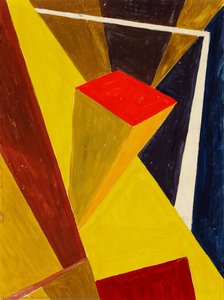
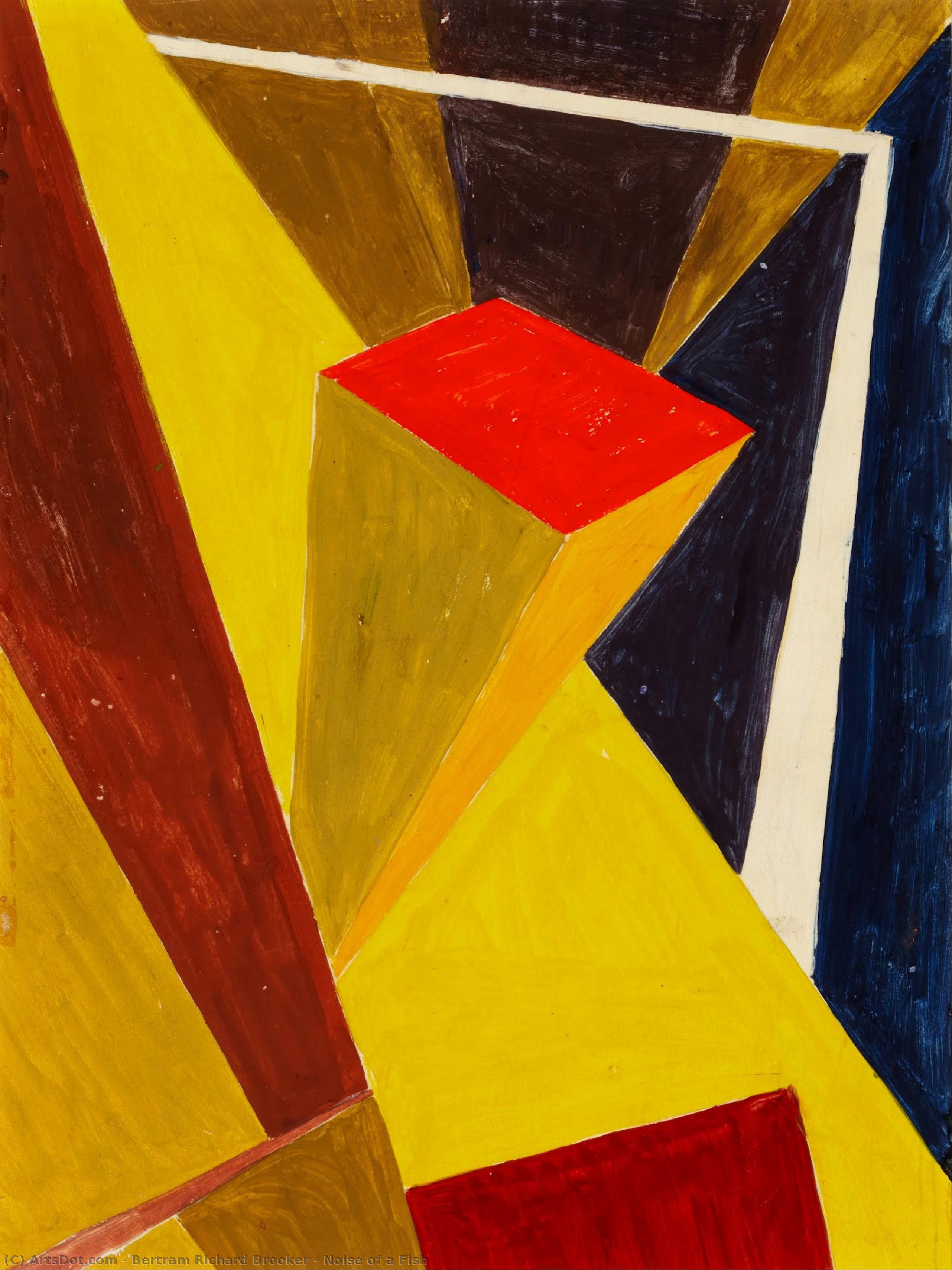
In the realm of early twentieth-century abstraction, few works capture the rhythmic pulse of modernism as vibrantly as Bertram Richard Brooker’s Noise of a Fish. Created in 1924, this masterpiece serves as a profound testament to the era's departure from representational reality toward a language of pure form and color. At first glance, the viewer is met with a striking composition dominated by a bold red triangle that commands the canvas. Set against a luminous yellow background, the geometric figure is not a static shape but a dynamic entity, divided into distinct sections that suggest movement and internal structure. A singular, piercing blue line cuts through the warmth of the primary palette, acting as a visual conductor that orchestrates the tension between the heavy reds and the radiant yellows.
The technique employed by Brooker reflects his deep immersion in the avant-garde movements of his time, particularly the influence of Cubism and Primitivism. Rather than seeking to replicate the physical texture of a fish or the literal sound of water, Brooker utilizes flattened perspectives and simplified forms to evoke a sensory experience. The painting operates through a deliberate rejection of academic depth, opting instead for a powerful, graphic immediacy. This approach allows the colors—vibrant, saturated, and unapologetically bold—to carry the emotional weight of the piece. For the discerning collector or interior designer, this work offers a sophisticated interplay of light and shape that can serve as a commanding focal point in any contemporary space.
Beyond its aesthetic brilliance, Noise of a Fish invites a deeper philosophical inquiry into the relationship between sight and sound. The title itself suggests a synesthetic experience, where the visual elements are meant to trigger an auditory sensation—the "noise" of a living, breathing world translated into the silent language of geometry. Brooker, a pioneer of Canadian abstract art, masterfully uses the contrast of his palette to create this sensory overlap. The heat of the red and yellow evokes a certain energy, while the cool blue line provides a rhythmic interruption, much like a sudden note in a musical composition. It is an evocative piece that transcends its era, offering timeless inspiration through its ability to turn abstract shapes into a profound emotional resonance.
Related Artworks

Artist Biography
A Polymath of the Prairie: The Life and Vision of Bertram Richard Brooker
The story of Bertram Richard Brooker is not merely a biography of a painter, but a chronicle of a restless, multi-faceted intellect that refused to be confined by the boundaries of a single medium. Born in Croydon, England, in 1888, Brooker’s early years were shaped by the traditions of his birthplace, yet it was his relocation to Portage la Prairie, Manitoba, at the age of seventeen that would fundamentally alter the trajectory of his creative soul. This transition from the structured landscapes of the United Kingdom to the vast, untamed expanses of the Canadian prairies provided the essential raw material for a lifetime of exploration. Brooker emerged as a singular figure in Canadian art history—a man who moved with equal grace between the worlds of fine art, literature, and graphic design, weaving a tapestry of modernism that would eventually redefine the aesthetic landscape of a nation.
As his artistic consciousness matured, Brooker began to look beyond the traditional confines of Impressionism and Cubism, seeking a visual language that could capture the primal essence of existence. He became a pioneer of abstract art in Canada, yet his path to abstraction was paved with a profound appreciation for naivety and primitivism. Rather than adhering to the rigid academic conventions of his era, he embraced simplified forms and flattened perspectives, creating works that felt both ancient and avant-garde. This stylistic choice was more than a mere aesthetic preference; it was a deliberate attempt to strip away the superficial layers of reality to reveal the underlying geometric truths and emotional resonances of the natural world.
The Convergence of Form and Narrative
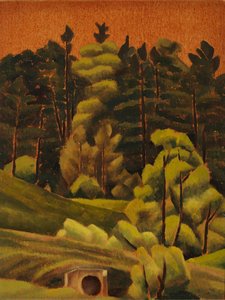
Brooker’s brilliance lay in his ability to synthesize disparate disciplines into a unified creative vision. His paintings, such as the striking “Abstract Still Life,” demonstrate a masterful command of technique, utilizing a black and white pointillist approach to create depth through light and shadow alone. In other works like “Ravine Culvert,” he transitioned toward an impressionistic warmth, capturing the fleeting, golden light of the Canadian landscape with a sensitivity that felt deeply rooted in the earth. His eye for composition was further refined through his career as an advertising executive and graphic designer, where the bold use of color and form became a tool for communication, influencing the visual culture of his time.
Yet, to view Brooker solely through the lens of a painter would be to overlook the profound depth of his literary contributions. He was a storyteller of remarkable versatility, a novelist and poet whose prose possessed a psychological acuity that mirrored the complexity of his canvases. His achievements in literature were nothing short of extraordinary, most notably earning the Governor General’s Award for Fiction. Through his novels, he explored themes of identity, memory, and the human condition, imbuing his narratives with a poetic sensibility that resonated far beyond the borders of Canada. Whether through the stroke of a brush or the tip of a pen, Brooker remained obsessed with the fundamental essence of being.
Legacy and Historical Significance
The historical significance of Bertram Richard Brooker rests in his role as a bridge between the traditional and the modern. He acted as a catalyst for change, introducing the radical concepts of abstraction to a Canadian audience that was still largely tethered to representational realism. His ability to blend the primitive with the modernist allowed him to create a unique aesthetic that felt both culturally grounded and internationally relevant.
His enduring legacy can be summarized through several key pillars of his career:
- Pioneering Abstraction: He was instrumental in bringing the language of modern abstraction to the Canadian art scene, breaking away from academic realism.
- Interdisciplinary Mastery: His rare ability to achieve excellence as a painter, novelist, playwright, and graphic designer set a precedent for the "total artist."
- Literary Distinction: His recognition by the Governor General’s Award solidified his place as a titan of Canadian letters.
- Aesthetic Innovation: Through his use of Naive art and Primitivism, he offered a new way to perceive the beauty of the wilderness and the structure of the natural world.
Today, Brooker is remembered not just as an artist of a specific movement, but as a visionary who saw no borders between the visual and the verbal. His life remains a testament to the power of boundless curiosity and the enduring impact of a creative spirit that seeks to find the universal within the particular.
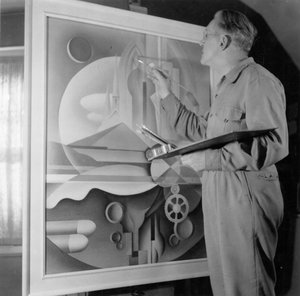
bertram richard brooker
1888 - 1955 , United Kingdom
Quick Facts
- Artistic Movement Or Style: Naive Art/Primitivism; Graphic Design; Advertising Executive
- Date Of Birth: March 31, 1888
- Date Of Death: March 21, 1955
- Full Name: Bertram Richard Brooker
- Nationality: English-Canadian
- Notable Artworks:
- Abstract Still Life
- Ravine Culvert
- Place Of Birth: Croydon, United Kingdom
Related Articles

Slate Blue Masterpieces: 10 Iconic Paintings & Timeless Home Decor Ideas
Immerse yourself in the captivating world of slate blue! Explore 10 iconic paintings by Monet, Van Gogh & Renoir. Discover their stories, techniques & find museum-quality art reproductions for your home at .
The Allure of Azure: Exploring the Symbolic & Aesthetic Depths of Blue in Art History
Explore the rich history of blue in art! Discover its symbolism, from ancient pigments to modern masterpieces by Kandinsky & Seurat. Uncover the psychological impact and cultural meanings behind this captivating hue.
Golden Hues: 10 Masterpieces Dominated by Chrome Yellow | ArtsDot
Immerse yourself in golden light! Explore 10 famous paintings dominated by 'Chrome Yellow', from Van Gogh’s Sunflowers to Monet's Haystacks. Discover the stories behind these iconic Impressionist & Post-Impressionist masterpieces and find museum-quality art reproductions at ArtsDot.com.
Kandinsky's Masterpieces: 25 Paintings That Define Abstract Art | ArtsDot
Journey through Wassily Kandinsky's 25 most iconic abstract paintings. Explore his revolutionary use of color, form & spiritual expressionism. Find museum-quality Kandinsky reproductions and elevate your home decor with ArtsDot.com. Discover all masterpieces on ArtsDot.com!

Crimson Threads of Narrative: Exploring Symbolism & Representation in Artworks Featuring the Red Dress
Explore the rich symbolism of the red dress in art history! From ancient power displays to iconic portraits like Cézanne’s 'Madame Cezanne', discover the cultural and artistic significance behind this captivating color. Expert analysis & insights.