 Preview
 Send
Send Share
Share
 Details

 Download
 Similars
 X-Ray
X-Ray Diaporama
 Stats
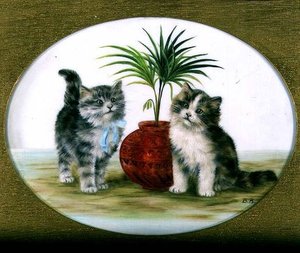
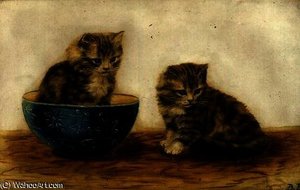
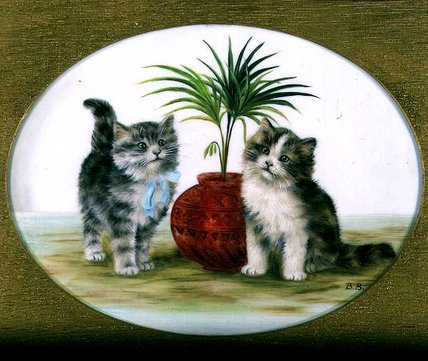
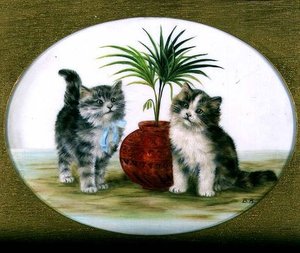
StatsKittens By A Palm In A Bowl
 Read More
Giclée / Art Print
Museum-quality giclée or canvas print with fast production and flexible finish options. ( Buy Hand Made Painting Switch to Digital Image)




































Pick from our preset sizes that match the artwork's original proportions.

You may enter your own dimensions to fit a specific frame or space. If your selected size does not match the original image's proportions, we will either crop the artwork or extend the image with a mirrored or solid-fill edge. A digital mockup will be sent for your approval before production begins.
Please note that the on-screen preview does not reflect the actual cropping or extension. Only the mockup will accurately show the final composition.
While custom sizes are available, we recommend selecting a dimension from the predefined list to preserve the original proportions.
Worldwide Delivery () in 2 weeks instead of standard 4/5 weeks. (9 September)

Free Worldwide Express Shipping

High-Quality Linen Canvas

Full Shipping Insurance

Customs Tax Refund Guarantee

True Color Matching Guarantee

100-Day Return Policy (Defects Only)

100% Money-Back Guarantee

Bulk Discount Offer
 Glass option is only available in size under 110 CM

Kittens By A Palm In A Bowl
Giclée / Art Print
Reproduction Size
-


Total Price
$ 63
Related Artworks



Artist Biography
The Delicate Legacy of Bessie Bamber
In the quiet corners of British art history, few figures possess the enigmatic charm and specialized mastery of Bessie Bamber. Born Elizabeth Margaret Bamber around 1870 in Birkenhead, Lancashire, her life remains partially shrouded in the mists of the late Victorian era. While biographical details are sparse, her artistic presence is unmistakable through her prolific and highly distinctive body of work. Active primarily between the 1880s and 1910, Bamber carved out a niche that was as technically demanding as it was emotionally resonant, focusing her gaze on the tender, often overlooked moments of domestic life through the lens of animal portraiture.
Her upbringing in the industrial landscape of Liverpool and Birkenhead likely provided a profound backdrop to her creative development. Descended from a family of progressive ideals—most notably her mother, Mary Little Bamber, a celebrated socialist and suffragette—Bessie was immersed in an environment that valued empathy and social awareness. This heritage of compassion may have subtly informed her choice of subject matter; rather than seeking the grandiosity of historical or mythological scenes, she found profound beauty in the small, vulnerable, and domestic. Her work captures a sense of quiet intimacy that mirrors the very essence of the era's shifting social consciousness.
A Mastery of Porcelain and Glass
What truly distinguishes Bamber from her contemporaries was her extraordinary technical command over unconventional surfaces. While many artists of her time adhered to traditional canvas, Bamber sought out porcelain and opaline glass as her primary stages. This choice was far from accidental. The smooth, reflective, and often fragile nature of these materials allowed her to experiment with light and translucency in ways that oil on canvas could not replicate. By applying thin, meticulous layers of paint onto glazed surfaces, she achieved a luminous quality that seemed to breathe life into her subjects.
Her technique was characterized by an incredible attention to detail, particularly when rendering the soft textures of fur and the bright, inquisitive eyes of her subjects. Interestingly, Bamber often preferred working with stuffed animals rather than live ones, a method that allowed her to manipulate poses and lighting with absolute precision. This approach enabled her to create highly composed, almost sculptural scenes of kittens and puppies. Whether painting on a polished mahogany panel or the delicate surface of glass, her ability to capture movement and expression remains a testament to her singular artistic vision.
The Enduring Charm of the Feline Portrait
The heart of Bamber’s oeuvre lies in her devotion to cats and kittens. These were not merely decorative studies; they were explorations of character and temperament. Through her work, one can observe a wide spectrum of feline behavior—from the playful energy of Felines at Play to the serene, contemplative stillness found in her more formal portraits. Her ability to imbant these small creatures with distinct personalities has ensured that her work continues to captivate collectors and art enthusiasts long after her era has passed.
The historical significance of Bessie Bamber lies in her rejection of academic rigidity in favor of a specialized, intimate realism. She proved that the miniature and the domestic could hold as much artistic weight as the monumental. Her legacy is found in the delicate balance of her materials and her subjects:
- Technical Innovation: The pioneering use of porcelain and opaline glass for fine-scale animal portraiture.
- Emotional Depth: A unique ability to convey vulnerability and tenderness through the depiction of domestic pets.
- Historical Resonance: A body of work that reflects the quiet, intimate side of the late Victorian and Edwardian periods.
bessie bamber
1870 - 1910 , United Kingdom
Quick Facts
- Artistic Movement Or Style: Socialist
- Artists Or Movements Influenced By This Artist: ['National Health Service']
- Artists Who Influenced This Artist: ['Mary Bamber']
- Date Of Birth: 24 September 1899
- Date Of Death: 13 November 1970
- Full Name: Elizabeth Margaret Braddock
- Nationality: British
- Notable Artworks:
- A Little Accident
- The Mischief Makers
- Place Of Birth: Liverpool, United Kingdom