 Preview
 Send
Send Share
Share
 Details

 Download
 Similars
 X-Ray
X-Ray Diaporama
 Stats
StatsA portrait of a Jew


 Read More
Giclée / Art Print
Museum-quality giclée or canvas print with fast production and flexible finish options. ( Buy Hand Made Painting Switch to Digital Image)




































Pick from our preset sizes that match the artwork's original proportions.

You may enter your own dimensions to fit a specific frame or space. If your selected size does not match the original image's proportions, we will either crop the artwork or extend the image with a mirrored or solid-fill edge. A digital mockup will be sent for your approval before production begins.
Please note that the on-screen preview does not reflect the actual cropping or extension. Only the mockup will accurately show the final composition.
While custom sizes are available, we recommend selecting a dimension from the predefined list to preserve the original proportions.
Worldwide Delivery () in 2 weeks instead of standard 4/5 weeks. (8 September)

Free Worldwide Express Shipping

High-Quality Linen Canvas

Full Shipping Insurance

Customs Tax Refund Guarantee

True Color Matching Guarantee

100-Day Return Policy (Defects Only)

100% Money-Back Guarantee

Bulk Discount Offer
 Glass option is only available in size under 110 CM

A portrait of a Jew
Giclée / Art Print
Reproduction Size
-


Total Price
$ 63
Related Artworks





Artist Biography
A Portraitist of Polish Identity
Bolesław Cybis (1895–1957) stands as a significant figure in 20th-century Polish art, particularly recognized for his evocative portraits and monumental murals that grapple with themes of social realism and historical memory. Born in Vilnius—then part of the Russian Empire—Cybis’s artistic journey began amidst the turbulent backdrop of post-revolutionary Poland, shaping his distinctive style and unwavering commitment to documenting the human condition. His early life was marked by a unique blend of physical discipline and architectural heritage; during his school years in Warsaw, he earned numerous awards for gymnastic excellence, while his formative years were profoundly influenced by his father’s architectural endeavors, specifically the design of Peterhoff Palace. This exposure to grand structural principles provided him with an early foundation in artistic craftsmanship and a deep appreciation for the permanence of art.
The trajectory of Cybis's career was irrevocously altered by the geopolitical shifts of the era. In 1915, he attended the St. Petersburg Academy of Fine Arts, immersing himself in the traditions of Western European art while simultaneously absorbing the spirit of Russian culture. However, the collapse of the White Russian movement in 1921 forced him into a period of wandering and adaptation. Seeking refuge in Constantinople, Cybis entered a vibrant era of artistic collaboration, cultivating relationships with fellow artists such as Constantin Alajal and Pavel Tchelitchev. During these years in Istanbul, he demonstrated remarkable versatility, supporting himself through the gritty reality of street-level artistry—sketching portraits in cafes, designing advertising billboards for theaters, and even painting sidewalk advertisements. This period of survival allowed him to hone a precise, observational skill set that would later define his mature style.
Mastery of Form and the New Objectivity
Upon returning to Warsaw in 1923, Cybis transitioned from a wandering artist to an established academic force, enrolling at the Warsaw School of Fine Arts and eventually serving as a professor. His artistic explorations continued throughout Europe, where he meticulously studied the techniques of the Old Masters, drawing inspiration from the luminous precision of Leonardo da Vinci and the dramatic depth of Rembrandt. This reverence for classical technique merged with contemporary movements, most notably the New Objectivity movement that emerged in Europe during the 1920s. His work often reflected a meticulous attention to detail, where every wrinkle of skin or texture of fabric was rendered with profound precision, lending his subjects an almost sculptural presence.
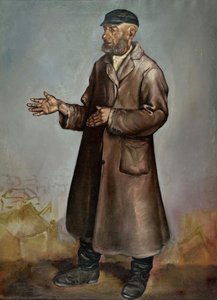
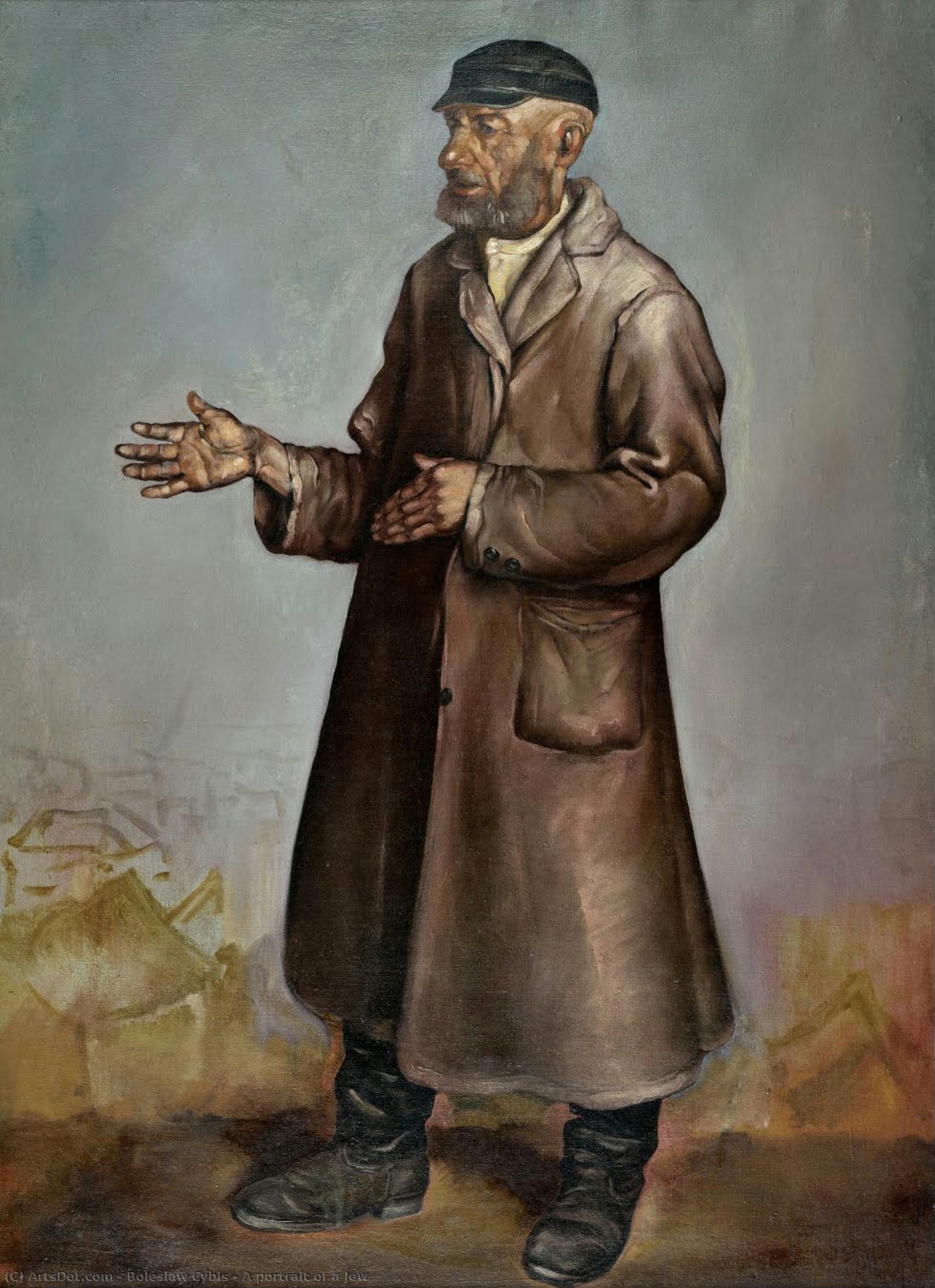
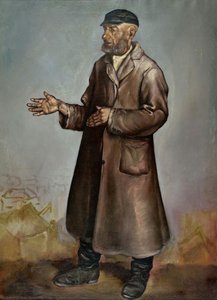
One of the most poignant expressions of his talent can be found in his depictions of the Polish people and their diverse communities. A notable example is his work "A Portrait of a Jew," which serves as a stylistic reference to the New Objectivity movement. In this piece, Cybis captures an elderly figure from the Kazimierz community with such intense detail that the expressive gestures of the hands and the weathered features of the face become a window into a vanishing way of life. By setting these characters against the architectural outlines of their towns, he anchored his subjects within the very landscape they inhabited, creating a sense of historical permanence.
Legacy and Artistic Significance
Throughout his career, Cybis’s reach extended far beyond the borders of Poland. His paintings, sculptures, and murals earned him international recognition in major cultural hubs including Paris, Geneva, Munich, Frankfurt, Moscow, St. Petersburg, Bucharest, and Vienna. Between 1926 and 1930, he underwent a profound period of fascination with the peasantry of the Polish countryside. He viewed these rural subjects through a lens of timelessness, likening them to the 15th-century medieval portraits of the great masters. This series of peasant portraits remains a cornerstone of his legacy, capturing the dignity and rugged beauty of the agrarian soul.
The historical significance of Bolesław Cybis lies in his ability to bridge the gap between the classical past and the turbulent modern era. His work serves as both a technical triumph of portraiture and a vital sociological record. Through his eyes, we witness:
- The intersection of cultures: From the imperial grandeur of St. Petersburg to the vibrant streets of Constantinople.
- Social documentation: The preservation of the identities of the Jewish community in Kazimierz and the Polish peasantry.
- Technical evolution: The seamless blending of Old Master techniques with the sharp, realistic edges of 20th-century modernism.
Ultimately, Cybis was more than a painter; he was a chronicler of identity, using his brush to ensure that the faces and stories of his era would endure long after the political tides had shifted.
bolesław cybis
1895 - 1957 , Poland
Quick Facts
- Artistic Movement Or Style: Realism
- Artists Or Movements Influenced By This Artist: ['Old Masters']
- Artists Who Influenced This Artist: ['Leonardo da Vinci']
- Date Of Birth: June 6, 1895
- Date Of Death: May 30, 1957
- Full Name: Bolesław Cybis
- Nationality: Polish
- Notable Artworks: ['Peasant Portraits']
- Place Of Birth: Vilnius, Poland