 Preview
 Send
Send Share
Share
 Details

 Download
 Similars
 X-Ray
X-Ray Diaporama
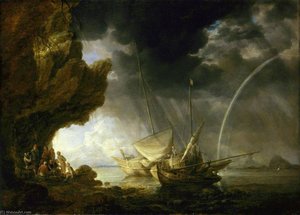
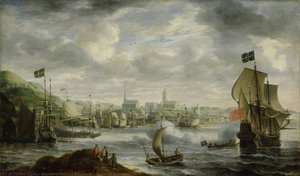
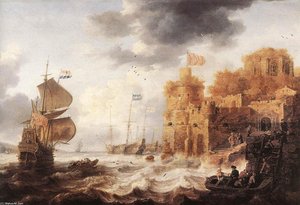
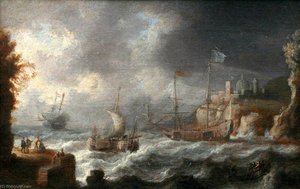
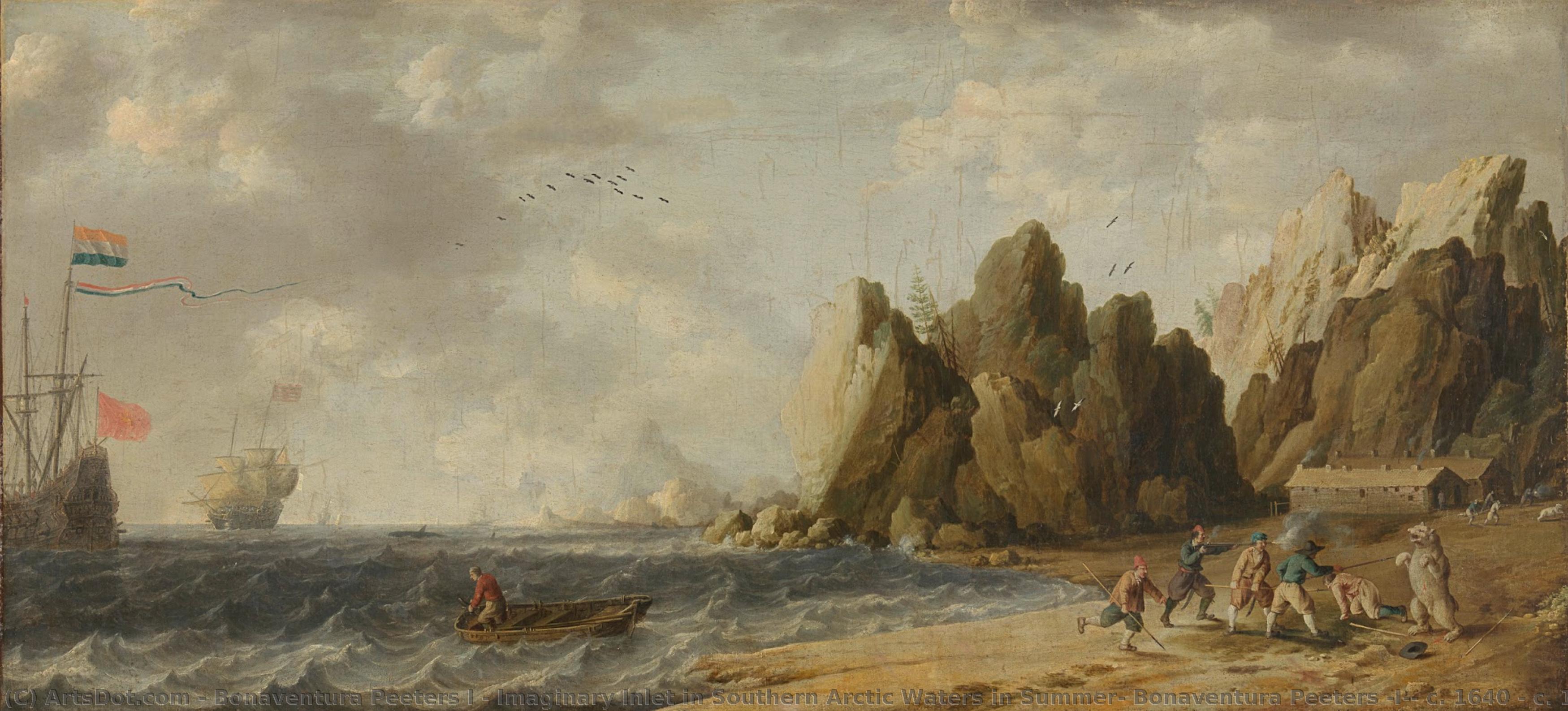
Imaginary Inlet in Southern Arctic Waters in Summer, Bonaventura Peeters (I), c. 1640 - c. 1650
 1650
1650 56.0 x 142.0 cm
 Read More
Hand Made Oil Reproduction
Hand-painted oil on canvas in your size and frame, made to order by our artists. ( Buy Print Buy Image)




































Pick from our preset sizes that match the artwork's original proportions.

You may enter your own dimensions to fit a specific frame or space. If your selected size does not match the original image's proportions, we will either crop the artwork or extend the painting with additional hand-painted elements. A digital mockup will be sent for your approval before production begins.
Please note that the on-screen preview does not reflect the actual cropping or extension. Only the mockup will accurately show the final composition.
While custom sizes are available, we recommend selecting a dimension from the predefined list to preserve the original proportions.
After order, ArtsDot.com team will email client for instructions and provide a mockup preview
Worldwide Delivery () in 3/4 weeks instead of standard 5 weeks. (30 August). No compromise on quality.

Free Worldwide Express Shipping

High-Quality Linen Canvas

Full Shipping Insurance

Customs Tax Refund Guarantee

True Color Matching Guarantee

60-Day Return Policy (Defects Only)

100% Money-Back Guarantee

Bulk Discount Offer
 Glass option is only available in size under 110 CM

Imaginary Inlet in Southern Arctic Waters in Summer, Bonaventura Peeters (I), c. 1640 - c. 1650
Reproduction Medium
Reproduction Size
-


Total Price
$ 263
Related Artworks









Artist Biography
The Master of Tempestuous Seas: The Life and Legacy of Bonaventura Peeters
In the heart of the seventeenth century, as the Low Countries emerged as a global maritime powerhouse, a specific kind of artistry began to flourish—one that captured the raw, unbridantly powerful essence of the ocean. At the forefront of this movement stood Bonaventura Peeters the Elder, a Flemish painter whose brush possessed the unique ability to translate the roar of a storm and the rhythmic pulse of the tide onto canvas. Born on July 23rd, 1614, in the vibrant artistic hub of Antwerp, Peeters was not merely an observer of the sea but a chronicler of its most dramatic moments. His life was deeply intertwined with the maritime identity of his era, and through his work, he granted immortality to the naval battles, shipwrecks, and tranquil harbors that defined the age of exploration.
Peeters’ artistic journey was shaped by a profound familial legacy. He was born into a lineage of creators, the son of Cornelis Peeters and Catharina van Eelen. This pedigree of talent extended to his siblings—Jan the Elder, Gillis the Elder, and Catharina—who were all accomplished painters in their own right. Such an environment fostered a specialized mastery of seascape painting that would become his hallmark. While his early training was rooted in this family tradition, scholarly consensus points to Andries van Eertvelt as a pivotal influence. From Van Eertvelt, Peeters likely inherited the technical prowess required to render the terrifying beauty of stormy seascapes, learning to use light and shadow to evoke the visceral tension of a vessel caught in a gale.
The professional ascent of Peeters was marked by significant milestones that solidified his standing within the prestigious Guild of Saint Luke in Antwerp, which he formally entered in 1634. This period of his life saw him transitioning from a promising talent to a sought-after master. His reputation for precision and observational accuracy was cemented when he received a commission from the Pensionary of Antwerp to document the siege of Kallo and Verrebroek. By creating detailed maps of this harrowing conflict, Peeters demonstrated a capacity for topographical truth that complemented his more atmospheric maritime works. This ability to blend strategic documentation with artistic expression allowed him to serve both the historical record and the aesthetic demands of his patrons.
Technique, Symbolism, and the Drama of the Deep
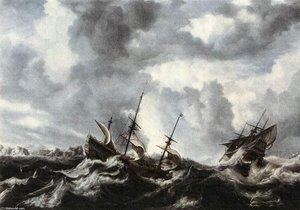
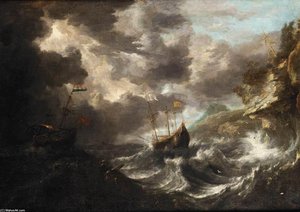
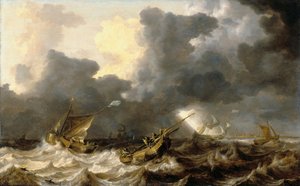
To gaze upon a work by Bonaventura Peeters is to experience the sublime—that specific aesthetic tension between awe and terror. His technique was characterized by a masterful use of chiaroscuro, where deep, churning shadows in the troughs of waves contrasted sharply with the frothing white crests of breaking surf. This interplay of light did more than just create depth; it imbued his paintings with a sense of divine presence and natural fury. In masterpieces such as Sailing Boats in a Thunderstorm, the viewer is not a distant spectator but a participant, feeling the spray of the salt air and the instability of the deck beneath their feet.
Beyond the sheer spectacle of weather, Peeters’ work often explored the intricate details of maritime commerce and civilization. His depictions of harbors, such as the evocative An Oriental Harbour, showcase a different facet of his genius. Here, the chaos of the storm is replaced by the organized bustle of trade. Through these scenes, he captured:
- The complexity of naval architecture: Meticulously rendered ships and boats that served as windows into 17th-century engineering.
- The vibrancy of maritime culture: The movement of figures along shorelines and the interaction of diverse vessels in crowded ports.
- The atmospheric light of the Low Countries: A soft, diffused glow that could transform a simple harbor view into a moment of profound tranquility.
His work often functioned as a symbolic dialogue between man and nature. The shipwreck, a recurring motif in his oeuvre, served as a poignant memento mori—a reminder of the fragility of human endeavor when confronted with the infinite power of the elements. Whether he was painting the strategic movements of naval fleets or the quiet dignity of a river scene, Peeters maintained an unwavering commitment to capturing the soul of the sea.
Historical Significance and Enduring Influence
Though his life was relatively short, ending in 1652, the impact of Bonaventura Peeters the Elder on the genre of marine art is immeasurable. He helped define a specific Flemish aesthetic that bridged the gap between the detailed realism of the Dutch Golden Age and the dramatic emotionalism of the Baroque period. His ability to document both the strategic realities of naval warfare and the poetic beauty of the natural world ensured that his work remained relevant to both historians and art enthusiasts alike.
The legacy of Peeters extends through the generations of the Peeters family, influencing subsequent artists like Bonaventura Peeters the Younger. His contributions helped establish Antwerp as a center for maritime excellence, providing a visual vocabulary for the era's naval triumphs and tragedies. Today, his paintings remain vital historical documents, offering us a window into a world where the horizon was not just a boundary, but a theater of human ambition and elemental power. Through his eyes, we continue to witness the timeless, tempestuous dance of the ocean.
bonaventura i peeters
1614 - 1652
Quick Facts
- Artistic Movement Or Style: Marine Art
- Artists Or Movements Influenced By This Artist: ['Dutch Golden Age']
- Artists Who Influenced This Artist: ['Andries van Eertvelt']
- Date Of Birth: 1614
- Date Of Death: 1652
- Full Name: Bonaventura Peeters I
- Nationality: Flemish
- Notable Artworks:
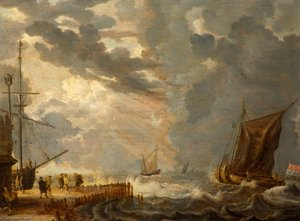
- Travellers Disembarking at a Jetty on the Scheldt in Strong Winds
- Imaginary Inlet in Southern Arctic Waters in Summer
- An Oriental Harbour
- Place Of Birth: Antwerp, Belgium