 Preview
 Send
Send Share
Share
 Details

 Download
 Similars
 X-Ray
X-Ray Diaporama
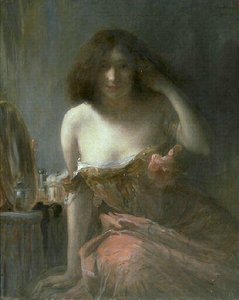
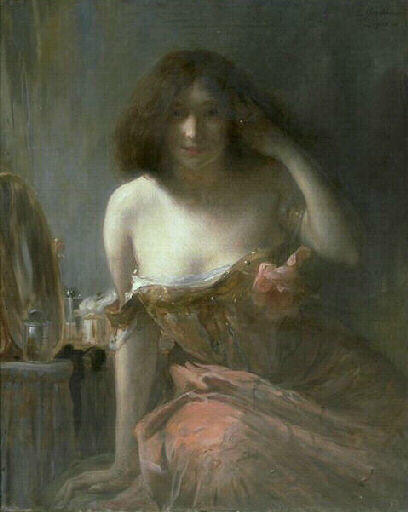
Femme à sa toilette
 Read More
Giclée / Art Print
Museum-quality giclée or canvas print with fast production and flexible finish options. ( Buy Hand Made Painting Buy Image)




































Pick from our preset sizes that match the artwork's original proportions.

You may enter your own dimensions to fit a specific frame or space. If your selected size does not match the original image's proportions, we will either crop the artwork or extend the image with a mirrored or solid-fill edge. A digital mockup will be sent for your approval before production begins.
Please note that the on-screen preview does not reflect the actual cropping or extension. Only the mockup will accurately show the final composition.
While custom sizes are available, we recommend selecting a dimension from the predefined list to preserve the original proportions.
Worldwide Delivery () in 2 weeks instead of standard 4/5 weeks. (26 August)

Free Worldwide Express Shipping

High-Quality Linen Canvas

Full Shipping Insurance

Customs Tax Refund Guarantee

True Color Matching Guarantee

60-Day Return Policy (Defects Only)

100% Money-Back Guarantee

Bulk Discount Offer
 Glass option is only available in size under 110 CM

Femme à sa toilette
Giclée / Art Print
Reproduction Size
-


Total Price
$ 63
Related Artworks

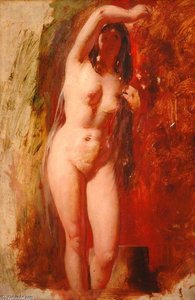








Artist Biography
Ernest Bordes: A Pioneer of Parisian Realism
Ernest Bordes (1852-1914) stands as a significant figure in the landscape of French Impressionist and Post-Impressionist painting, though his artistic trajectory often diverges from the mainstream narratives surrounding those movements. Born in Paris to a family of artists—his father was a sculptor—Bordes’s early exposure instilled within him a deep appreciation for meticulous observation and skillful rendering, shaping his distinctive approach to artmaking that would define his career. While he initially flirted with Impressionistic techniques, particularly capturing fleeting moments of light and atmosphere, Bordes swiftly transitioned towards a more rigorously realistic style, prioritizing anatomical accuracy and detailed depiction of textures—a stylistic choice that cemented his reputation as a master of academic realism.- Early Life & Artistic Training: Bordes received formal training at the École Supérieure des Beaux-Arts in Paris, where he honed his skills under influential instructors like Alexandre Cabanel and Jean-Léon Gérôme. These formative years instilled in him a profound understanding of classical artistic conventions and established a foundation for his later explorations of form and composition.
- Influences & Artistic Style: Bordes’s artistic sensibilities were profoundly impacted by the works of Gustave Courbet, whose uncompromising realism served as an inspiration for Bordes's own commitment to portraying subjects with unflinching honesty. Furthermore, he absorbed elements from Italian Renaissance art, particularly the meticulous attention to detail and idealized beauty evident in masterpieces by Raphael and Michelangelo—influences that subtly permeate his oeuvre.
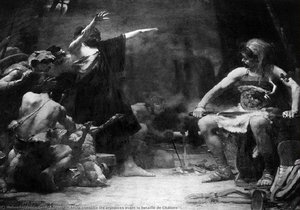
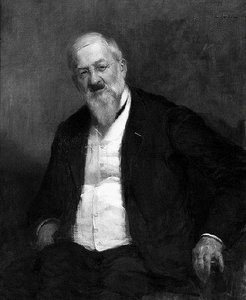
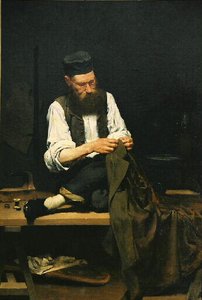
- Notable Paintings: Bordes’s artistic output encompassed a diverse range of subjects, including portraits, landscapes, and historical scenes. Among his most celebrated works are “Sous le porche,” a masterful depiction of domestic tranquility bathed in diffused sunlight; "Portrait d'Ernest Picot," showcasing exceptional anatomical precision; and “Le Concierge est tailleur,” an evocative portrayal capturing the everyday life of Parisian artisans. His monumental canvas “Attila” remains one of his most ambitious undertakings, demonstrating his ability to convey grandeur and drama with remarkable realism.
Technique & Artistic Philosophy
Bordes’s artistic philosophy centered on a belief in the transformative power of observation—a conviction that informed his meticulous approach to painting. Unlike Impressionists who sought to capture ephemeral sensations, Bordes prioritized capturing the essence of his subjects with unwavering accuracy. He employed techniques honed through years of disciplined practice, utilizing glazing layers and subtle tonal gradations to achieve unparalleled luminosity and depth. His canvases bear witness to an extraordinary command of color and texture—a testament to his dedication to mastering the complexities of artistic representation.- Glazing Technique: Bordes skillfully utilized glazing – applying thin translucent layers of paint over underlying colors – to build up tonal variations and create a sense of atmospheric depth. This technique allowed him to capture subtle nuances of light and shadow, enhancing the realism of his compositions.
- Detailed Rendering & Anatomical Accuracy: Bordes’s portraits are distinguished by their remarkable anatomical precision—a hallmark of academic realism. He meticulously studied human anatomy, painstakingly rendering muscles, bones, and skin textures with meticulous detail.
- Compositional Considerations: Bordes carefully considered compositional elements—such as perspective, balance, and spatial arrangement—to create visually compelling images that conveyed both intellectual rigor and emotional resonance.
Legacy & Historical Significance
Ernest Bordes’s contribution to French art history extends beyond his individual paintings; he represents a crucial link between Impressionism and Post-Impressionism, embodying the enduring influence of classical artistic traditions while simultaneously embracing innovative stylistic developments. His unwavering commitment to realism—coupled with his profound understanding of artistic technique—established him as a beacon of excellence within his era. Today, Bordes’s work continues to inspire artists and scholars alike, serving as a reminder that beauty can be found in meticulous observation and skillful execution—a legacy that secures his place among the most respected painters of the late nineteenth century.Further Exploration
You can find more information about Ernest Bordes and his artwork at Musée National Ernest Hébert: Musée National Ernest Hébert. Also, explore articles detailing his artistic journey: Ernest Hébert: A Master of Academic Realism & Parisian Salon Success and Ernest Biéler: Navigating Modernity Through Light & Form – A Comprehensive Exploration.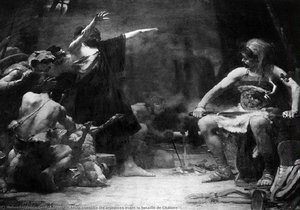
bordes ernest
1852 - 1914
Quick Facts
- Artistic Movement Or Style: Realism
- Date Of Birth: 1852
- Date Of Death: 1914
- Full Name: Ernest Bordes
- Nationality: French
- Notable Artworks: ['Attila']
- Place Of Birth: Paris, France