 Preview
 Send
Send Share
Share
 Details

 Download
 Similars
 X-Ray
X-Ray Diaporama
 Stats
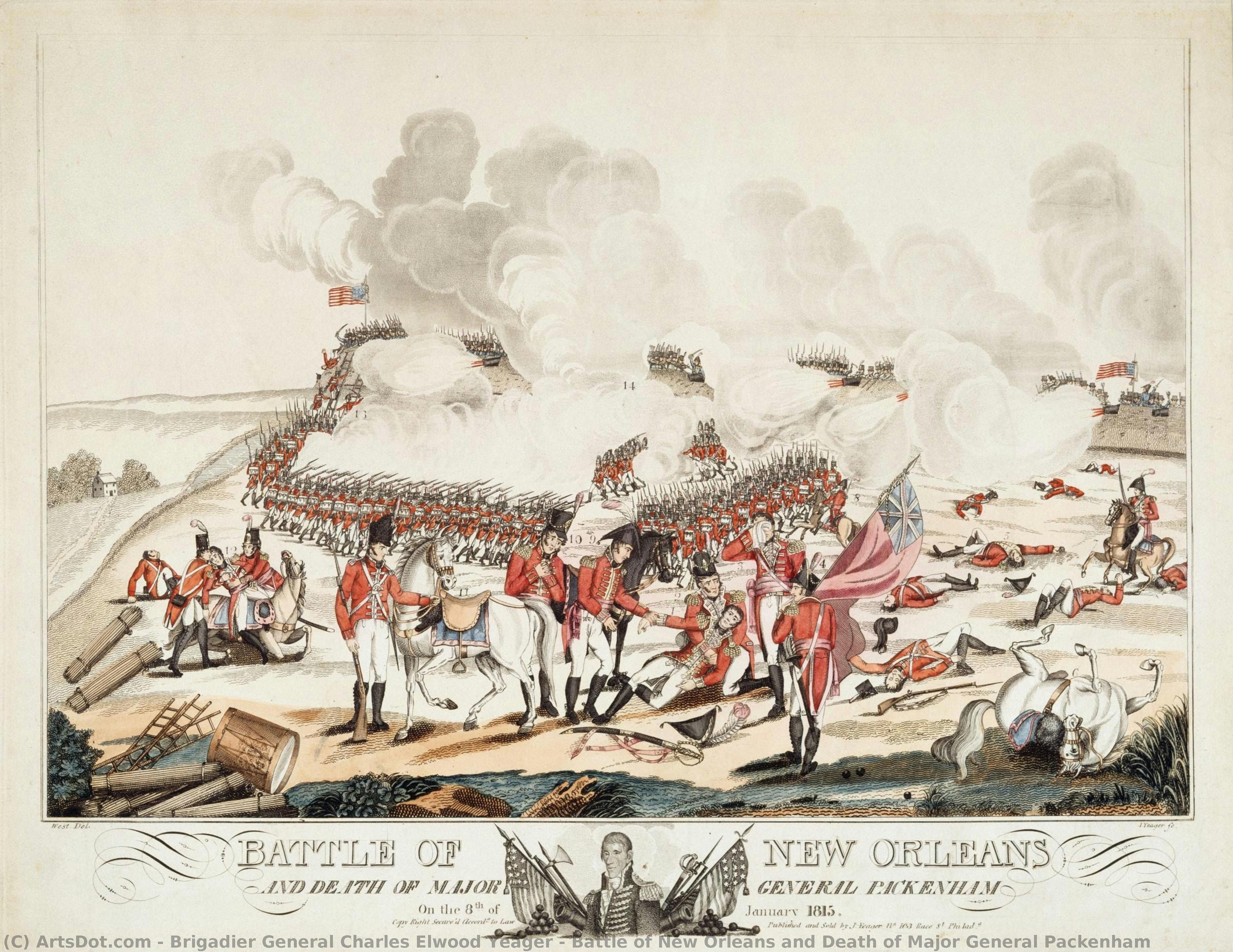
StatsBattle of New Orleans and Death of Major General Packenham
 57.0 x 45.0 cm
 Read More
Giclée / Art Print
Museum-quality giclée or canvas print with fast production and flexible finish options. ( Buy Hand Made Painting Switch to Digital Image)




































Pick from our preset sizes that match the artwork's original proportions.

You may enter your own dimensions to fit a specific frame or space. If your selected size does not match the original image's proportions, we will either crop the artwork or extend the image with a mirrored or solid-fill edge. A digital mockup will be sent for your approval before production begins.
Please note that the on-screen preview does not reflect the actual cropping or extension. Only the mockup will accurately show the final composition.
While custom sizes are available, we recommend selecting a dimension from the predefined list to preserve the original proportions.
Worldwide Delivery () in 2 weeks instead of standard 4/5 weeks. (9 September)

Free Worldwide Express Shipping

High-Quality Linen Canvas

Full Shipping Insurance

Customs Tax Refund Guarantee

True Color Matching Guarantee

100-Day Return Policy (Defects Only)

100% Money-Back Guarantee

Bulk Discount Offer
 Glass option is only available in size under 110 CM

Battle of New Orleans and Death of Major General Packenham
Giclée / Art Print
Reproduction Size
-


Total Price
$ 63
Related Artworks









Artist Biography
Roy Lichtenstein: A Pop Art Pioneer
Roy Fox Lichtenstein, born on October 27, 1923, in New York City, wasn’t simply an artist; he was a provocateur, a revolutionary who irrevocably altered the landscape of modern art. His life, shaped by a childhood steeped in scientific curiosity and cultural immersion, ultimately fueled his distinctive style – a vibrant collision of comic book imagery, advertising techniques, and a surprisingly profound exploration of American culture. Lichtenstein’s journey wasn't one of traditional artistic training; instead, he cultivated his vision through independent study, museum visits, and a deep engagement with the visual language of everyday life. His early influences were remarkably diverse, ranging from the grand narratives of Rembrandt and Daumier to the bold experimentation of Picasso – figures who challenged conventional notions of beauty and representation. This eclectic foundation would prove crucial in shaping his unique artistic voice.Early Years & Influences: A Foundation for Innovation
Lichtenstein’s childhood was a rich tapestry woven with intellectual stimulation and artistic exposure. Born into a comfortable middle-class family, he benefited from the cultural resources of New York City – frequent visits to the American Museum of Natural History and the Museum of Modern Art became formative experiences. His father, Milton Lichtenstein, was a successful real estate broker, while his mother, Beatrice Werner Lichtenstein, had trained as a pianist and instilled in her children a love for music and art. This dual influence—a pragmatic businessman alongside a cultured homemaker—provided a unique backdrop for Roy’s development. He displayed artistic talent early on, sketching, painting, and sculpting with evident skill. Notably, his fascination with the Bayeux Tapestry, a medieval embroidery depicting the Norman Conquest, is often cited as an early inspiration, demonstrating a nascent interest in narrative imagery and meticulous detail – elements that would later become hallmarks of his work. Hoyt L. Sherman, a teacher at Ohio State University (OSU), played a particularly significant role, introducing Lichtenstein to a method of composition based on visual organization and unity—a technique he carried with him throughout his career.The Emergence of Pop Art & Methodical Reproduction
Lichtenstein’s artistic trajectory truly took shape in the late 1940s and early 1950s, as he began to draw inspiration from printed images – comic strips, advertisements, and packaging. This shift marked his entry into the burgeoning movement known as Pop Art. Rejecting the prevailing Abstract Expressionist focus on individual emotion and subjective experience, Lichtenstein embraced the commonplace, the mass-produced, and the readily accessible. He meticulously studied the techniques of commercial printing—Ben Day dots, halftone patterns, and screenprinting—and employed them to create his iconic paintings. These works weren’t simply reproductions; they were deliberate reinterpretations, imbued with a subtle irony and a commentary on American consumer culture. His early series, depicting stylized knights, castles, and maidens inspired by the Bayeux Tapestry, demonstrated a playful engagement with historical imagery, while later works focused on scenes from comic books and advertisements, such as “Drowning Girl” (1963), offered sharp critiques of societal anxieties and romantic ideals.A Vast Oeuvre & Lasting Legacy
Over the course of his prolific career, Roy Lichtenstein produced an astonishing volume of over 5,000 paintings, prints, drawings, sculptures, murals, and other objects. This immense output reflects not only his tireless dedication but also a constant exploration of themes and techniques. He wasn’t simply repeating images; he was refining them, experimenting with scale, color palettes, and compositional arrangements. His work became increasingly complex and layered over time, incorporating elements of Surrealism and even classical art. Lichtenstein's influence extends far beyond the Pop Art movement itself. His innovative use of commercial printing techniques paved the way for subsequent generations of artists who sought to blur the boundaries between high and low culture. He demonstrated that seemingly mundane imagery could be elevated to the level of fine art, challenging traditional notions of artistic merit. Roy Lichtenstein died on September 14, 2023, leaving behind a legacy as one of the most important and influential artists of the 20th century—a testament to his unique vision and unwavering commitment to pushing the boundaries of contemporary art.Key Characteristics & Artistic Techniques
- Halftone Dots:** Lichtenstein’s signature technique involved meticulously recreating the visual effect of newspaper printing using tiny dots of varying shades, creating a sense of depth and texture.
- Comic Book Imagery: He frequently drew inspiration from comic book panels, adapting their dynamic composition, bold colors, and simplified narratives into his paintings.
- Advertising Motifs: Lichtenstein’s work often incorporated elements from advertisements, reflecting the pervasive influence of consumer culture in American society.
- Irony & Commentary: While superficially resembling commercial art, Lichtenstein's paintings frequently carried subtle layers of irony and social commentary, prompting viewers to question their assumptions about beauty, value, and representation.

brigadier general charles elwood yeager
1923 - 2020 , United States of America
Quick Facts
- Artistic Movement Or Style: Pop Art
- Artists Or Movements Influenced By This Artist:
- Comic strips
- Advertisement
- Artists Who Influenced This Artist:
- Rembrandt
- Daumier
- Picasso
- Date Of Birth: 1923-10-27
- Date Of Death: 2020
- Full Name: Roy Fox Lichtenstein
- Nationality: American
- Notable Artworks:
- Whaam!
- Drowning Girl
- Hopelessness
- Place Of Birth: New York City, USA