Preview
 Send
Send Share
Share
 Details

 Download
 Similars
 X-Ray
X-Ray Diaporama
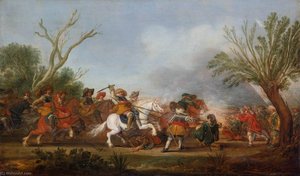
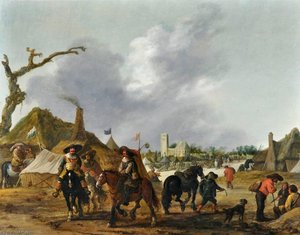
Cavalry Skirmish
 49.0 x 85.0 cm
 Read More
Hand Made Oil Reproduction
Hand-painted oil on canvas in your size and frame, made to order by our artists. ( Buy Print Buy Image)




































Pick from our preset sizes that match the artwork's original proportions.

You may enter your own dimensions to fit a specific frame or space. If your selected size does not match the original image's proportions, we will either crop the artwork or extend the painting with additional hand-painted elements. A digital mockup will be sent for your approval before production begins.
Please note that the on-screen preview does not reflect the actual cropping or extension. Only the mockup will accurately show the final composition.
While custom sizes are available, we recommend selecting a dimension from the predefined list to preserve the original proportions.
After order, ArtsDot.com team will email client for instructions and provide a mockup preview
Worldwide Delivery () in 3/4 weeks instead of standard 5 weeks. (22 August). No compromise on quality.

Free Worldwide Express Shipping

High-Quality Linen Canvas

Full Shipping Insurance

Customs Tax Refund Guarantee

True Color Matching Guarantee

60-Day Return Policy (Defects Only)

100% Money-Back Guarantee

Bulk Discount Offer
 Glass option is only available in size under 110 CM

Cavalry Skirmish
Reproduction Medium
Reproduction Size
-


Total Price
$ 263
Related Artworks







Artist Biography
Palamedes Palamedesz: A Dutch Master of Battlefield Drama
The world of 17th-century Dutch painting is a rich tapestry woven with portraits, landscapes, and still lifes – yet within this diverse landscape, a particular niche was carved out by Palamedes Palamedesz (1607-1638), a painter whose dramatic depictions of military encampments and battles stand apart. Though his life was tragically short, and he remains somewhat obscure compared to contemporaries like Rembrandt or Vermeer, Palamedesz’s work possesses a raw energy and visceral realism that continues to captivate viewers today. He wasn't born into the established artistic circles; instead, his story begins in London, where his father, a skilled gem cutter employed by King James I, provided for the family before they returned to Delft, Palamedes’ birthplace.
Palamedes’ early life was marked by an unusual physical appearance – he was described as short, hunchbacked, and unattractive. Despite these challenges, his talent blossomed under the tutelage of his brother, Anthonie Palamedesz, a respected portrait painter. Crucially, however, Palamedes eschewed formal training, preferring to learn through meticulous copying of Esaias van de Velde’s dynamic battle scenes. This deliberate choice reveals a key aspect of his artistic philosophy: a deep respect for the established masters while simultaneously forging his own distinctive style. He famously declared “to begin from the beginning,” a sentiment that perhaps reflected his determination to overcome his personal limitations and establish himself as an artist.
The Influence of Van de Velde and Haarlem’s Military Tradition
Palamedes' artistic journey was profoundly shaped by Esaias van de Velde, whose dynamic compositions depicting cavalry charges and military maneuvers served as a crucial model. Van de Velde’s influence is evident in Palamedes’ own works – the same sense of movement, the careful rendering of armor and weaponry, and the dramatic use of light and shadow are all hallmarks of both artists. However, Palamedes didn't simply imitate; he absorbed Van de Velde’s techniques and adapted them to his own subject matter and artistic vision.
Furthermore, Palamedes was influenced by the military painting tradition that flourished in Haarlem during this period. Haarlem had a long-standing connection with the Dutch army, and its artists were frequently commissioned to create depictions of battles and military campaigns. This fostered a culture of realism and attention to detail within the city’s artistic community, which undoubtedly impacted Palamedes' approach to his subject matter. The works of Hendrik Avercamp, another Haarlem painter known for his scenes of military life, likely provided further inspiration.
A Specialist in Battlefield Scenes
Palamedes quickly established himself as a specialist in depicting battlefield scenes – a genre that was gaining popularity throughout the Dutch Republic during the 17th century. His paintings typically featured large-scale compositions filled with figures engaged in combat, showcasing the chaos and drama of war. Unlike some of his contemporaries who focused on idealized or heroic representations of military events, Palamedes’ scenes were often gritty and realistic, capturing the brutality and suffering inherent in warfare. He frequently depicted cavalry skirmishes, infantry engagements, and siege operations – subjects that offered ample opportunities for dramatic composition and dynamic movement.
His most notable works are closely linked to Cornelis de Bie's *Het Gulden Cabinet*, a lavish compendium of military history and strategy. Palamedes’ paintings served as visual illustrations for De Bie’s text, providing a vivid depiction of the events described within its pages. This association helped to elevate his reputation and establish him as a leading artist in the field of military painting.
A Short but Significant Career
Despite his talent and growing recognition, Palamedes' career was tragically cut short by illness. He died in Delft at the young age of 31, leaving behind only four children. His life was remarkably brief, yet during that time he produced a significant body of work – approximately 20-30 paintings are currently attributed to him.
Palamedes’ legacy is one of innovation and determination. He defied conventional expectations by developing his artistic skills independently, mastering the techniques of established masters while forging his own unique style. His dynamic depictions of battlefield scenes offer a compelling glimpse into the realities of 17th-century warfare and demonstrate the remarkable talent of a painter whose career was tragically curtailed but whose work continues to resonate with viewers today.
Palamedes Palamedesz: A Continuing Legacy
Today, Palamedes Palamedesz’s paintings are held in prominent collections around the world, including the Mauritshuis in The Hague and the Rijksmuseum in Amsterdam. His work is valued for its dramatic intensity, realistic detail, and insightful portrayal of military life. Research continues to shed light on his artistic influences, techniques, and place within the broader context of Dutch Golden Age painting. While he may not be as widely celebrated as some of his contemporaries, Palamedes Palamedesz remains a significant figure in the history of Dutch art – a testament to the power of talent, perseverance, and a singular artistic vision.
called stevaerts palamedes palamedesz
1607 - 1638
Quick Facts
- Artistic Movement Or Style: Military genre
- Artists Or Movements Influenced By This Artist: ['Anthonie Palamedesz']
- Artists Who Influenced This Artist: ['Esaias van de Velde']
- Date Of Birth: 1607, London
- Date Of Death: 1638, Delft
- Full Name: Palamedes Palamedesz
- Nationality: Dutch
- Notable Artworks: ['Battle scenes']
- Place Of Birth: London, England