 Preview
 Send
Send Share
Share
 Details

 Download
 Similars
 X-Ray
X-Ray Diaporama
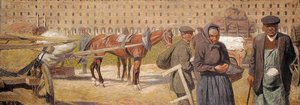
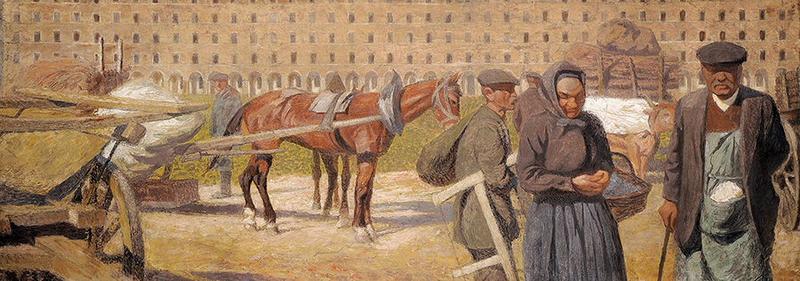
Marché au bois, place de Verdun (2)
 Read More
Hand Made Oil Reproduction
Hand-painted oil on canvas in your size and frame, made to order by our artists. ( Buy Print Buy Image)




































Pick from our preset sizes that match the artwork's original proportions.

You may enter your own dimensions to fit a specific frame or space. If your selected size does not match the original image's proportions, we will either crop the artwork or extend the painting with additional hand-painted elements. A digital mockup will be sent for your approval before production begins.
Please note that the on-screen preview does not reflect the actual cropping or extension. Only the mockup will accurately show the final composition.
While custom sizes are available, we recommend selecting a dimension from the predefined list to preserve the original proportions.
After order, ArtsDot.com team will email client for instructions and provide a mockup preview
Worldwide Delivery () in 3/4 weeks instead of standard 5 weeks. (27 August). No compromise on quality.

Free Worldwide Express Shipping

High-Quality Linen Canvas

Full Shipping Insurance

Customs Tax Refund Guarantee

True Color Matching Guarantee

60-Day Return Policy (Defects Only)

100% Money-Back Guarantee

Bulk Discount Offer
 Glass option is only available in size under 110 CM

Marché au bois, place de Verdun (2)
Reproduction Medium
Reproduction Size
-


Total Price
$ 313
Related Artworks









Artist Biography
The Academic Foundation of a Master
Born in the vibrant heart of Paris in 1853, Camille Félix Bellanger entered a world defined by the grandeur of the Second Empire and the rigorous standards of the French academic tradition. His early years were shaped by the monumental shifts occurring in the Parisian landscape under Baron Haussmann, yet his artistic soul was deeply rooted in the timeless principles of the Beaux-Ons style. As a student at the prestigious École des Beaux-Arts, Bellanger walked the same halls as the titans of classical representation, absorbing the meticulous techniques of masters like Alexandre Cabanel and William Bouguereau. This period of intense training instilled in him a profound respect for anatomical precision, sculptural clarity, and the dramatic potential of historical narrative.
The dawn of his professional recognition arrived with striking force in 1875, when his work The Death of Abel earned him a Second Class Medal at the renowned Prix de Rome competition. This achievement was more than a mere accolade; it was a formal induction into the upper echelons of the French artistic hierarchy. In this early masterpiece, one can observe the palpable influence of his mentors, specifically through the use of dramatic composition and a reverence for the human form that mirrored Bouguereau’s own pursuit of serene, idealized beauty. During these formative years, Bellanger’s brush was dedicated to the weight of history, often exploring religious iconography and mythological themes that sought to impart moral lessons through the lens of classical heroism.
From Heroic Narratives to Rural Realism
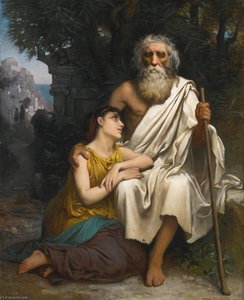
As his career progressed, Bellanger demonstrated a remarkable capacity for stylistic evolution, moving beyond the rigid confines of academic idealism toward a more nuanced observation of life. While he continued to command respect through large-scale commissions—such as The Death of Demosthenes and Chalonidas’ Last Appeal, which celebrated the virtues of sacrifice and national duty—a new sensitivity began to emerge in his work. His later years saw a departure from the heavy drapery of antiquity toward the sun-drenched, atmospheric textures of the French countryside. This transition marked his engagement with the burgeoning movements of realism and impressionistic observation, where the focus shifted from the legendary to the everyday.
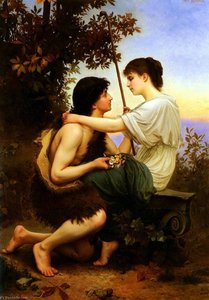
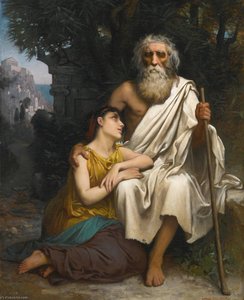
This stylistic broadening was perhaps most evident in his depictions of Provence, where the artist captured the rhythmic pulse of rural existence. In works such as Idylle, Bellanger moved away from sculptural precision to embrace a more romantic, hazy landscape that evoked the warmth and nostalgia of youthful love. His fascination with the local character of France led him to document the vibrant energy of market scenes, such as Marché au bois, place de Verdun. In these canvases, the meticulous control of his academic training met a new, looser brushstroke, allowing for a play of light and shadow that suggested the fleeting nature of a moment—a hallmark of the impressionistic spirit.
A Lasting Legacy in French Art
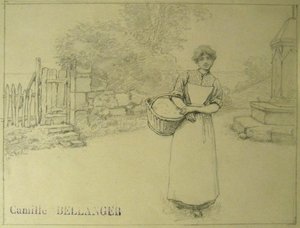
The significance of Camille Félix Bellanger lies in his unique position as a bridge between two eras. He possessed the rare ability to uphold the dignity of the classical tradition while remaining receptive to the sensory revolutions of his time. Whether rendering the stark, emotive lines of a black and white drawing like Fermière or capturing the bustling, colorful atmosphere of a Provencal market, Bellanger’s oeuvre remains a testament to the versatility of the nineteenth-century French painter. His life, which concluded in 1923, spanned a period of immense artistic upheaval, yet his work remained anchored by a fundamental commitment to truth—be it the historical truth of a myth or the lived truth of a peasant woman.
Today, his contributions are preserved in esteemed collections such as the Musée Ziem, where his ability to blend romantic idealism with observational realism continues to captivate scholars and art lovers alike. His legacy is defined by several key artistic pillars:
- Technical Mastery: A lifelong dedication to the anatomical accuracy and compositional balance inherited from the École des Beaux-Arts.
- Thematic Versatility: The successful transition from heavy mythological and religious subjects to the light-filled, pastoral scenes of French provincial life.
- Historical Synthesis: Serving as a vital link between the structured grandeur of the Second Empire and the atmospheric explorations of late nineteenth-century realism.
camille félix bellanger
1853 - 1923
Quick Facts
- Artistic Movement Or Style: Academic Style
- Artists Or Movements Influenced By This Artist: ['Neo-classical Sculpture']
- Artists Who Influenced This Artist:
- Alexandre Cabanel
- William Bouguereau
- Date Of Death: 1923
- Full Name: Camille Félix Bellanger
- Nationality: French
- Notable Artworks:
- Idylle
- Marché au bois, place de Verdun (1)
- Fermière
- Place Of Birth: Paris