 Preview
 Send
Send Share
Share
 Details

 Download
 Similars
 X-Ray
X-Ray Diaporama
Story of Tobias
 Acrylic On Canvas
- WallArt
- Baroque
 1660
1660 133.0 x 165.0 cm
 Hermitage Museum
 Read More
Hand Made Oil Reproduction
Hand-painted oil on canvas in your size and frame, made to order by our artists. ( Buy Print Buy Image)




P118B $10

P118H $10

P118W $10

P438Z $10

P508JH $12

P508YH $12

P805H $10

P805Z $10

P919BZ $10

P919G $10

P919XJ $10

P959ZH $10

P968JZ $12

W106C $8

W218G $10

W218JH $8

W218Y $10

W307PJ $10

W316G $10

W316PJ $8

W316Y $10

W398PJ $8

W4111J $10

W500HY $15

W500JH $15

W692G $12

W849H $8

W940BG $15

W953PJ $8




Pick from our preset sizes that match the artwork's original proportions.

You may enter your own dimensions to fit a specific frame or space. If your selected size does not match the original image's proportions, we will either crop the artwork or extend the painting with additional hand-painted elements. A digital mockup will be sent for your approval before production begins.
Please note that the on-screen preview does not reflect the actual cropping or extension. Only the mockup will accurately show the final composition.
While custom sizes are available, we recommend selecting a dimension from the predefined list to preserve the original proportions.
After order, ArtsDot.com team will email client for instructions and provide a mockup preview
Worldwide Delivery () in 3/4 weeks instead of standard 5 weeks. (16 August). No compromise on quality.

Free Worldwide Express Shipping

High-Quality Linen Canvas

Full Shipping Insurance

Customs Tax Refund Guarantee

True Color Matching Guarantee

60-Day Return Policy (Defects Only)

100% Money-Back Guarantee

Bulk Discount Offer
 Glass option is only available in size under 110 CM

Story of Tobias
Reproduction Medium
Reproduction Size
-


Total Price
$ 263
Artwork Description
The Story of Tobias: A Baroque Masterpiece
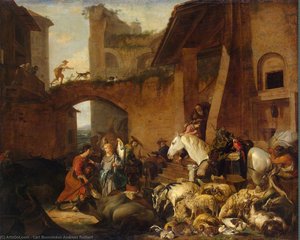
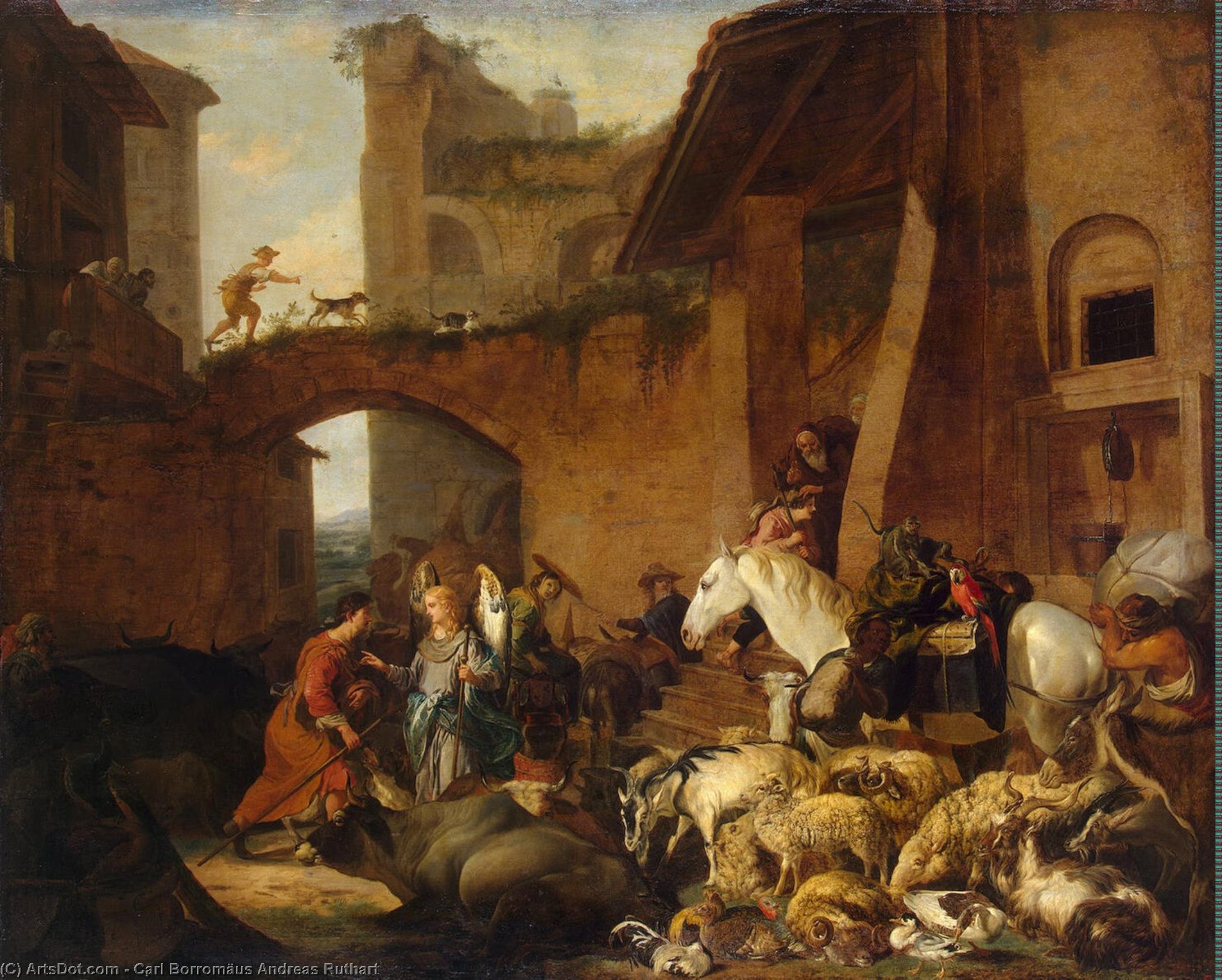
Carl Borromäus Andreas Ruthart’s “Story of Tobias” stands as a testament to the grandeur and dramatic intensity characteristic of Baroque art. Painted circa 1660, this monumental oil on canvas transcends mere depiction; it embodies a profound exploration of biblical narrative interwoven with masterful artistic execution.
- Subject Matter: The painting recounts the biblical tale of Tobias, recounting the miraculous deliverance of Tobias and his father from a fearsome dragon. This story served as a springboard for Ruthart’s artistic vision, capturing pivotal moments—the farewell between Tobias and his father at the porch of their home, and the triumphant return with Sarah, laden with riches and livestock—demonstrating Ruthart's ability to convey complex emotions within a meticulously crafted scene.
- Style & Technique: Ruthart’s style aligns squarely with Baroque principles, prioritizing dynamism and theatricality. Employing chiaroscuro – the skillful manipulation of light and shadow championed by Rubens – he achieves an unparalleled level of realism while simultaneously elevating the composition to a sublime aesthetic. The artist's brushstrokes are bold and confident, conveying movement and texture that imbue the canvas with palpable energy.
- Historical Context: Created during a period marked by papal patronage and fervent religious fervor, “Story of Tobias” reflects the Baroque preoccupation with portraying biblical narratives as expressions of divine grace. Ruthart’s work aligns with the broader artistic trends of Antwerp and Rome, where artists sought to inspire awe and reverence through grand scale and dramatic visual storytelling.
- Symbolism: The abundance of animals—horses, sheep—within the painting serves as more than mere decorative elements; they symbolize fertility, prosperity, and divine providence. Ruthart’s careful placement of figures and animals contributes to a multilayered narrative that speaks to themes of faith, courage, and redemption.
- Emotional Impact: Viewing “Story of Tobias” evokes a sense of wonder and contemplation. The artist's masterful portrayal of human emotion—fear, determination, joy—resonates deeply with the viewer, capturing the essence of biblical storytelling at its most compelling.
Ruthart’s dedication to detail and his command of artistic technique are evident throughout the canvas. The meticulous rendering of textures—the rough stone of Tobias's house, the fleece of Sarah’s sheep—enhances the realism of the scene while simultaneously conveying a sense of immediacy.
Related Artworks
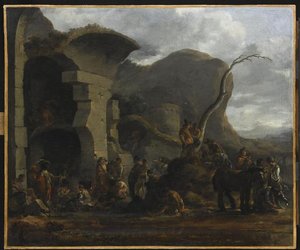
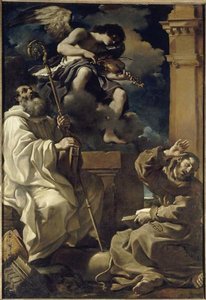
Artist Biography
Carl Borromäus Andreas Ruthart: A Baroque Visionary Embracing Nature’s Majesty
Carl Borromäus Andreas Ruthart (1630 – c. 1703; also known as Carl Ruther and Karl Ruthard; in Italian as Carlo Borromeo Rutardo) stands as a pivotal figure within the artistic landscape of Baroque Italy, particularly during its formative years. Born in Gdańsk, Poland—a crossroads of European culture—Ruthart’s journey toward becoming a celebrated painter began with an apprenticeship under Daniel Schultz, establishing him firmly within the burgeoning artistic milieu of Antwerp. This early exposure to Flemish masters undoubtedly instilled a foundational appreciation for meticulous detail and dramatic composition, elements that would permeate his subsequent oeuvre.- Early Influences: Schultz’s workshop fostered Ruthart's understanding of chiaroscuro—the masterful interplay of light and shadow—a technique championed by Rubens himself, whose influence is palpable throughout Ruthart’s artistic style.
- Antwerp Guild Mastership (1663-1664): Achieving guild master status signified not merely professional success but also acceptance into the established artistic hierarchy. During this period, Ruthart honed his skills and gained invaluable experience collaborating with fellow artists on ambitious projects.
- Vienna Years (Late 1660s): Ruthart’s brief stint in Vienna provided him with exposure to Habsburg patronage and broadened his artistic horizons. He undertook commissions for ecclesiastical institutions, reflecting the prevailing religious fervor of the era.
Notable Works: Echoes of Rubens and Symbolism
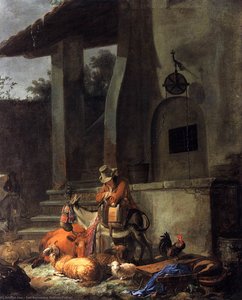
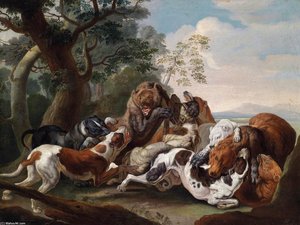
Ruthart's artistic legacy rests upon several iconic paintings that exemplify his stylistic prowess and thematic concerns. “Rest by the Draw Well” exemplifies Ruthart’s meticulous attention to detail and masterful use of color, capturing a serene pastoral scene imbued with spiritual significance—a deliberate homage to Rubens’s celebrated landscapes. Similarly, "Bear Hunt" showcases Ruthart's dynamic composition and expressive brushstrokes, portraying a thrilling chase through woodland terrain that symbolizes the pursuit of righteousness. These works stand as testament to Ruthart’s ability to transform natural beauty into vehicles for conveying profound philosophical ideas.Technique and Artistic Style
Ruthart’s artistic technique is rooted in the principles of Flemish Baroque painting, prioritizing realism combined with idealized forms. He skillfully employed oil paints on canvas, achieving luminous surfaces and capturing subtle tonal variations—a hallmark of Rubensian artistry. Ruthart's compositions are carefully balanced, utilizing pyramidal structures to guide the viewer’s gaze and creating a sense of grandeur and solemnity. His brushwork is characterized by smooth gradations and textural nuances, contributing to the overall impression of visual richness and emotional depth.Legacy and Historical Significance
Carl Borromäus Andreas Ruthart's contribution to Baroque art extends beyond his individual masterpieces. He represents a crucial link between Flemish artistic traditions and Italian stylistic developments—a conduit for disseminating humanist ideals across Europe. His paintings continue to inspire admiration for their beauty, precision, and spiritual resonance, securing his place as one of the most accomplished artists of his generation. Ruthart’s enduring influence underscores the power of art to communicate complex ideas and elevate the human spirit—a legacy that resonates powerfully within the annals of artistic history.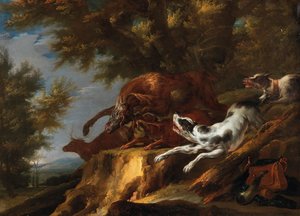
carl borromäus andreas ruthart
1630 - 1703 , Poland
Quick Facts
- Artistic Movement Or Style: Baroque
- Artists Or Movements Influenced By This Artist: ['Renaissance Mantua']
- Artists Who Influenced This Artist: ['Peter Paul Rubens']
- Date Of Birth: Gdńsk, Poland (1630)
- Full Name: Carl Borromäus Andreas Ruthart
- Nationality: German
- Notable Artworks:
- Rest by the Draw Well
- Bear Hunt
- Story of Tobias
- Place Of Birth: Danzig
Related Articles

Dutch Baroque Masters: 10 Paintings That Shaped an Era | ArtsDot
Journey through the Golden Age with our guide to the Top 10 Dutch Baroque masterpieces! Explore iconic paintings by Rembrandt, Vermeer & Frans Hals. Find museum-quality art reproductions and elevate your home decor at ArtsDot.com.

Golden Age Reflections: Dutch Baroque Painting & Cultural Innovation
Explore the Dutch Golden Age of painting! Discover key artists like Vermeer & ter Borch, their innovative techniques, and the rich cultural context behind these Baroque masterpieces. Learn about collecting & appreciating this iconic art period.

Baroque Masterpieces: 10 Paintings That Defined an Era |
Journey through the drama & grandeur of Baroque art! Explore 10 masterpieces by Caravaggio, Rembrandt, Rubens & more. Discover stunning oil paintings, rich colors & timeless stories. Find museum-quality reproductions at .

Baroque Drama: Bringing Opulence & Emotion into Contemporary Interiors
Explore the opulent world of Baroque interior design! Discover key elements, modern applications & how to bring dramatic elegance into your home with 's authentic reproductions.

The Dramatic Flourish: Exploring the Baroque Movement's Enduring Legacy in Art History
Explore the dramatic world of Baroque art! Discover iconic artists like Caravaggio & Rubens, defining techniques, and its lasting impact on art history. Expert insights for collectors & enthusiasts at ArtsDot.