 Preview
 Send
Send Share
Share
 Details

 Download
 Similars
 X-Ray
X-Ray Diaporama
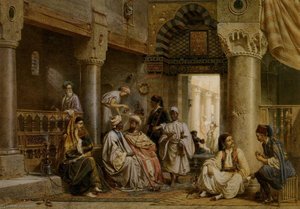
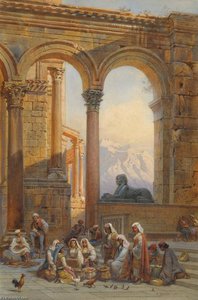
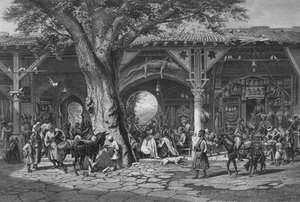
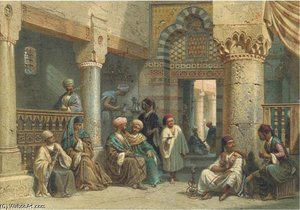
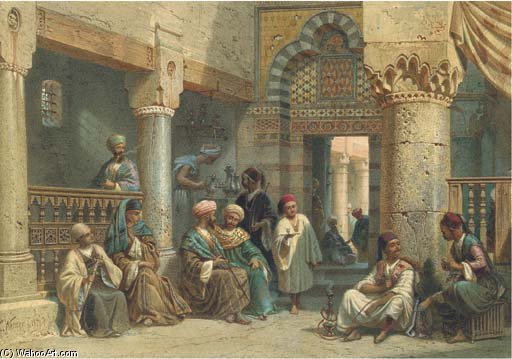
The Coffee House
 Read More
Hand Made Oil Reproduction
Hand-painted oil on canvas in your size and frame, made to order by our artists. ( Buy Print Buy Image)




































Pick from our preset sizes that match the artwork's original proportions.

You may enter your own dimensions to fit a specific frame or space. If your selected size does not match the original image's proportions, we will either crop the artwork or extend the painting with additional hand-painted elements. A digital mockup will be sent for your approval before production begins.
Please note that the on-screen preview does not reflect the actual cropping or extension. Only the mockup will accurately show the final composition.
While custom sizes are available, we recommend selecting a dimension from the predefined list to preserve the original proportions.
After order, ArtsDot.com team will email client for instructions and provide a mockup preview
Worldwide Delivery () in 3/4 weeks instead of standard 5 weeks. (16 August). No compromise on quality.

Free Worldwide Express Shipping

High-Quality Linen Canvas

Full Shipping Insurance

Customs Tax Refund Guarantee

True Color Matching Guarantee

60-Day Return Policy (Defects Only)

100% Money-Back Guarantee

Bulk Discount Offer
 Glass option is only available in size under 110 CM

The Coffee House
Reproduction Medium
Reproduction Size
-


Total Price
$ 263
Related Artworks

Artist Biography
The Visionary of Light and Water: The Life of Carl Friedrich Heinrich Werner
In the quiet, scholarly atmosphere of 19th-century Weimar, a profound artistic journey began that would eventually bridge the gap between the romanticized European imagination and the sun-drenched realities of the Orient. Carl Friedrich Heinrich Werner, born in 1808, was not merely a painter of landscapes but a meticulous chronicler of light, architecture, and cultural essence. His early years were shaped by the rigorous artistic traditions of Germany, where he studied under the esteemed Julius Schnorr von Carolsfeld in Leipzig. This foundation provided him with a technical precision that would later become his greatest asset when navigating the complex textures of distant lands. While his brief foray into studying architecture in Munich between 1829 and 1831 might have seemed a departure from fine art, it actually gifted his later paintings with an unparalleled structural integrity, allowing him to render the ancient monuments of the Middle East with the soul of an artist and the eye of an architect.
The trajectory of Werner’s career took a transformative turn when he followed the path of many great travelers of his era, seeking inspiration beyond the borders of Europe. His time in Italy, particularly his establishment of a studio in Venice, served as a vital period of refinement. In the shimmering canals and decaying grandeur of Venice, Werner mastered the delicate art of watercolor layering, learning to capture the way light dances upon water and settles into stone. This period of his life was marked by an increasing fascination with the interplay between atmosphere and form, a skill that would later define his most celebrated works. As he moved through Europe, exhibiting in prestigious venues like the New Watercolour Society in England, his reputation as a master of the medium began to solidify, setting the stage for his most ambitious expeditions.
A Journey Through the Orient: Capturing the Sacred and the Sublime
The true essence of Werner’s legacy lies in his profound engagement with the landscapes of Palestine and Egypt. Unlike many Orientalist painters who relied on studio-bound fantasies or secondhand accounts, Werner sought direct, visceral contact with his subjects. His travels in the 1860s were more than mere sightseeing; they were spiritual and artistic pilgrimages. He possessed a rare privilege during his time in Jerusalem, becoming one of the few non-Muslim artists able to gain access to the interior of the Dome of the Rock. This intimate encounter allowed him to document the intricate mosaics and sacred geometry of the site with a level of detail that remains breathtaking even by modern standards.
His work from these expeditions transcends simple topographical recording. Through his brush, the bustling marketplaces, the ancient tombs of Egypt, and the sprawling vistas of the Nile became living, breathing entities. He had an uncanny ability to capture the atmospheric conditions—the heavy heat of a desert afternoon, the cool shadows of a stone portal, or the hazy light of a Mediterranean morning. His paintings often feature:
- Architectural Grandeur: A precise rendering of historical monuments such as the Sphinx and the Pyramids of Giza, treated with both reverence and scientific accuracy.
- Cultural Immediacy: The inclusion of human activity that provides a sense of scale and life to the vast landscapes.
- Tonal Mastery: An expert use of watercolor washes to create depth, suggesting the dusty air and sun-bleached surfaces of the Levant.
Legacy and Historical Significance
As the 19th century progressed, Werner’s work stood as a testament to the power of observation. While the Romantic movement often leaned toward the dramatic and the exaggerated, Werner maintained a commitment to a certain truthfulness, even when depicting the exotic. His published collection, Jerusalem, served as a vital visual record for a European audience hungry for authentic glimpses of the Holy Land. He did not merely paint scenes; he translated the very atmosphere of a culture into a medium that felt both intimate and expansive.
Today, the works of Carl Friedrich Heinrich Werner are cherished not only for their aesthetic beauty but for their historical value. They serve as windows into a world that was undergoing profound transitions, captured by an artist who possessed the patience to wait for the light and the skill to immortalize it. His contribution to the genre of Orientalist watercolor remains significant, marking him as a pioneer who moved beyond the superficial to find the enduring spirit within the architecture and landscapes of the East. Through his meticulous hand, the ancient stones of Egypt and the sacred halls of Jerusalem continue to speak to the modern viewer with clarity and grace.
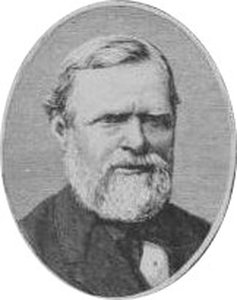
carl (friedrich heinrich) werner
1808 - 1894 , Germany
Quick Facts
- Artistic Movement Or Style: Orientalism
- Date Of Birth: October 4, 1808
- Date Of Death: January 10, 1894
- Full Name: Carl Friedrich Heinrich Werner
- Nationality: German
- Notable Artworks:
- David's Strasse
- An Arab Street Scene
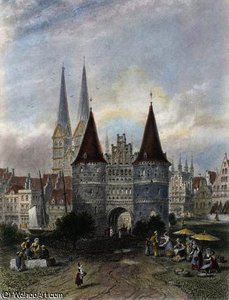
- Holsten gate at Lubeck
- Place Of Birth: Weimar, Germany