 Preview
 Send
Send Share
Share
 Details

 Download
 Similars
 X-Ray
X-Ray Diaporama
Physichromie No. 326


 Read More
Hand Made Oil Reproduction
Hand-painted oil on canvas in your size and frame, made to order by our artists. ( Buy Print Buy Image)




P118B $10

P118H $10

P118W $10

P438Z $10

P508JH $12

P508YH $12

P805H $10

P805Z $10

P919BZ $10

P919G $10

P919XJ $10

P959ZH $10

P968JZ $12

W106C $8

W218G $10

W218JH $8

W218Y $10

W307PJ $10

W316G $10

W316PJ $8

W316Y $10

W398PJ $8

W4111J $10

W500HY $15

W500JH $15

W692G $12

W849H $8

W940BG $15

W953PJ $8




Pick from our preset sizes that match the artwork's original proportions.

You may enter your own dimensions to fit a specific frame or space. If your selected size does not match the original image's proportions, we will either crop the artwork or extend the painting with additional hand-painted elements. A digital mockup will be sent for your approval before production begins.
Please note that the on-screen preview does not reflect the actual cropping or extension. Only the mockup will accurately show the final composition.
While custom sizes are available, we recommend selecting a dimension from the predefined list to preserve the original proportions.
After order, ArtsDot.com team will email client for instructions and provide a mockup preview
Worldwide Delivery () in 3/4 weeks instead of standard 5 weeks. (20 August). No compromise on quality.

Free Worldwide Express Shipping

High-Quality Linen Canvas

Full Shipping Insurance

Customs Tax Refund Guarantee

True Color Matching Guarantee

60-Day Return Policy (Defects Only)

100% Money-Back Guarantee

Bulk Discount Offer
 Glass option is only available in size under 110 CM

Physichromie No. 326
Reproduction Medium
Reproduction Size
-


Total Price
$ 263
Artwork Description
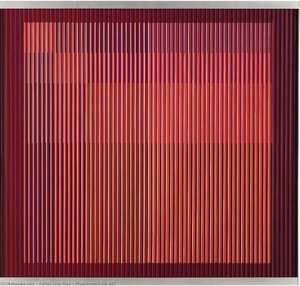
Physichromie No. 326: A Symphony of Perception
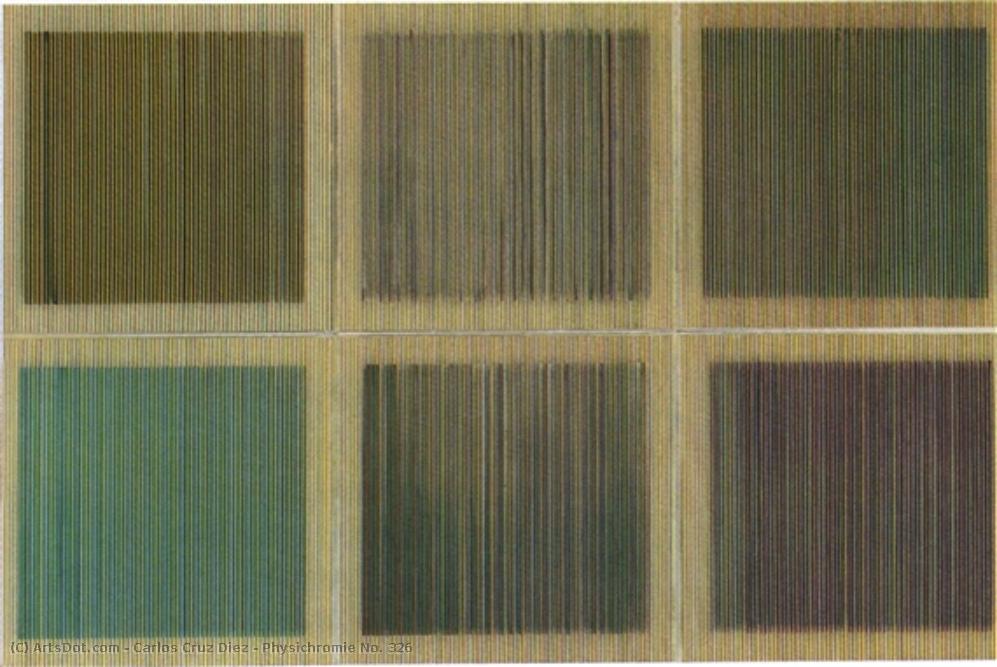
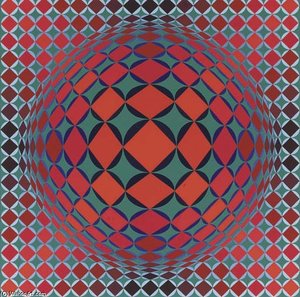
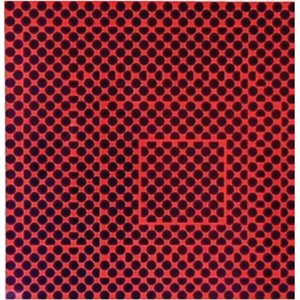
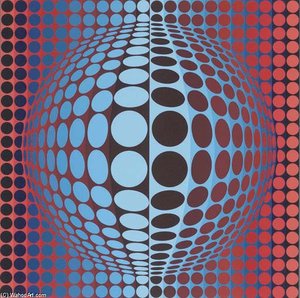
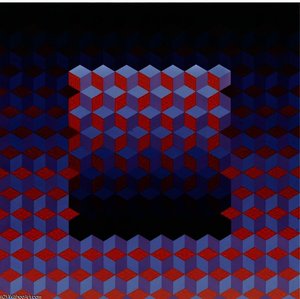
Carlos Cruz-Diez’s “Physichromie No. 326,” created in 1967, isn't merely a painting; it’s an invitation to reconsider the very nature of visual experience. Born in Caracas, Venezuela in 1923 and continuing his artistic journey until his passing in 2019, Cruz-Diez dedicated his life to exploring how our eyes perceive color—a pursuit that fundamentally reshaped the landscape of modern art. This monumental piece exemplifies Op Art’s core principle: transforming reality through illusion, prompting viewers to actively engage with the artwork and questioning their assumptions about visual representation.Composition and Structure – Order from Chaos
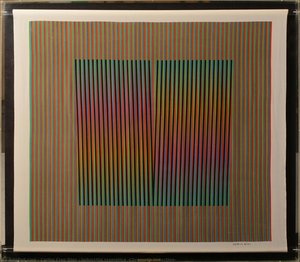
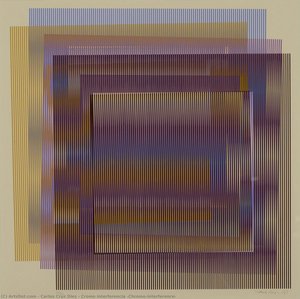
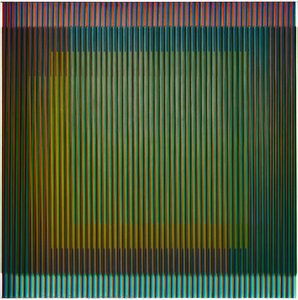
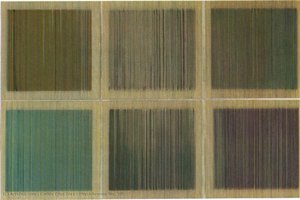
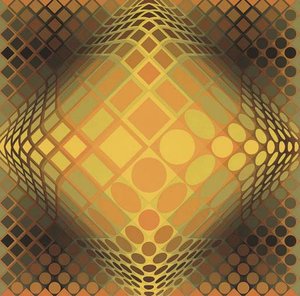
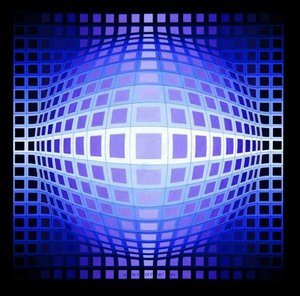
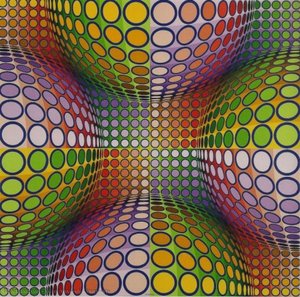
The artwork's striking geometric design immediately commands attention. Composed of six rectangular panels arranged in two rows of three, “Physichromie No. 326” utilizes a rigid grid format—a deliberate choice that underscores order and repetition. Each panel is dominated by vertical stripes of varying hues – yellows, greens, browns, reds – creating a dynamic visual rhythm against the backdrop of the structured grid. This careful arrangement isn’t simply aesthetically pleasing; it reflects Cruz-Diez's profound belief that color operates independently of objects, constantly shifting within space and influencing our perception.Color Palette and Technique – Beyond Static Hue
Cruz-Diez’s masterful technique—characterized by precise application of color in parallel stripes—goes far beyond traditional painting methods. He painstakingly manipulated pigment to achieve subtle gradients and tonal variations within each stripe, demonstrating an unwavering commitment to scientific rigor alongside artistic creativity. The color palette itself is deliberately diverse, encompassing warm tones like yellows and reds alongside cooler shades of green and brown. These hues aren’t randomly chosen; they represent Cruz-Diez's extensive research into color phenomena—specifically, how our eyes perceive color under different lighting conditions. This meticulous attention to detail contributes to the artwork’s hypnotic effect, drawing the viewer into a contemplative state.Historical Context – The Birth of Kinetic Perception
“Physichromie No. 326” emerged during the height of Op Art's influence in the mid-1960s—a movement that sought to challenge conventional artistic conventions by exploiting optical illusions. Artists like Cruz-Diez recognized that visual perception isn’t passive; it actively constructs our experience of reality. This groundbreaking work aligns perfectly with the broader philosophical concerns of the era, questioning the boundaries between art and science and advocating for a more holistic understanding of human consciousness. It stands as a testament to Cruz-Diez's unwavering belief in the transformative power of color—a conviction that continues to inspire artists and collectors alike.Symbolic Resonance – Vibrations of Light and Space
Ultimately, “Physichromie No. 326” transcends its formal elements to evoke a powerful emotional response. The subtle shifts in hue within each stripe create an illusion of movement—a sensation akin to vibrating light—drawing the viewer’s gaze across the surface of the artwork. This deliberate manipulation of perception speaks to Cruz-Diez's fascination with the interplay between color, light, and space—concepts he explored throughout his prolific career. More than just a visual spectacle, “Physichromie No. 326” invites us to contemplate our own subjective experience and to appreciate the profound beauty inherent in the simplest of sensory perceptions.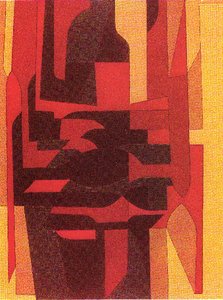
Artist Biography
A Life Immersed in Color: The World of Carlos Cruz-Diez
Carlos Cruz-Diez, born in Caracas, Venezuela in 1923 and passing in 2019, wasn’t merely an artist; he was a relentless investigator of perception, a philosopher wielding color as his medium. He stands as one of the most innovative figures of the 20th and 21st centuries, celebrated as a pioneer of both Kinetic and Op art, earning him the deserved title of “master of color.” His work transcends simple visual experience, inviting viewers into a realm of philosophical reflection on how we perceive reality itself. Cruz-Diez’s extensive research fundamentally advanced our understanding of color phenomena in art, dramatically expanding its perceptual possibilities and challenging conventional notions of artistic representation. He believed that color wasn't inherent to an object but existed as an autonomous entity, evolving dynamically within real time and space—a revelation born from interaction rather than static observation.Early Influences and the Path to Abstraction
Cruz-Diez’s artistic journey began with formal training at the School of Plastic and Applied Arts in Caracas in 1940, where he earned a degree in art education and manual arts by 1945. However, his early career took a pragmatic turn as he worked first as a publications designer for Creole Petroleum Corporation (1944-1945) and later as an art director at McCann Erickson advertising agencies in both Caracas and New York (1946-1951). These experiences, while seemingly removed from the world of fine art, honed his understanding of visual communication and the power of design. It was during this period that he began to absorb influences that would shape his future artistic explorations. The pointillist techniques of Georges Seurat, with their meticulous application of color to create luminous effects, resonated deeply with him. Equally significant was the work of Josef Albers, whose investigations into color relationships and perceptual illusions provided a crucial foundation for Cruz-Diez’s own research. Exposure to diverse plant life during his travels further stimulated his interest in the subtle variations and interactions of color found in nature. These early influences coalesced, setting the stage for his eventual departure from traditional painting towards a more experimental and conceptually driven approach.The Birth of Physichromies: Color as an Event
By 1957, Cruz-Diez had returned to Venezuela and established his Estudio de Artes Visuales, dedicating himself to investigating the role of color within kinetic art. This marked a pivotal turning point in his artistic practice. In 1959, he began working with “radiation of color”—colored light—effectively abandoning paint as his primary medium. This wasn’t simply a change in materials; it was a fundamental shift in perspective. The breakthrough came with the development of his signature "Physichromies," spurred by Edwin Land’s groundbreaking research on polarized lenses. These works, characterized by their grid-like structures and seemingly static appearance, reveal dynamic color shifts as the viewer moves around them. Cruz-Diez wasn't interested in depicting objects or scenes; he aimed to create an experience where color itself became the subject—a constantly evolving phenomenon dependent on the observer’s position and perception. The Physichromies weren’t paintings to be looked *at*; they were environments to be experienced, demanding active participation from the viewer. He termed this sensation of movement created by shifting perspective as “vibrations.” This emphasis on viewer interaction was central to his artistic philosophy, demonstrating that color exists not as a fixed property but as an event unfolding in time and space.Legacy and Lasting Impact
Alongside fellow Venezuelan artists Jesús Rafael Soto and Alejandro Otero, Carlos Cruz-Diez played a crucial role in establishing Venezuela’s position within the international art world. His research significantly contributed to a new understanding of color phenomena, expanding its perceptual universe and demonstrating how color becomes an autonomous reality through viewer interaction. Beyond gallery walls, Cruz-Diez extended his artistic vision into public spaces, creating notable installations such as the crosswalk at the Miami Marlins Ballpark, works at the Caracas Airport, and projects at the University of Houston. His art is now represented in prestigious museums worldwide—MoMA (New York), Tate Modern (London), Centre Pompidou (Paris), and the Museum of Fine Arts (Houston) among them—solidifying his status as a key figure in 20th and 21st-century art. Cruz-Diez emerged during a period of significant cultural change in Venezuela, fueled by industrialization and oil exportation, creating an audience receptive to artists who challenged traditional painting styles. His work also resonated within the political landscape of the time, gaining popularity among the elite due to its lack of overt political messaging. Furthermore, his focus on environment and events as integral parts of the viewing experience aligns conceptually with the Fluxus group, highlighting a shared interest in participatory art practices. Carlos Cruz-Diez’s dedication to color, line, and viewer perception has left an indelible mark on contemporary art, inspiring generations of artists to explore the dynamic possibilities of visual experience and challenging us all to reconsider how we perceive the world around us.
Carlos Cruz-Diez
1923 - , Venezuela
Quick Facts
- Artistic Movement Or Style: Kinetic & Op Art
- Artists Or Movements Influenced By This Artist:
- Jesús Rafael Soto
- Fluxus
- Artists Who Influenced This Artist:
- Georges Seurat
- Josef Albers
- Date Of Birth: 1923
- Date Of Death: 2019
- Full Name: Carlos Cruz-Diez
- Nationality: Venezuelan
- Notable Artworks:
- Physichromie N o 436
- Cromo interferencia
- Inducción cromática
- Place Of Birth: Caracas, Venezuela
Related Articles

Geometric Abstraction's 10 Defining Masterpieces | Art for Your Home - ArtsDot
Explore 10 defining masterpieces of Geometric Abstraction! Discover Kandinsky, Mondrian & Malevich’s iconic works. Find museum-quality art reproductions and curated decor ideas to elevate your home at ArtsDot.com.
Beyond Form & Color: Geometric Abstraction's Evolution in 20th/21st Century Art
Explore the evolution of geometric abstraction from Cubism to contemporary art. Discover key artists like Malevich & Mondrian, investment insights, and expert collecting advice at ArtsDot.
Beyond Form & Color: Geometric Abstraction's Enduring Legacy in Art History
Explore the captivating world of geometric abstraction! Discover its origins, key artists like Malevich & Mondrian, and why this movement remains highly valued by art collectors today. Expert insights at ArtsDot.

Kandinsky's Masterpieces: 25 Paintings That Define Abstract Art | ArtsDot
Journey through Wassily Kandinsky's 25 most iconic abstract paintings. Explore his revolutionary use of color, form & spiritual expressionism. Find museum-quality Kandinsky reproductions and elevate your home decor with ArtsDot.com. Discover all masterpieces on ArtsDot.com!
Beyond Form: Exploring the Philosophical Foundations of Geometric Abstraction
Explore the philosophical roots & artistic evolution of geometric abstraction with ArtsDot. Discover Mondrian, Malevich, De Stijl & more. Expert insights for collectors and art enthusiasts.