 Send
Send Share
Share
 Details

 Download
 Similars
 Diaporama
Owls at Noon Prelude: The Hollow Men


 Read More
Giclée / Art Print
Museum-quality giclée or canvas print with fast production and flexible finish options. ( Buy Hand Made Painting Buy Image)




































Pick from our preset sizes that match the artwork's original proportions.

You may enter your own dimensions to fit a specific frame or space. If your selected size does not match the original image's proportions, we will either crop the artwork or extend the image with a mirrored or solid-fill edge. A digital mockup will be sent for your approval before production begins.
Please note that the on-screen preview does not reflect the actual cropping or extension. Only the mockup will accurately show the final composition.
While custom sizes are available, we recommend selecting a dimension from the predefined list to preserve the original proportions.
Worldwide Delivery () in 2 weeks instead of standard 4/5 weeks. (1 September)

Free Worldwide Express Shipping

High-Quality Linen Canvas

Full Shipping Insurance

Customs Tax Refund Guarantee

True Color Matching Guarantee

60-Day Return Policy (Defects Only)

100% Money-Back Guarantee

Bulk Discount Offer
 Glass option is only available in size under 110 CM

Owls at Noon Prelude: The Hollow Men
Giclée / Art Print
Reproduction Size
-


Total Price
$ 63
Owls at Noon Prelude: The Hollow Men – A Meditation on Memory and Absence
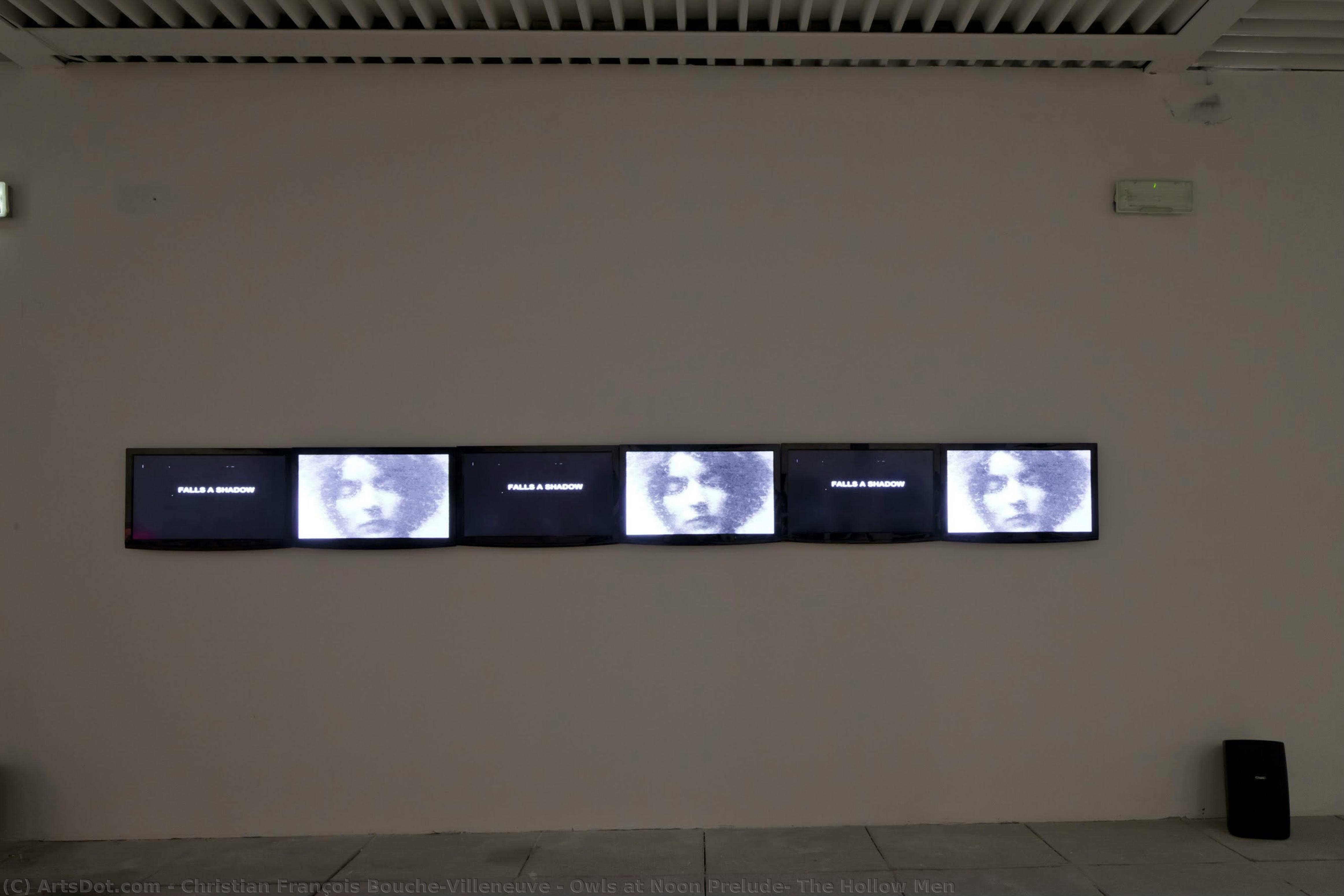
Chris Marker’s “Owls at Noon Prelude: The Hollow Men” isn't merely a photograph; it’s an invitation into a carefully constructed dialogue between art history, cinematic influence, and the profound contemplation of time itself. Captured in 2005 as part of ‘The Yoshiko and Akio Morita Gallery’ exhibition at MoMA, this striking installation presents three identical screens displaying a portrait of a woman's face – a deliberate repetition designed to amplify its impact.
- Subject Matter: The artwork centers around a single image—a grayscale portrait—chosen specifically for its ability to evoke introspection. Marker’s selection speaks volumes about his fascination with capturing fleeting moments and exploring the elusive nature of remembrance, mirroring themes prevalent in his celebrated films like “La Jetée” and “Sans soleil”.
- Style & Technique: The photograph exemplifies contemporary art installation, utilizing video projection as its medium. This technique isn’t simply about displaying an image; it's about layering perspectives and creating a space for contemplation. Marker’s masterful control of lighting contributes to subtle tonal variations within the grayscale palette, enhancing depth and fostering a sense of quiet solemnity.
- Historical Context: Marker’s artistic trajectory is inextricably linked to the Left Bank group—a cohort of filmmakers who spearheaded the Nouvelle Vague movement in the 1950s—including Alain Resnais, Armand Gatti, Henri Colpi, and Agnes Varda. This collective championed experimental filmmaking and challenged conventional cinematic narratives, reflecting a broader cultural shift toward questioning established norms.
- Symbolism: The title itself – “Owls at Noon Prelude: The Hollow Men” – draws heavily from T.S Eliot’s iconic poem, referencing the desolate landscape of disillusionment and the fragmentation of consciousness. Marker skillfully employs repetition to underscore these ideas, prompting viewers to consider the emptiness inherent in memory and the difficulty of grasping totality.
The Influence of Cinema: A Visual Echo
Marker’s cinematic background profoundly informs his artistic approach. Like many filmmakers of his era, he embraced montage—the juxtaposition of disparate images—as a tool for storytelling and conveying complex emotions. “Owls at Noon Prelude” echoes this stylistic sensibility, presenting the portrait not as a static representation but as an element within a larger visual framework. This deliberate choice reflects Marker’s belief that film could illuminate hidden truths and challenge viewers to confront uncomfortable realities.
Material Considerations: Monochrome & Spatial Arrangement
The photograph's materiality—the smooth surface of the screens reflecting ambient light—further contributes to its contemplative atmosphere. The stark white wall serves as a neutral counterpoint, emphasizing the artwork’s visual impact and creating a sense of spaciousness. Careful consideration was given to the positioning of the screens, ensuring they were evenly spaced and aligned – a compositional element that reinforces the piece's deliberate simplicity.
Emotional Resonance: A Portrait of Absence
"Owls at Noon Prelude: The Hollow Men" transcends mere visual representation; it invites viewers into an emotional journey. The grayscale palette evokes feelings of melancholy and nostalgia, mirroring the themes explored in Eliot’s poem. Marker's masterful execution captures not just a likeness but also the intangible essence of memory—the lingering traces of experience that shape our understanding of the world.
Related Artworks
Artist Biography
A Phantom of the Image: The Enigmatic Life and Work of Chris Marker
Christian François Bouche-Villeneuve, a name often eclipsed by his adopted persona, Chris Marker, remains one of the most profoundly influential yet deliberately elusive figures in 20th and 21st century art. Born in Neuilly-sur-Seine, France, on July 29, 1921 – though accounts of his birthplace have occasionally varied, mirroring a life spent embracing ambiguity – Marker wasn’t simply an artist; he was a shape-shifter, a polymath who defied easy categorization. His journey began within the confines of a bourgeois Catholic upbringing and education at the Lycée Pasteur, but quickly diverged into realms of intellectual curiosity that spanned literature, poetry, cinema, and political engagement. Even as a student, contributing to his lycée’s journal under a succession of pseudonyms, he demonstrated an early inclination towards reinvention, a foreshadowing of the many identities he would inhabit throughout his life. The shadow of World War II loomed large over his formative years, with reports suggesting participation in the French Resistance – initially with the FTP (Francs-Tireurs et Partisans) and potentially later as a translator for the American army. Details remain shrouded in mystery, adding to the aura of enigma that would define his public persona.Beyond Boundaries: A Multidisciplinary Vision
Following the war, Bouche-Villeneuve formally adopted the name Chris Marker, a gesture signifying a deliberate break with convention and an embrace of artistic freedom. He became deeply involved with organizations like Peuple et Culture, forging connections with pivotal figures such as André Bazin and Alain Resnais – relationships that would prove crucial to his artistic development. A landmark collaboration with Resnais came in 1953 with *Les statues meurent aussi*, a film commissioned by *Présence Africaine*. This project wasn’t merely a cinematic endeavor; it was a powerful critique of Western perspectives on African art, and marked the beginning of a long-term artistic dialogue. Marker's genius lay in his refusal to be confined by disciplinary boundaries. He moved seamlessly between filmmaking, photography, writing, editing, translation, and more, blurring the lines between these mediums and creating a unique artistic language. His cinematic style was particularly distinctive – a potent blend of documentary realism, essayistic reflection, fictional narrative, and experimental techniques. Montage, voice-over narration, and archival footage became his signature tools, employed to explore complex themes of memory, time, politics, and the ever-evolving relationship between humanity and technology.Landmarks in Time: Major Works and Enduring Themes
Marker’s oeuvre is populated with works that have become touchstones for generations of artists and thinkers. Perhaps his most celebrated creation is *La Jetée* (1962), a science fiction short film constructed almost entirely from still photographs. This haunting meditation on memory, trauma, and the possibility – and perils – of time travel remains remarkably innovative in its visual storytelling. Then there’s *Sans Soleil* (1983), an essay film of immense influence that delves into the complexities of memory, history, and the experience of travel through a fragmented narrative structure and evocative imagery. *Le Joli Mai* (1963) offers a poetic snapshot of life in Paris during May 1963, notable for its observational style and lyrical sensibility. And *Le Fond de l'air est rouge* (1977), a collaborative film with Marie Joséphine Hooghe, provides a compelling exploration of the political climate of the late 1960s and early 1970s. Throughout his work, certain themes recur with striking consistency: the fragility of memory, the weight of history, the transformative power – and potential dangers – of technology, the imperative for political engagement, and a persistent questioning of the very nature of representation itself. He consistently challenged traditional narrative structures, seeking alternative ways to tell stories and engage audiences on an intellectual and emotional level.A Legacy of Innovation: Influences and Lasting Impact
Marker’s artistic vision was shaped by a diverse range of influences. His early exposure to literature, particularly the works of Jean-Paul Sartre, instilled in him a profound philosophical outlook. He also harbored a deep fascination with popular culture, especially American comics, recognizing their potential as a powerful form of visual storytelling. The French New Wave movement, spearheaded by André Bazin and his contemporaries, exerted a significant influence on his approach to filmmaking, while his collaborations with Alain Resnais further refined his artistic sensibilities. His work was consistently informed by a strong political consciousness, reflecting his involvement in leftist movements and his unwavering commitment to social justice. Chris Marker’s legacy extends far beyond the realm of cinema. He is widely regarded as one of the most important and innovative filmmakers of the 20th and 21st centuries, and his films continue to be studied and celebrated for their intellectual depth, artistic originality, and enduring relevance. He inspired generations of artists with his experimental approach, his willingness to challenge conventions, and his unwavering commitment to exploring complex ideas. He passed away on July 29, 2012, in Paris, on his 91st birthday – a fittingly symbolic end for an artist who had spent a lifetime defying expectations and embracing the mysteries of time and memory.A Catalogue of Selves
The sheer number of pseudonyms adopted by Christian François Bouche-Villeneuve speaks volumes about his artistic philosophy: Chris Marker, Sandor Krasna, Jacopo Berenzi, Fritz Markassin, Chris Villeneuve – each name a mask, a persona through which to explore different facets of creativity. This deliberate obfuscation wasn’t merely an act of self-protection; it was a fundamental aspect of his art, a rejection of the cult of personality and a commitment to allowing the work to speak for itself. He famously avoided being photographed for decades, preferring to be represented by images of a cat – a playful gesture that underscored his disdain for celebrity culture and his desire to remain an enigmatic figure. This elusiveness, combined with the intellectual rigor and emotional depth of his work, has cemented Chris Marker’s place as a true visionary, a phantom of the image whose influence will continue to resonate for generations to come.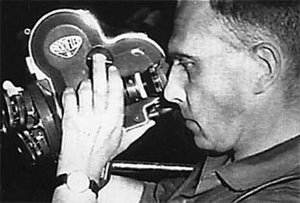
Christian François Bouche-Villeneuve
1921 - 2012 , France
Quick Facts
- Artistic Movement Or Style: Modernism, Essay Film
- Artists Or Movements Influenced By This Artist: ['Experimental filmmakers']
- Artists Who Influenced This Artist:
- André Bazin
- Alain Resnais
- Jean-Paul Sartre
- Date Of Birth: July 29, 1921
- Date Of Death: July 29, 2012
- Full Name: Christian François Bouche-Villeneuve
- Nationality: French
- Notable Artworks:
- La Jetée
- Sans Soleil
- Le Joli Mai
- Owls at Noon
- Place Of Birth: Neuilly-sur-Seine, France
Related Articles

White on Canvas: 10 Masterpieces & Timeless Elegance for Your Home Decor
Explore 10 iconic white paintings by Monet, Whistler & Rothko! Discover the stories behind these serene masterpieces and their impact on art history. Find museum-quality reproductions for your home decor at .

Dark Masterpieces: 10 Iconic Paintings Dominated by Black Tones |
Explore 10 iconic paintings dominated by black tones, from Rembrandt’s chiaroscuro to Goya's dark expressions. Discover the stories behind these masterpieces & find museum-quality art reproductions for your home at .

Monochrome Visions: Exploring the Aesthetic & Historical Significance of Black & White Photography
Explore the rich history & artistic power of black and white photography. From early techniques to iconic masters like Ansel Adams, discover why monochrome continues to captivate art lovers today. Expert insights for collectors.
Mars Black Masterpieces: 10 Iconic Paintings & Timeless Art Decor Ideas
Delve into the power of 'Mars Black' with 10 iconic paintings by masters like Rembrandt & Caravaggio. Explore dramatic chiaroscuro, gothic art, and timeless beauty. Find museum-quality reproductions & elevate your home decor on .
The Subtleties of Shade: Exploring Black, White & Gray Abstraction in Modern Interior Design
Explore the power of black, white & gray abstraction in modern interior design. Discover how minimalist art impacts spatial perception & creates sophisticated hotel spaces. Expert insights for designers.