

 Preview
 Send
Send Share
Share
 Details

 Download
 Similars
 X-Ray
X-Ray Diaporama
Cheapside, City of London


 Read More
Purchase a high-resolution, enhanced digital image, far superior to the online preview.
Each file is meticulously prepared by our in-house specialists using advanced tools and expert manual retouching. We ensure every image has exceptional clarity, precise color accuracy, and fine detail.
The final file is delivered via email within 72 hours, optimized for immediate use in professional, editorial, and print environments. This is the same quality trusted by top-tier design studios, publishers, and galleries.
Digital Image
Download a high-resolution file for personal display, printing, and creative projects. ( Buy Print Buy Hand Made Painting)
Included in Every Digital Image Order
Expert Digital Delivery, Guaranteed
When you choose ArtsDot.com, you're not just getting an image - you're receiving a professionally enhanced digital artwork, crafted with precision and backed by a satisfaction guarantee. Here's everything that comes with your order, automatically:

Fast Email Delivery
Your high-resolution digital image file will be emailed to you within 72 hours of ordering - ready for immediate use.

AI-Enhanced Digital File
Your artwork is professionally optimized using advanced AI tools and manual editing, ensuring maximum detail, clarity, and color accuracy.

Free Lifetime Re-Delivery
Accidentally deleted or lost your file? No worries - we'll resend it to you anytime, free of charge.

No Import Fees - Ever
Enjoy your artwork instantly with zero customs, duties, or delivery fees - digital downloads are always tax-free.

Color Accuracy Guarantee
We ensure your digital image reflects the original colors as closely as possible using professional tools and color management.

60-Day Satisfaction Guarantee
If you're not satisfied with your digital image, we'll revise it or refund 100% within 60 days - no questions asked.

100% Money-Back Guarantee
Not satisfied? Get a full refund within 60 days of receiving your digital file - no questions asked.

Bulk Order Discounts
Buy 3 images, save 10% - Buy 5, save 15% - Buy 10+, save 20%. Great for creative projects, galleries, and agencies.
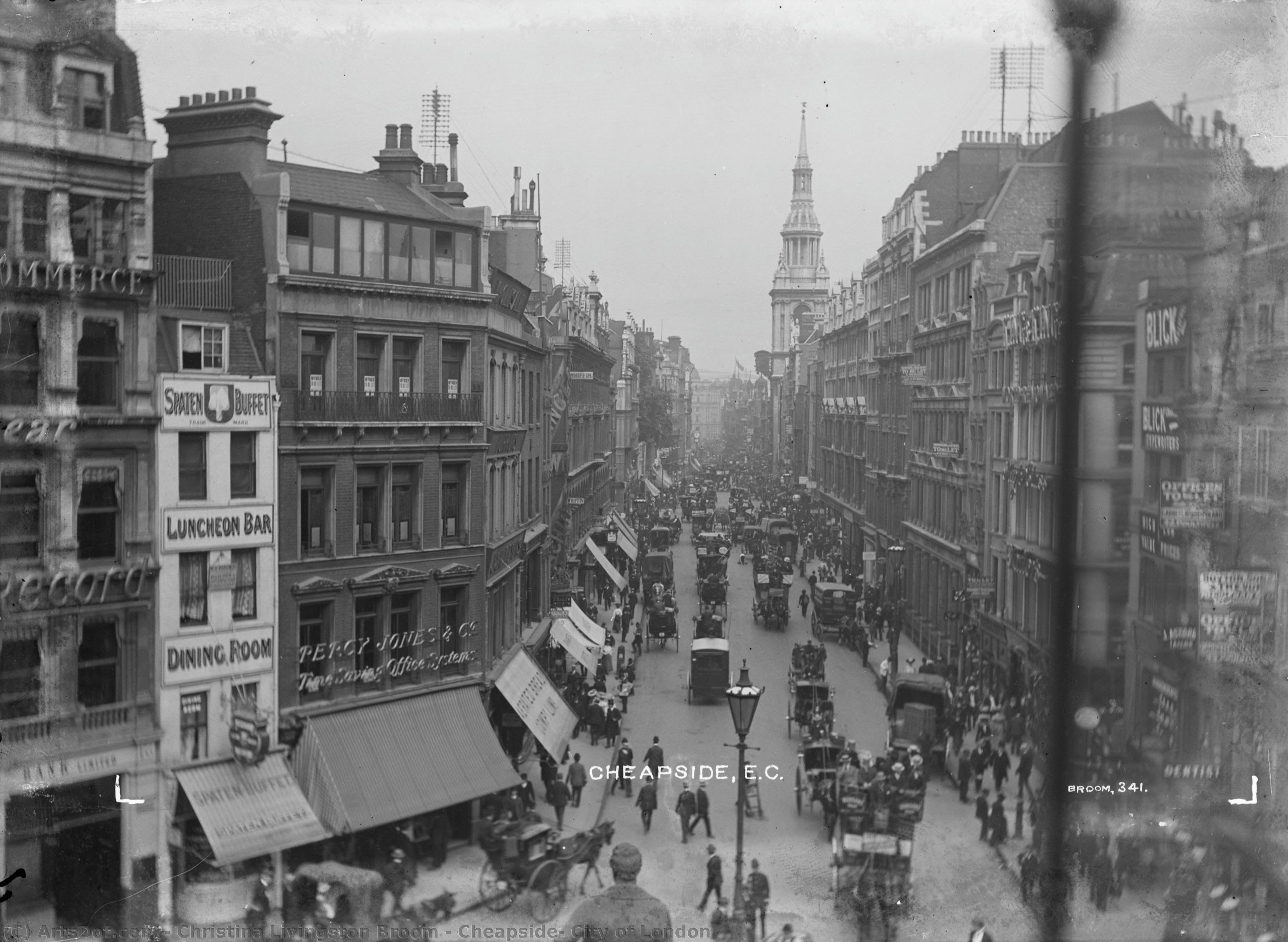
Cheapside, City of London – A Snapshot of Edwardian Life
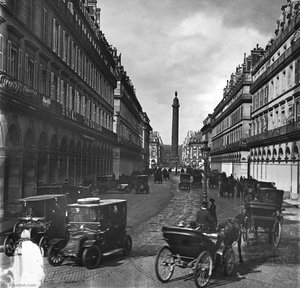
Christina Livingston Broom’s photograph captures a vibrant slice of London life in 1910—a moment frozen in time amidst the bustling energy of Cheapside. More than just an image of a street scene, it's a testament to Broom’s meticulous observation and her ability to convey the spirit of the era. The composition immediately draws the eye upwards towards a distant spire, establishing a strong diagonal line that guides our gaze through the densely populated thoroughfare. This perspective technique isn’t merely aesthetically pleasing; it serves to emphasize the grandeur of the cityscape while simultaneously grounding us in the everyday realities of Victorian society.- Subject Matter: The photograph focuses squarely on urban life—the movement of pedestrians, the presence of automobiles and buses, and the diverse architectural styles adorning the buildings lining Cheapside. Broom skillfully portrays a snapshot of Edwardian London, reflecting the social transformations occurring at the time.
- Style & Technique: Documentary photography reigned supreme during Broom’s era, prioritizing accuracy over artistic embellishment. The image utilizes a wide-angle lens to maximize the visual impact of the scene and employs natural lighting—likely overcast conditions—to achieve soft shadows and even illumination across the frame. Subtle vertical distortion adds an element of realism, mirroring imperfections inherent in photographic prints from that period.
- Historical Context: 1910 marks a pivotal year for London – the height of the Edwardian Period, characterized by optimism, social stability, and burgeoning industrial growth. Broom’s photograph serves as invaluable documentation of this era, capturing the visual culture of a city undergoing significant change. Notably, it coincided with the fervent activism of the Suffragette movement, whose banners and demonstrations would have been visible within Cheapside's streets.
- Symbolism & Emotional Impact: Beyond its descriptive qualities, the photograph evokes a sense of nostalgia for a bygone era—a time of elegance, formality, and palpable energy. The spire’s upward trajectory symbolizes aspiration and faith, contrasting with the horizontal expanse of the street, representing the grounded realities of daily life. Broom's masterful use of light and composition contributes to an overall feeling of serenity amidst the commotion.
Artist Background: Christina Livingston Broom – Pioneer of Female Photography
Christina Livingston Broom (1862-1939) stands as a remarkable figure in photographic history—the UK’s first female press photographer. Her dedication to documenting Edwardian London and the Suffragette movement cemented her legacy as an advocate for women's rights and artistic innovation. Trained at City Lit, Broom honed her skills capturing candid portraits of prominent figures and social events, demonstrating a commitment to portraying reality with unflinching honesty. Her work exemplifies the spirit of the time—a desire to record history while simultaneously challenging societal conventions.Technical Details: Glass Print – A Legacy of Photographic Craftsmanship
The photograph itself is executed on glass—a technique prevalent during Broom’s lifetime that ensured exceptional clarity and longevity for prints. This medium demanded meticulous attention to detail, reflecting the precision inherent in early 20th-century photographic processes. The print's texture appears remarkably smooth, characteristic of the era’s printing methods—a testament to the skill and artistry involved in producing high-quality reproductions.Availability & Inspiration
A stunning reproduction of Cheapside, City of London by Christina Livingston Broom is available at ArtsDot.com. Bring a piece of Edwardian London into your home or office—a timeless image that captures the beauty and dynamism of a pivotal moment in British history. Explore similar artworks on our platform to discover inspiration for interior design projects!Related Artworks
Artist Biography
Gustav Klimt: A Rebel of Form and Feeling
Born in Vienna in 1862, Gustav Klimt’s life was a tapestry woven with threads of artistic ambition, personal tragedy, and ultimately, revolutionary style. His early years were marked by a modest upbringing – his father, Ernst, a struggling gold engraver, and his mother, Anna, a musically inclined woman denied her professional dreams. This backdrop of quiet striving likely instilled in Klimt a deep appreciation for beauty and a desire to transcend the limitations of his circumstances. He displayed an exceptional talent from a young age, leaving the traditional Gymnasium at fourteen to pursue formal training at the Vienna School of Arts and Crafts – a significant achievement considering his family’s financial constraints.
Klimt's initial artistic trajectory was conservative, focused on architectural painting, mirroring the prevailing academic style favored by the Viennese elite. However, this period served as a crucial foundation, providing him with technical skills and an understanding of classical composition. His early commissions – murals for public spaces like the Vienna Burgtheater and the Kunsthistorisches Museum – established his reputation and allowed him to hone his craft within the established artistic circles. Yet, beneath the surface of these seemingly conventional works, Klimt was already experimenting, laying the groundwork for his later, intensely personal style.
The Seeds of Secession
A pivotal moment in Klimt’s career arrived with the formation of the Vienna Seccession in 1897. This movement, a direct challenge to the conservative artistic establishment, championed individualism and sought to break free from academic constraints. Klimt, along with other artists like Egon Schiele and Max Klinger, embraced a new aesthetic characterized by rich ornamentation, symbolic imagery, and a deliberate rejection of naturalism. The Seccession’s manifesto declared that “art must not be merely decorative, but must also be powerful.” This sentiment perfectly encapsulated Klimt's evolving artistic vision.
A particularly significant event in this period was his relationship with Emilie Flöge, sister of Gustav’s wife, Adele. Their intense and passionate connection profoundly influenced Klimt’s work, injecting a new layer of eroticism and psychological depth into his paintings. The loss of his brother Ernst in 1891, compounded by the death of his father shortly after, further fueled this emotional intensity, prompting him to explore themes of grief, mortality, and the complexities of human relationships. These personal tragedies served as catalysts for a radical shift in his artistic language – moving away from representational accuracy towards a highly symbolic and emotionally charged style.
The Golden Phase: Portraiture and Myth
Klimt’s most celebrated works emerged during this “golden phase,” marked by the lavish use of gold leaf, intricate patterns, and stylized figures. His portraits, particularly *Portrait of Adele Bloch-Bauer*, became iconic examples of his distinctive style – a blend of decorative elegance and psychological insight. The portrait is not merely a likeness; it’s an exploration of identity, power, and the sitter's inner world, rendered through shimmering gold and carefully constructed geometric forms.
This period also saw Klimt delve into mythological themes, creating masterpieces like *The Kiss*, arguably his most famous work. This painting depicts a couple embracing within a golden rectangle, their bodies intertwined in an almost abstract manner. The image transcends the literal representation of love; it’s a potent symbol of unity, intimacy, and the merging of masculine and feminine energies. The use of gold further elevates the scene to a realm of timeless beauty and spiritual significance.
Legacy and Influence
Gustav Klimt's impact on 20th-century art is undeniable. His innovative use of color, pattern, and symbolism paved the way for Art Nouveau and Expressionism, influencing generations of artists. His exploration of psychological themes and his rejection of academic conventions challenged traditional notions of beauty and representation. While initially met with controversy, Klimt’s work gradually gained recognition as a groundbreaking achievement, solidifying his place as one of the most important figures in modern art.
Despite facing personal struggles and periods of obscurity, Gustav Klimt left behind a remarkable body of work that continues to captivate audiences today. His paintings are not simply beautiful images; they are windows into the complexities of human emotion, the power of symbolism, and the enduring allure of artistic innovation. His legacy endures as a testament to the transformative potential of art – its ability to both reflect and shape our understanding of the world.
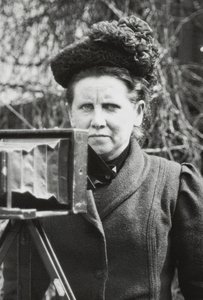
christina livingston broom
1862 - 1939 , Scotland
Quick Facts
- Artistic Movement Or Style: Portrait, cityscape
- Date Of Birth: 1862
- Date Of Death: 1891
- Full Name: Robert S German
- Nationality: German
- Notable Artworks: ['At Binsey, near Oxford']
- Place Of Birth: Berlin, Germany

