 Preview
 Send
Send Share
Share
 Details

 Download
 Similars
 X-Ray
X-Ray Diaporama
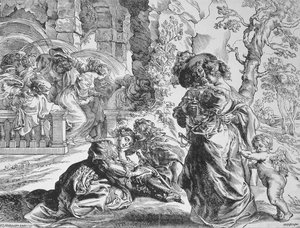
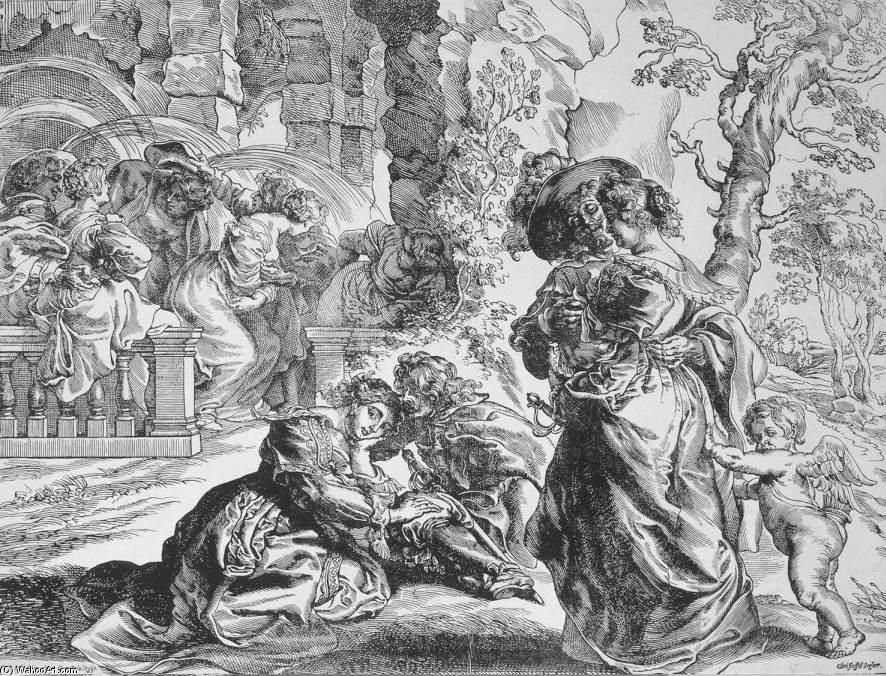
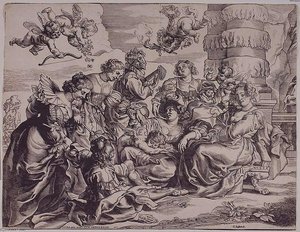
The Garden of Love
 1631
1631 465.0 x 598.0 cm
 Hermitage Museum
 Read More
Giclée / Art Print
Museum-quality giclée or canvas print with fast production and flexible finish options. ( Buy Hand Made Painting Buy Image)




































Pick from our preset sizes that match the artwork's original proportions.

You may enter your own dimensions to fit a specific frame or space. If your selected size does not match the original image's proportions, we will either crop the artwork or extend the image with a mirrored or solid-fill edge. A digital mockup will be sent for your approval before production begins.
Please note that the on-screen preview does not reflect the actual cropping or extension. Only the mockup will accurately show the final composition.
While custom sizes are available, we recommend selecting a dimension from the predefined list to preserve the original proportions.
Worldwide Delivery () in 2 weeks instead of standard 4/5 weeks. (27 August)

Free Worldwide Express Shipping

High-Quality Linen Canvas

Full Shipping Insurance

Customs Tax Refund Guarantee

True Color Matching Guarantee

60-Day Return Policy (Defects Only)

100% Money-Back Guarantee

Bulk Discount Offer
 Glass option is only available in size under 110 CM

The Garden of Love
Giclée / Art Print
Reproduction Size
-


Total Price
$ 63
Related Artworks






Artist Biography
The Master of the Woodcut: The Life and Legacy of Christoffel Jegher
In the heart of the 17th-century Flemish Baroque, amidst the bustling artistic fervor of Antwerp, the name Christoffel Jegher resonates with the profound impact of a true visionary. Born around 1596, Jegher emerged from an era defined by dramatic movement and emotional intensity. While history often remembers the grand canvases of painters, Jegher carved his legacy into the very grain of wood, serving as one of the most significant engravers and woodcut artists of his time. His life was inextricably linked to the golden age of Antwerp, a period where the boundaries between fine art and printmaking were blurred by the sheer brilliance of technical mastery.
Jegher’s journey was not merely that of a solitary craftsman but one deeply embedded in the prestigious circles of the Guild of St. Luke, where he achieved master status in 1628. His career was marked by an extraordinary professional intimacy with the giants of his age, most notably Peter Paul Rubens. It is whispered in art historical circles that Jegher was perhaps the only woodcutter of his era to work so closely within Rubens’ own studio. This collaboration was more than mere employment; it was a symbiotic exchange of genius. While Rubens provided the sweeping, muscular compositions and divine inspiration, Jegher possessed the surgical precision required to translate those fluid brushstrokes into the rugged, high-contrast medium of woodcut. In some instances, the master himself may have drawn directly onto the blocks, leaving Jegher to breathe life into the lines through meticulous cutting.
A Symphony of Light and Shadow
To observe a work by Jegher is to witness a dramatic theatricality that defines the Baroque spirit. His technique was a masterful manipulation of chiaroscuro, using the stark contrast between deep, velvety blacks and brilliant white spaces to evoke a sense of divine presence or mythological grandeur. This ability to command light allowed him to transform simple book illustrations into epic narratives. His work for the renowned Antwerp publishing house, Plantin-Moretus, ensured that his artistic vision reached far beyond the elite collectors, permeating the religious and scholarly texts of Europe.
His repertoire was as diverse as it was profound, ranging from the sacred to the profane. Jegher’s hands brought to life scenes of intense psychological depth, such as:
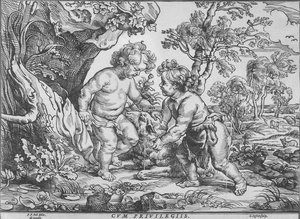
- Biblical Narratives: Where he captured the tender vulnerability of figures like Jesus and St. John the Baptist in their Childhood, utilizing anatomical precision to ground spiritual truths in human emotion.
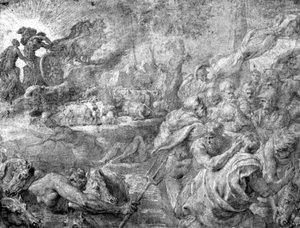
- Mythological Epics: Such as his breathtaking execution of Hercules Fighting Fury and Discord, a work that mirrors the monumental scale and muscular energy of Rubens’ own paintings.
- Luminous Landscapes: In works like The Garden of Love, where he demonstrated an unexpected sensitivity to texture and light, creating idyllic scenes that seem to glow from within the paper itself.
An Enduring Artistic Lineage
The influence of Christoffel Jegher extended far beyond his own lifetime, flowing through a lineage of artists that helped shape the visual language of the 17th century. His mastery was not a solitary flame but a torch passed to the next generation; he was the father of the engraver Jan Christoffel Jegher, who continued to navigate the intricate world of religious prints and book illustrations, even contributing to the early precursors of what we might today recognize as the modern comic strip through sequential narrative prints.
Jegher’s historical significance lies in his role as a bridge between the high art of the painterly tradition and the widespread accessibility of print culture. He elevated the woodcut from a secondary reproductive medium to a primary vehicle for artistic expression. Through his hands, the monumental energy of the Flemish Baroque was democratized, allowing the triumphs of Rubens and the spiritual fervor of the Counter-Reformation to be felt by the hands of many. Even today, as we gaze upon the intricate lines of his prints in museums like the British Museum or the Saint Louis Art Museum, we are reminded of a man who could find infinite depth within the narrow confines of a wooden block.
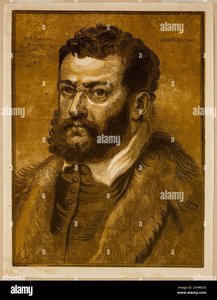
christoffel jegher
1596 - 1652 , Belgium
Quick Facts
- Artistic Movement Or Style: Baroque
- Artists Who Influenced This Artist:
- Peter Paul Rubens
- Anthony van Dyck
- Date Of Birth: 1596 Antwerp Belgium
- Date Of Death: 1652 Antwerp Belgium
- Full Name: Christoffel Jegher
- Nationality: Flemish
- Notable Artworks:
- The Garden of Love
- Jesus and St John the Baptist in their Childhood
- Place Of Birth: Antwerp Belgium