 Preview
 Send
Send Share
Share
 Details

 Download
 Similars
 X-Ray
X-Ray Diaporama
 Stats
StatsSide View of the Ship the

 Read More
Giclée / Art Print
Museum-quality giclée or canvas print with fast production and flexible finish options. ( Buy Hand Made Painting Switch to Digital Image)




































Pick from our preset sizes that match the artwork's original proportions.

You may enter your own dimensions to fit a specific frame or space. If your selected size does not match the original image's proportions, we will either crop the artwork or extend the image with a mirrored or solid-fill edge. A digital mockup will be sent for your approval before production begins.
Please note that the on-screen preview does not reflect the actual cropping or extension. Only the mockup will accurately show the final composition.
While custom sizes are available, we recommend selecting a dimension from the predefined list to preserve the original proportions.
Worldwide Delivery () in 2 weeks instead of standard 4/5 weeks. (7 September)

Free Worldwide Express Shipping

High-Quality Linen Canvas

Full Shipping Insurance

Customs Tax Refund Guarantee

True Color Matching Guarantee

100-Day Return Policy (Defects Only)

100% Money-Back Guarantee

Bulk Discount Offer
 Glass option is only available in size under 110 CM

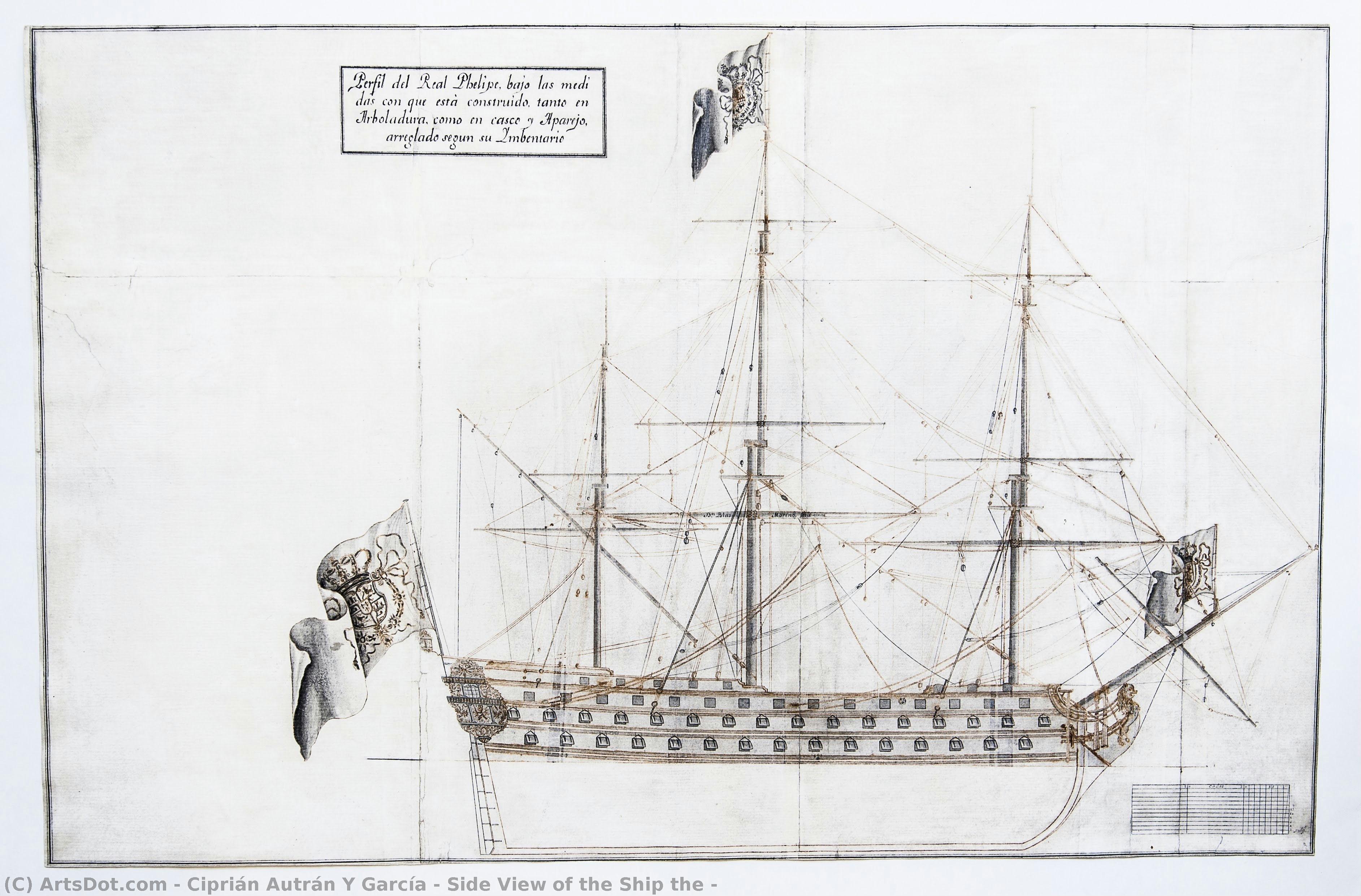
Side View of the Ship the
Giclée / Art Print
Reproduction Size
-


Total Price
$ 63
Related Artworks










Artist Biography
A Titan of Naval Innovation: The Legacy of Ciprián Autrán y García
In the grand tapestry of 18th-century Spanish history, few figures command as much respect for their technical mastery and visionary spirit as Ciprián Autrán y García. Born in 1797 in the coastal town of Puerto Real, Cádiz, Autrán lived through an era defined by the Enlightenment—a period where the boundaries between scientific rigor and creative ingenuity began to blur. While his name may not be etched into the annals of fine art painting with the same frequency as the masters of the canvas, his life was a profound exercise in structural artistry. He was a man who understood that the strength of a nation could be measured by the resilience of its hulls and the precision of its engineering.
The trajectory of Autrán’s career was shaped by the turbulent yet transformative reigns of Spanish monarchs, most notably Ferdinand VI and Charles III. Following the passing of the legendary shipbuilder Antonio de Gaztañète in 1728, Autrán emerged as a central figure in the revitalization of the Spanish maritime fleet. Alongside collaborators like Juan Pedro Boyer, he took up the mantle of responsibility at the Cantabrian dockyards. His approach was not merely one of maintenance but of radical evolution; he meticulously studied the blueprints of his predecessors to refine and improve upon existing systems, blending traditional craftsmanship with the burgeoning scientific advancements of the age.
Mastery of the Seas and Engineering Brilliance
The true genius of Autrán lay in his ability to translate complex mathematical principles into formidable naval vessels. His most celebrated achievement remains the launch of the ‘Real Felipe’, a vessel that would forever alter the landscape of naval warfare. As the first Spanish three-decker ship, it represented a pinnacle of maritime architecture, embodying both power and sophisticated design. This was not an isolated success; Autrán’s tenure as the Director of the Arsenal of Cádiz was marked by a relentless pursuit of excellence, resulting in a succession of warships, frigates, and bomb vessels that allowed the Spanish navy to assert its dominance across the vast oceans.
Beyond the salt spray and the timber of his ships, Autrán’s creative intellect found expression in the very land he called home. He possessed a rare ability to apply engineering precision to agricultural prosperity, viewing the landscape as a canvas for productivity. On his estate, the Cerro de Autrán, he implemented ambitious hydraulic projects that demonstrated his holistic vision of progress. By commissioning the construction of advanced waterwheels to harness the power of the Almendral River, he transformed arid tracts into thriving, irrigated landscapes, proving that his capacity for innovation was as much about sustaining life on land as it was about conquering the waves.
Historical Significance and Enduring Influence
The historical significance of Ciprián Autrán y García extends far beyond the physical structures he built. He represents a bridge between the artisanal traditions of the past and the industrial precision of the future. His life’s work serves as a testament to the impact of the Enlightenment on Spanish infrastructure, showing how scientific inquiry can be harnessed to bolster national identity and economic strength. To study Autrán is to study the very mechanics of an era that sought to master the elements through intellect and design.
His legacy remains anchored in several key pillars of achievement:
- Naval Architecture: The creation of the Real Felipe, a landmark in three-decker ship construction.
- Industrial Leadership: His transformative role as Director of the Arsenal of Cádiz, modernizing Spain's shipbuilding industry.
- Agricultural Innovation: The implementation of hydraulic engineering to revolutionize irrigation in the region of Puerto Real.
- Scientific Spirit: A lifelong dedication to refining maritime systems through meticulous analysis and experimentation.
Though his contributions were primarily structural rather than pictorial, the spirit of an artist is undeniably present in his work. Every vessel he launched was a masterpiece of balance, strength, and form—a sculptural triumph of wood and iron that navigated the currents of history.
ciprián autrán y garcía
1697 - 1773 , Spain
Quick Facts
- Artistic Movement Or Style: Naval Art
- Date Of Birth: 1697
- Date Of Death: 1773
- Full Name: ciprián autrán y garcía
- Nationality: Spanish
- Notable Artworks: ['Side View of the Ship the']
- Place Of Birth: Puerto Real, Spain