 Preview
 Send
Send Share
Share
 Details

 Download
 Similars
 X-Ray
X-Ray Diaporama
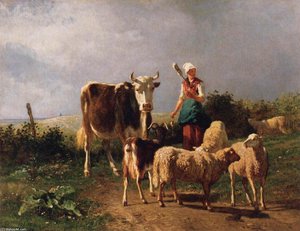
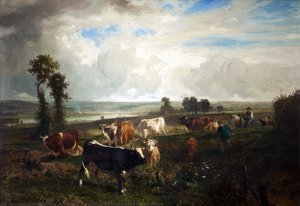
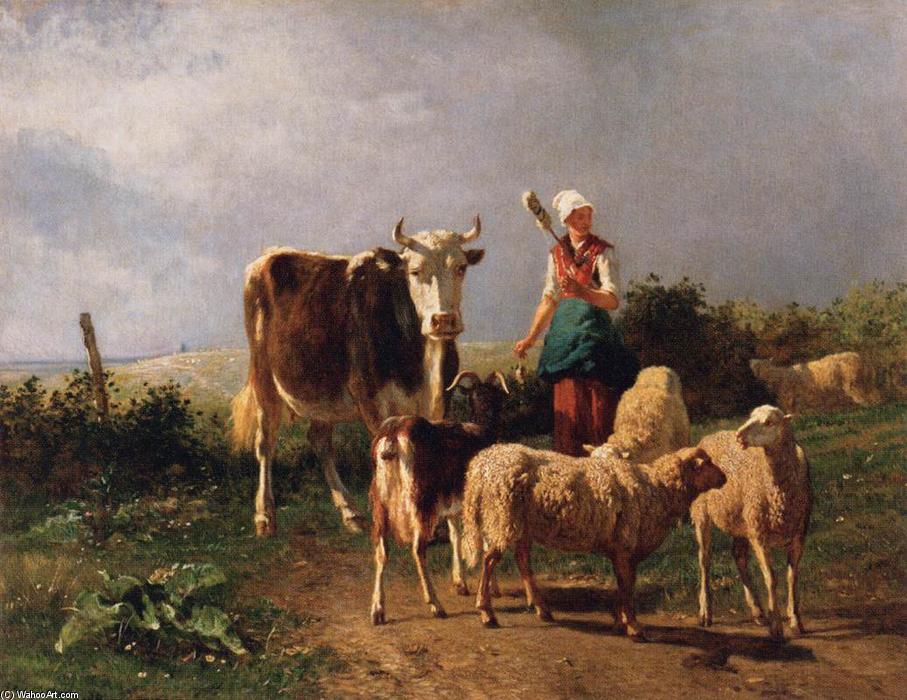
Return of the Herd
 Oil On Canvas
- WallArt
- Barbizon Realism
 1860
1860 79.0 x 92.0 cm
 The Louvre
 Read More
Hand Made Oil Reproduction
Hand-painted oil on canvas in your size and frame, made to order by our artists. ( Buy Print Buy Image)




P118B $10

P118H $10

P118W $10

P438Z $10

P508JH $12

P508YH $12

P805H $10

P805Z $10

P919BZ $10

P919G $10

P919XJ $10

P959ZH $10

P968JZ $12

W106C $8

W218G $10

W218JH $8

W218Y $10

W307PJ $10

W316G $10

W316PJ $8

W316Y $10

W398PJ $8

W4111J $10

W500HY $15

W500JH $15

W692G $12

W849H $8

W940BG $15

W953PJ $8




Pick from our preset sizes that match the artwork's original proportions.

You may enter your own dimensions to fit a specific frame or space. If your selected size does not match the original image's proportions, we will either crop the artwork or extend the painting with additional hand-painted elements. A digital mockup will be sent for your approval before production begins.
Please note that the on-screen preview does not reflect the actual cropping or extension. Only the mockup will accurately show the final composition.
While custom sizes are available, we recommend selecting a dimension from the predefined list to preserve the original proportions.
After order, ArtsDot.com team will email client for instructions and provide a mockup preview
Worldwide Delivery () in 3/4 weeks instead of standard 5 weeks. (17 August). No compromise on quality.

Free Worldwide Express Shipping

High-Quality Linen Canvas

Full Shipping Insurance

Customs Tax Refund Guarantee

True Color Matching Guarantee

60-Day Return Policy (Defects Only)

100% Money-Back Guarantee

Bulk Discount Offer
 Glass option is only available in size under 110 CM

Return of the Herd
Reproduction Medium
Reproduction Size
-


Total Price
$ 263
Artwork Description
A Pastoral Vision: Constant Troyon’s “Return of the Herd”
Constant Troyon's "Return of the Herd," painted in 1860, is more than just a depiction of rural life; it’s a carefully constructed tableau brimming with quiet dignity and a profound connection to the land. This oil on cradled panel offers a glimpse into the heart of the Barbizon school of painting, an artistic movement that championed direct observation of nature and a rejection of academic formality. Troyon masterfully captures a fleeting moment in the countryside – the return of livestock after a day’s grazing – imbuing it with a sense of peace and timelessness.
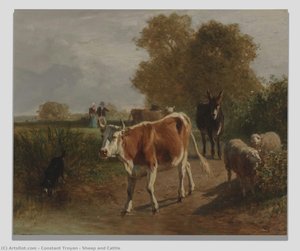
The scene unfolds within a modestly sized, yet richly detailed landscape. A woman, rendered with a subtle realism that belies the idealized forms often found in earlier pastoral scenes, stands as the focal point. She is not a grand figure, but rather a humble shepherdess, her posture suggesting both authority and gentle guidance. Her attire – simple and practical – speaks to her role within this rural community. Beside her stand two cows, their coats rendered with an impressive attention to texture and light, and a scattering of sheep, adding depth and movement to the composition. A watchful dog completes the group, its presence hinting at the vital role animals played in the lives of those who inhabited this landscape.
Barbizon Style and Artistic Technique
Troyon’s style is deeply rooted in the Barbizon school's philosophy. Rejecting the polished surfaces and elaborate compositions favored by earlier generations, he embraced a looser, more expressive brushstroke. Notice how the paint appears to be applied with visible strokes, capturing the fleeting effects of light and shadow across the fields and foliage. This technique, reminiscent of Dutch landscape painting – particularly the works of Jacob van Ruysdael – creates an atmospheric depth that draws the viewer into the scene. The artist skillfully employs a limited palette of earthy tones—ochres, browns, greens, and blues—to evoke the muted colors of autumn, further enhancing the sense of realism and grounding the image in its natural setting.
The use of light is particularly noteworthy. Troyon doesn’t simply depict illumination; he captures the *quality* of light – the way it filters through the trees, casts shadows on the ground, and warms the animals' coats. This attention to detail elevates the painting beyond a mere representation of a scene, transforming it into a study of atmosphere and mood.
Symbolism and Historical Context
"Return of the Herd" resonates with broader symbolic meanings. The image speaks to the enduring relationship between humans and nature, highlighting the importance of agriculture and animal husbandry in rural life. The woman’s role as shepherdess is a powerful symbol of stewardship – her responsibility for caring for these animals reflects a deeper connection to the land. Painted during a period of significant social and political change in France, the painting can also be interpreted as a nostalgic yearning for a simpler, more agrarian past.
Troyon’s early life, shaped by his family's involvement with the prestigious Sèvres porcelain manufactory, instilled within him a meticulous eye for detail and precision. This training undoubtedly informed his approach to landscape painting, contributing to the remarkable realism evident in "Return of the Herd." His travels throughout France, coupled with mentorship from artists like Camille Roqueplan, exposed him to diverse environments and artistic influences, ultimately shaping his distinctive style.
A Timeless Masterpiece – Reproduction Possibilities
ArtsDot.com is proud to offer meticulously crafted hand-painted reproductions of Constant Troyon’s “Return of the Herd.” We strive to capture not only the visual details but also the emotional resonance of this captivating artwork, ensuring that your reproduction faithfully reflects the spirit and beauty of the original. Whether you're seeking a stunning addition to your home or office, or a unique gift for an art lover, our reproductions provide an authentic and accessible way to experience the timeless appeal of this Barbizon masterpiece.
Explore our range of sizes and framing options to find the perfect representation of “Return of the Herd” for your space. Each reproduction is created with archival-quality materials, guaranteeing its longevity and preserving the integrity of Troyon’s artistic vision for generations to come.
Related Artworks
Artist Biography
Early Life and Training
- Born: Seville, France (1810)
- Died: 1865
- Constant Troyon's early years were shaped by his family’s connection to the porcelain manufactory in Sèvres. His father and mother both worked there, fostering an environment where artistic skill was valued.
- He began as a decorator at the manufactory, meticulously honing his skills in porcelain ornamentation from a young age. This training instilled in him a keen eye for detail and precision that would later influence his painting style.
- By 21, Troyon embarked on countrywide travels, dedicating himself to landscape painting whenever finances allowed. These journeys provided invaluable experience and exposure to diverse environments.
- When funds were low, he returned to porcelain decoration, demonstrating a pragmatic approach to supporting his artistic ambitions.
- He received mentorship from Camille Roqueplan, who introduced him to other prominent Barbizon artists like Rousseau and Jules Dupré. While initially influenced by their style, Troyon would eventually develop his own distinct voice.
Artistic Development and Dutch Influence
- A pivotal moment in Troyon's artistic development occurred during a trip to the Netherlands in 1846.
- Inspired by Paulus Potter’s "Young Bull" and masterpieces by Cuyp and Rembrandt, he transitioned to animal painting, discovering his true calling.
- This experience marked a significant shift in his style, moving away from purely landscapes towards depictions of animals within their natural settings.
- The Dutch masters' emphasis on realism and capturing the essence of animals deeply resonated with Troyon, shaping his artistic vision.
Artistic Style and Legacy
- Troyon’s works were characterized by authenticity, showcasing animals in their natural, dynamic states. He strived to capture not just their physical appearance but also their character and behavior.
- Art critic Albert Wolff noted Troyon's transformative style, praising his ability to breathe life into animals and create compelling landscapes.
- Despite achieving considerable success, Troyon remained somewhat skeptical of his own accomplishments, reflecting a humble and introspective nature.
- He received numerous accolades throughout his career, including the Legion of Honour and five Paris Salon medals, demonstrating widespread recognition for his talent.
- Napoleon III was among his clientele, further solidifying his reputation as a leading artist of the time.
- Sadly, success took a toll on Troyon's mental health, and he passed away in 1865 after periods of unrest.
Notable Works and Lasting Impact
- Most of his renowned works date from 1850 to 1864, with earlier pieces considered less significant as they predate his Dutch-inspired style.
- His legacy includes the Troyon Prize for animal paintings at the École des Beaux Arts, established by his mother to honor his memory and encourage future artists.
- Major works can be found in prestigious galleries worldwide, including the Wallace Gallery (Glasgow), Louvre, and the Metropolitan Museum of Art.
- "Vallée de la Toucque, Normandy," exemplifies his genius, showcasing his ability to capture both the beauty of the landscape and the vitality of its animal inhabitants.
- He influenced subsequent artists, such as Émile van Marcke, demonstrating the enduring impact of his artistic vision.
Connection to the Barbizon School
- Troyon was a significant member of the Barbizon School, a group of French landscape painters who favored painting outdoors and depicting realistic scenes from nature.
- The Barbizon School emphasized direct observation and sought to capture the essence of rural life and landscapes, rejecting the idealized depictions prevalent in academic art.
- While Troyon initially followed the style of other Barbizon artists, his unique talent for animal painting distinguished him within the group.
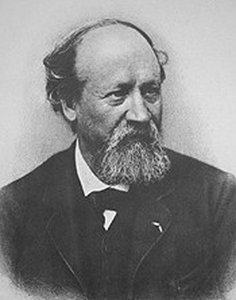
Constant Troyon
1810 - 1865 , France
Quick Facts
- Artistic Movement Or Style: Barbizon School, Naturalism
- Artists Or Movements Influenced By This Artist: ['Émile van Marcke']
- Artists Who Influenced This Artist:
- Paulus Potter
- Aelbert Cuyp
- Rembrandt
- Date Of Birth: August 28, 1810
- Date Of Death: February 21, 1865
- Full Name: Constant Troyon
- Nationality: French
- Notable Artworks:
- Vallée de la Toucque, Normandy
- Watering Cattle
- Cattle in Stormy Weather
- Oxen at Work
- Returning to the Farm
- Place Of Birth: Sèvres, France
Related Articles

Beyond the Horizon: 10 Landscape Masterpieces for Your Home Decor
Journey through 10 breathtaking landscape paintings by Monet, Van Gogh & more! Explore iconic artworks, artistic techniques & find inspiration for your home decor. Museum-quality reproductions at ArtsDot.com. Discover all masterpieces on ArtsDot.com

Romantic Landscapes: 10 Masterpieces for Your Home | ArtsDot
Journey through 10 Romantic landscape masterpieces by Friedrich, Turner & Cole. Explore emotional art, sublime nature scenes & iconic 19th-century paintings. Find museum-quality reproductions for your home at ArtsDot.com – discover the full collection online!
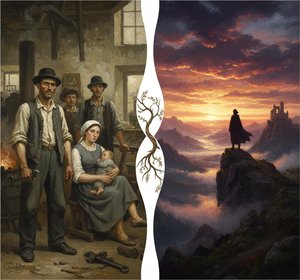
Romantic Realism's Finest: 10 Masterpieces for Your Home | ArtsDot
Explore 10 defining masterpieces of Romantic Realism! Discover Courbet, Millet & Daumier's powerful paintings—capturing emotion and social realities. Find museum-quality reproductions for your home at ArtsDot.com.

Evocations of Place: A Historical Journey Through Landscape Art
Explore the rich history of landscape art with ArtsDot. Discover renowned artists, movements like Impressionism & Romanticism, and expert guidance for collecting timeless pieces. Find your perfect serene escape today!

John Constable's Masterpieces: Explore 25 Iconic Landscapes for Your Home
Journey through John Constable's 25 most celebrated landscapes. Explore Romanticism, Dedham Vale & his masterful use of light in iconic paintings like 'Hay Wain'. Find museum-quality art reproductions and elevate your home decor on ArtsDot.com.