 Send
Send Share
Share
 Details

 Download
 Similars
 Diaporama
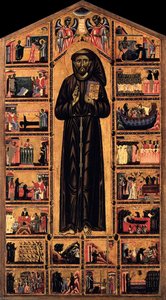
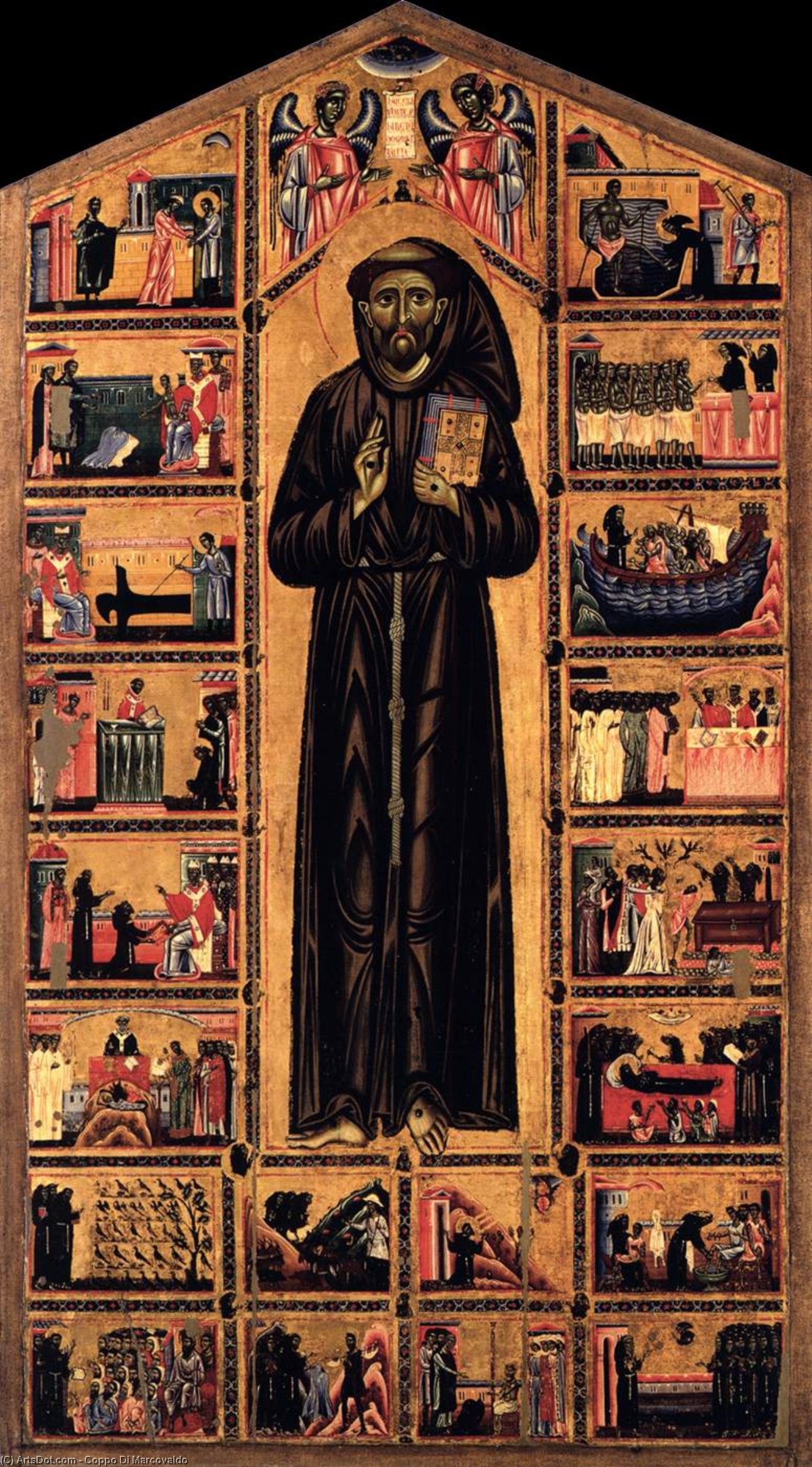
St Francis and Twenty Episodes from his Life


 Read More
Hand Made Oil Reproduction
Hand-painted oil on canvas in your size and frame, made to order by our artists. ( Buy Print Buy Image)




































Pick from our preset sizes that match the artwork's original proportions.

You may enter your own dimensions to fit a specific frame or space. If your selected size does not match the original image's proportions, we will either crop the artwork or extend the painting with additional hand-painted elements. A digital mockup will be sent for your approval before production begins.
Please note that the on-screen preview does not reflect the actual cropping or extension. Only the mockup will accurately show the final composition.
While custom sizes are available, we recommend selecting a dimension from the predefined list to preserve the original proportions.
After order, ArtsDot.com team will email client for instructions and provide a mockup preview
Worldwide Delivery () in 3/4 weeks instead of standard 5 weeks. (24 August). No compromise on quality.

Free Worldwide Express Shipping

High-Quality Linen Canvas

Full Shipping Insurance

Customs Tax Refund Guarantee

True Color Matching Guarantee

60-Day Return Policy (Defects Only)

100% Money-Back Guarantee

Bulk Discount Offer
 Glass option is only available in size under 110 CM

St Francis and Twenty Episodes from his Life
Reproduction Medium
Reproduction Size
-


Total Price
$ 263
Artwork Description
A Visionary Tapestry of Devotion
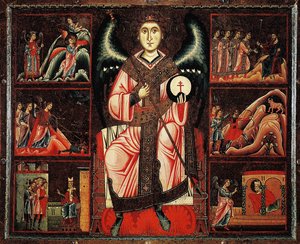
In the heart of the thirteenth century, a transformative era in Florentine art, Coppo di Marcovaldo breathed life into a monumental vision known as St Francis and Twenty Episodes from his Life. This sprawling mural is not merely a painting but a sacred narrative, a window into the spiritual fervor of 1240. As a pioneer of the Italo-Byzantine style, Coppo masterfully bridges the gap between the rigid, formal elegance of Eastern iconography and a burgeoning Italian humanism. The composition unfolds like a divine tapestry, where the central figure of St. Francis—the beloved patron saint of animals and the environment—serves as the anchor for a complex web of miraculous events. Clad in the humble robes of a monk and cradling a sacred book, Francis stands as a beacon of serenity amidst a whirlwind of celestial and earthly activity.
The sheer scale of this work invites the viewer to lose themselves in its intricate details. Scattered throughout the mural are numerous smaller figures, ranging from humble peasants to ethereal angels that drift through the upper reaches of the composition. Each episode is meticulously rendered, capturing specific moments of the saint's life with a sense of dramatic urgency. The artist utilizes a sophisticated arrangement of figures to guide the eye across the surface, creating a rhythmic movement that mimics the flow of a holy pilgrimage. For the discerning collector or interior designer, this piece offers an unparalleled depth of storytelling, making it a profound focal point for any space dedicated to contemplation, history, or classical grandeur.
Symbolism and the Mastery of Light
Every element within Coppo’s masterpiece is imbued with profound symbolic weight. The book held by St. Francis is more than an accessory; it represents the Word and the foundation of Franciscan wisdom. The surrounding figures, often caught in moments of intense emotion or quiet prayer, reflect the interconnectedness of all living things—a core tenet of the saint's philosophy. Through his unique technique, Coppo employs a palette that honors the Byzantine tradition while introducing a new, emotive quality to the facial expressions and gestures of his subjects. The interplay of light and shadow across the various scenes creates a sense of volume and presence, pulling the viewer into the sacred atmosphere of the medieval world.
To possess a reproduction of such a significant historical work is to bring a piece of the Florentine Renaissance's dawn into the modern home. The emotional impact of the mural lies in its ability to evoke both awe and intimacy. It captures the tension between the divine and the mundane, the celestial and the terrestrial. Whether placed in a grand library, a sophisticated gallery, or a curated living space, this artwork serves as a testament to the enduring power of faith and the timeless beauty of the Italo-Byzantine tradition. It is an invitation to reflect on the legacy of Coppo di Marcovaldo, an artist who dared to innovate while remaining deeply rooted in the spiritual essence of his age.
Related Artworks
![Legend Of St Francis - [23] - St Francis Mourned By St Clare — Giotto Di Bondone, Gothic](/media/artworks/images-thumb/17/1c/171c284c41dc3ef8bca83e51c1e1e531.jpg)
![Legend Of St Francis - [08] - Vision Of The Flaming Chariot — Giotto Di Bondone, Gothic And Proto-renaissance](/media/artworks/images-thumb/65/6e/656e345ff55e49ce2e4377a050b85aa1.jpg)
![Legend Of St Francis - [11] - St Francis Before The Sultan (trial By Fire) — Giotto Di Bondone, Proto-renaissance](/media/artworks/images-thumb/0d/32/0d328acfb6c90f7ef32707586e86044b.jpg)
![Legend Of St Francis - [24] - Canonization Of St Francis — Giotto Di Bondone, Gothic](/media/artworks/images-thumb/81/9b/819b5f0656848eb5cb3fcd40fd5756aa.jpg)
Artist Biography
The Dawn of a Florentine Master: Coppo di Marcovaldo
In the vibrant, turbulent landscape of thirteenth-century Florence, a transformative artistic spirit emerged to bridge the gap between the rigid traditions of the past and the burgeoning humanism of the future. Coppo di Marcovaldo stands as this pivotal figure, a pioneer whose brushstrokes breathed new life into the Italo-Bzantine style. Born in Florence around 1225, Coppo operated during an era of profound cultural shifts, where the solemnity of Byzantine iconography began to encounter the burgeoning naturalism of Italian sensibilities. His life was not merely one of quiet contemplation in a studio; historical records, such as those found in the Book of Montaperti, suggest he was even caught in the violent currents of Florentine military campaigns against Siena in 1260. This connection to the civic struggles of his city underscores a man deeply embedded in the very fabric of the society he would eventually immortalize through sacred art.
The artistry of Coppo di Marcovaldo is characterized by a masterful tension between the ethereal and the earthly. While he remained deeply rooted in the Byzantine tradition—utilizing gold grounds, stylized features, and a sense of divine permanence—he introduced a revolutionary sense of volume and weight. He moved away from the flat, two-dimensional figures of his predecessors, instead imbuing his subjects with a sculptural presence that hinted at the physical reality of the human form. This evolution was not merely a technical achievement but a theological one, as it allowed the faithful to perceive the divine through a more relatable, tangible lens.
The Majesty of the Madonna del Bordone
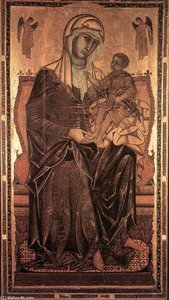
The zenith of Coppo’s career and his most enduring contribution to the Western canon is undoubtedly the Madonna del Bordone. Commissioned by the Servites Order, this monumental work serves as a watershed moment in art history. In this masterpiece, Coppo achieved what few of his contemporaries could: a groundbreaking compositional innovation through the use of an angled throne. By tilting the seat of the Virgin, he created a sense of architectural depth and three-dimensional space that was unprecedented for a Florentine painter of his time. This device did more than just showcase technical prowess; it invited the viewer into the sacred space, breaking the barrier between the celestial realm and the earthly observer.
Beyond this singular achievement, Coppo’s influence can be traced through several key thematic explorations in his oeuvre:
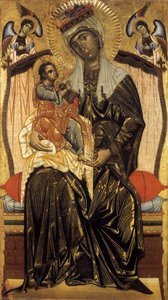
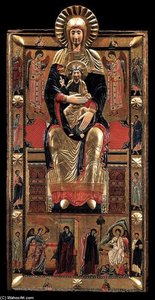
- The Madonna and Child: In various depictions of the Virgin and Christ Child, Coppo utilized a divine arrangement of celestial angels to surround the central figures, showcasing a mastery of the Italo-Byzantine style that invites profound spiritual reflection.
- Narrative Devotion: His work on St. Francis and Twenty Episodes from his Life demonstrates his ability to translate complex hagiographic narratives into intricate, Byzantine-influenced murals, offering a window into the intense medieval devotion of the period.
- Iconographic Synthesis: His ability to blend the formal rigidity of Eastern iconography with the emerging Italian interest in weight and form laid the essential groundwork for the later triumphs of the Early Renaissance.
A Lasting Legacy in the Florentine Tradition
Though his life ended in 1276, the echoes of Coppo di Marcovaldo’s innovation resonated through the centuries. He was a bridge-builder, an artist who took the established language of the Byzantine Empire and began to translate it into a local, Florentine dialect. His work provided the structural and stylistic foundation upon which later masters would build their own revolutions. By introducing volume, depth, and a more humanized divinity, Coppo did not just paint icons; he prepared the way for the profound naturalism that would eventually define the Renaissance.
To study Coppo is to witness the very moment when art began to move toward the light of realism. His legacy remains etched in the gold leaf and deep pigments of his surviving works, reminding us of a time when the boundaries of the sacred were being redrawn by the hands of a true visionary.
Coppo di Marcovaldo
1225 - 1276 , Italy
Quick Facts
- Artistic Movement Or Style: Italo-Byzantine Art
- Artists Or Movements Influenced By This Artist: ['Early Renaissance']
- Artists Who Influenced This Artist: ['Byzantine Artists']
- Date Of Birth: ca. 1225
- Date Of Death: ca. 1274
- Full Name: Coppo di Marcovaldo
- Nationality: Italian
- Notable Artworks: ['Madonna del Bordone']
- Place Of Birth: Florence, Italy
Related Articles

Elevating Interiors: How Murals are Redefining Kitchens and Bathrooms
Transform your kitchen & bathroom with stunning murals! Explore design trends, durable materials & expert advice. Elevate your interiors with 's bespoke mural solutions.

Francis Bacon's Masterpieces: Exploring 25 Iconic Paintings | ArtsDot
Delve into the haunting world of Francis Bacon with ArtsDot. Explore 25 iconic paintings, from his visceral portraits to powerful triptychs. Discover the stories behind these masterpieces & find museum-quality art reproductions for your home. Explore the full collection online!

From Jungle Scenes to Gold Leaf Geometry: A Guide to Today's Most Requested Mural Styles
Explore today's top mural styles for hotels & commercial spaces! Discover trends, expert insights, & custom design solutions. Elevate your space with .
Anchoring Interior Design with Murals: A Comprehensive Guide for Hotel Designers
Elevate your hotel's design with impactful murals! Our expert guide explores anchoring interior spaces, thematic storytelling & durable solutions for luxury hospitality. Discover bespoke art options & elevate the guest experience.

Transforming Spaces: How Custom Murals Forge Brand Identity & Enhance Customer Experience
Elevate your brand & spaces with custom murals. Explore expert insights on design, artists, materials & installation. Transform environments – discover 's bespoke solutions.