 Preview
 Send
Send Share
Share
 Details

 Download
 Similars
 X-Ray
X-Ray Diaporama
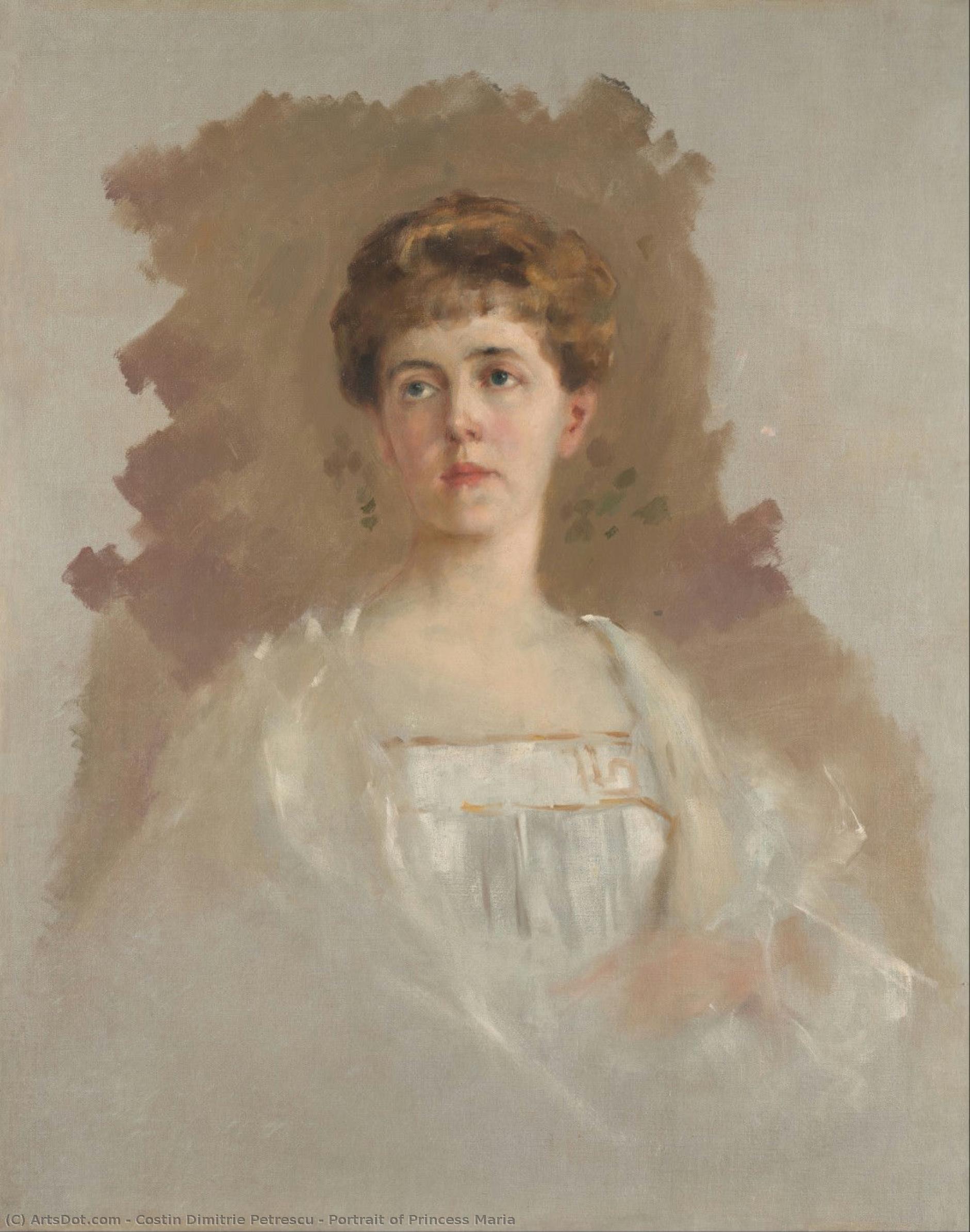
Portrait of Princess Maria
 1900
1900 105.0 x 69.0 cm
 Muzeul National Cotroceni
 Read More
Hand Made Oil Reproduction
Hand-painted oil on canvas in your size and frame, made to order by our artists. ( Buy Print Buy Image)




































Pick from our preset sizes that match the artwork's original proportions.

You may enter your own dimensions to fit a specific frame or space. If your selected size does not match the original image's proportions, we will either crop the artwork or extend the painting with additional hand-painted elements. A digital mockup will be sent for your approval before production begins.
Please note that the on-screen preview does not reflect the actual cropping or extension. Only the mockup will accurately show the final composition.
While custom sizes are available, we recommend selecting a dimension from the predefined list to preserve the original proportions.
After order, ArtsDot.com team will email client for instructions and provide a mockup preview
Worldwide Delivery () in 3/4 weeks instead of standard 5 weeks. (30 August). No compromise on quality.

Free Worldwide Express Shipping

High-Quality Linen Canvas

Full Shipping Insurance

Customs Tax Refund Guarantee

True Color Matching Guarantee

60-Day Return Policy (Defects Only)

100% Money-Back Guarantee

Bulk Discount Offer
 Glass option is only available in size under 110 CM

Portrait of Princess Maria
Reproduction Medium
Reproduction Size
-


Total Price
$ 263
Related Artworks









Artist Biography
Piet Mondrian: Architect of Abstraction
Piet Mondrian, a name synonymous with modern art’s pursuit of pure form and universal harmony, was far more than simply an abstract painter. Born Pieter Cornelis Mondriaan in Amersfoort, Netherlands, on March 7th, 1872, he embarked on a lifelong journey to distill the essence of visual experience into its most fundamental elements – straight lines, right angles, primary colors (red, blue, and yellow), and their corresponding black, white, and gray counterparts. His artistic evolution, spanning decades and continents, reflects not just stylistic shifts but also a profound philosophical quest for spiritual truth through art. Mondrian’s story is one of relentless experimentation, intellectual rigor, and an unwavering belief in the power of abstraction to transcend the limitations of representational imagery.Early Influences and Artistic Training
Mondrian's early life was steeped in artistic tradition. His father, Pieter Cornelis Mondriaan Sr., a schoolmaster and amateur draftsman, and his uncle, Frits Mondriaan, both painters associated with the Hague School, provided him with an environment rich in creative stimulation. Initially, he pursued a conventional education, studying to become a teacher, but his passion for art quickly superseded all other ambitions. He enrolled at the Amsterdam Academy of Fine Arts in 1892, where he honed his skills in landscape painting, initially adhering to the conventions of the time. However, Mondrian’s artistic sensibilities were already evolving beyond mere imitation of nature; he sought a deeper, more fundamental language for expressing visual experience. His early works demonstrate a careful observation of light and color, but also hint at an underlying desire to move beyond surface appearances. Crucially, his exposure to the work of Vincent van Gogh during this period profoundly influenced his approach to color and brushwork, laying the groundwork for his later explorations in abstraction.The Rise of De Stijl and Neo-Plasticism
A pivotal moment in Mondrian’s artistic development arrived in 1911 with his encounter with Cubism. While initially intrigued by its fragmentation of form, he recognized that it still relied on representation. Seeking a more radical departure, Mondrian joined the Dutch art movement *De Stijl* (The Style), co-founded with Theo van Doesburg in 1917. *De Stijl* advocated for a total synthesis of art and life, encompassing architecture, design, and painting – all based on geometric abstraction and a strict color palette. From this movement emerged Mondrian’s most influential style: Neo-Plasticism (also known as New Plastic Art). This wasn't simply an aesthetic choice; it was a philosophical declaration. He believed that by stripping away all superfluous elements—color, form, and subject matter—he could arrive at a universal visual language capable of expressing the underlying harmony of the cosmos. His paintings became characterized by grids of black lines intersecting with rectangles filled with primary colors, creating compositions of austere beauty and profound simplicity.Key Works and Artistic Development
Mondrian’s artistic output during this period is remarkably consistent in its core principles, yet subtly evolves over time. Early works like *Composition with Red, Blue and Yellow* (1930) demonstrate a growing confidence in his abstract vocabulary. Later paintings, such as *Broadway Boogie Woogie* (1942-43), incorporate dynamic rhythms and spatial relationships, suggesting a more complex engagement with the viewer’s perception. The influence of his time in Paris is evident in works like *Composition with Vertical Lines* (1930), which showcases his exploration of verticality as a fundamental element of composition. His most iconic pieces – *Victory Boogie Woogie* (1942) and *Composition with Red, Blue and Yellow* – represent the culmination of his lifelong pursuit of abstract harmony, embodying his belief that art could transcend the limitations of the material world.Legacy and Historical Significance
Piet Mondrian’s impact on 20th-century art is immeasurable. He not only pioneered a new visual language but also profoundly influenced subsequent generations of artists, architects, and designers. His rigorous approach to abstraction—reducing form to its essential elements—laid the groundwork for movements like Minimalism and Constructivism. Beyond his artistic achievements, Mondrian’s writings on art and aesthetics continue to be studied and debated today. He articulated a compelling vision of art as a means of achieving spiritual enlightenment through pure geometric forms, demonstrating that abstract art could be more than just decoration; it could be a pathway to universal understanding. He died in New York City on February 1st, 1944, leaving behind a legacy as one of the most influential and enduring figures in modern art. His work remains a testament to the power of abstraction to reveal the underlying order of the universe.
costin dimitrie petrescu
1872 - 1954 , Romania
Quick Facts
- Artistic Movement Or Style:
- Neo-Plasticism
- De Stijl
- Abstract art
- Artists Or Movements Influenced By This Artist:
- Vasily Kandinsky
- Kazimir Malevich
- Artists Who Influenced This Artist:
- Simon Mans
- Abraham Kuyper
- Date Of Birth: March 7, 1872
- Date Of Death: February 1, 1944
- Full Name: Pieter Cornelis Mondriaan
- Nationality: Dutch
- Notable Artworks:
- Broadway Boogie Woogie
- Composition with Red Blue and Yellow
- White Lines and Gray
- Place Of Birth: Amersfoort, Netherlands