 Preview
 Send
Send Share
Share
 Details

 Download
 Similars
 X-Ray
X-Ray Diaporama
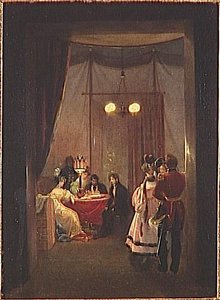
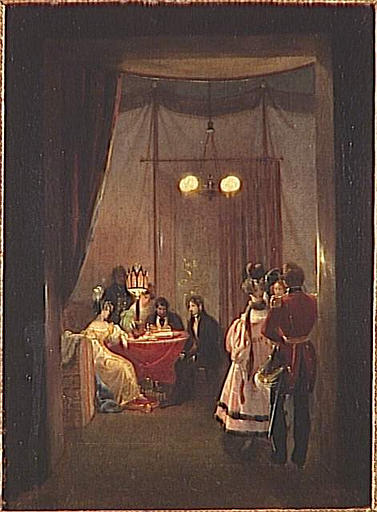
Salon de la Reine Hortense à Rome
 Read More
Hand Made Oil Reproduction
Hand-painted oil on canvas in your size and frame, made to order by our artists. ( Buy Print Buy Image)




































Pick from our preset sizes that match the artwork's original proportions.

You may enter your own dimensions to fit a specific frame or space. If your selected size does not match the original image's proportions, we will either crop the artwork or extend the painting with additional hand-painted elements. A digital mockup will be sent for your approval before production begins.
Please note that the on-screen preview does not reflect the actual cropping or extension. Only the mockup will accurately show the final composition.
While custom sizes are available, we recommend selecting a dimension from the predefined list to preserve the original proportions.
After order, ArtsDot.com team will email client for instructions and provide a mockup preview
Worldwide Delivery () in 3/4 weeks instead of standard 5 weeks. (1 September). No compromise on quality.

Free Worldwide Express Shipping

High-Quality Linen Canvas

Full Shipping Insurance

Customs Tax Refund Guarantee

True Color Matching Guarantee

60-Day Return Policy (Defects Only)

100% Money-Back Guarantee

Bulk Discount Offer
 Glass option is only available in size under 110 CM

Salon de la Reine Hortense à Rome
Reproduction Medium
Reproduction Size
-


Total Price
$ 363
Related Artworks






Artist Biography
The Luminous Legacy of Pierre-Félix Cottrau
Born into the vibrant cultural atmosphere of Paris on March 5, 1799, Pierre-Félix Cottrau emerged as a significant figure in the nineteenth-century French art scene. His lineage provided a foundation of cultural prestige; his father served as the secretary general of the Ministry of the Navy, and the family held deep connections to the musical world of Naples. This early exposure to both administrative order and artistic passion likely shaped Cottrau’s ability to navigate the prestigious salons of Paris while maintaining a profound connection to the romantic sensibilities of his era. His journey was one of movement and discovery, stretching from the neoclassical corridors of Naples to the historical heart of Rome, before finally settling in Paris, where his talent would find its most enduring recognition.
Cottrau’s artistic development was deeply influenced by the masters of his time. In Naples, he studied under Costanzo Angelini, a renowned neoclassical master whose guidance steered Cottrau toward the grand tradition of history painting. This training instilled in him a rigorous command over composition and narrative, allowing him to tackle complex, dramatic subjects with technical precision. However, the artist was never confined by a single genre. While his academic roots were firmly planted in historical scenes, he possessed an innate inclination for landscape painting—a passion that would later see him capturing the luminous beauty of Neapolitan views and the atmospheric depths of natural settings.
A Mastery of History and Light
The career of Cottrau is marked by a remarkable series of triumphs within the prestigious French Salons. His debut at the Bourbon Exhibition of 1826 was nothing short of spectacular, as he presented a compelling historical scene titled Lance-bearer dismounting from his horse to quench his thirst alongside evocative landscapes. This immediate success earned him a first-class silver medal, setting the stage for even greater accolades. By the Salon of 1827, he had secured a second-class gold medal, a testament to his growing mastery over portraiture and historical narrative. His ability to weave together the dramatic tension of history with the delicate nuances of light became his artistic signature.
Cottrau’s repertoire was as diverse as it was profound, ranging from the fantastical to the deeply religious. His works such as Lenore and The Vision of Saint Hubert demonstrate a fascination with the Romantic movement, utilizing dramatic lighting and emotional intensity to transport the viewer into legendary realms. At the same time, his devotion to landscape allowed him to explore the interplay between nature and light, seen in masterpieces like View. Fishing under Castel dell’Ovo. These works, often characterized by their luminous quality, reflect a bridge between the structured neoclassicism of his training and the emerging naturalism of the mid-nineteenth century.
Historical Significance and Artistic Recognition
Beyond the canvas, Cottrau was a respected figure within the institutional fabric of French art. His dedication to his craft led to his appointment as Inspecteur des Beaux-Arts in Paris, and in 1846, he was honored with the prestigious Legion of Honour. This recognition solidified his status not just as a painter, but as an influential custodian of the arts. His legacy is preserved through various museum collections across Europe, including the Capodimonte Museum and the Calais Museum, ensuring that his contributions to the Romantic and Neoclassical traditions continue to inspire collectors and historians alike.
The enduring appeal of Cottrau’s work lies in its ability to capture both the grandeur of historical moments and the quiet elegance of European life. Whether through a sweeping historical epic or a serene, sun-drenched landscape, his paintings remain windows into a vanished era of nobility and romanticism. His life, spanning from the dawn of the nineteenth century to his passing in 1852, remains a testament to the power of art to bridge the gap between the classical past and the burgeoning modern spirit.
Quick Facts
- Artistic Movement Or Style: Romanticism, Portraiture
- Artists Who Influenced This Artist:
- Costanzo Angelini
- Gabriele Smargiassi
- Date Of Birth: March 6, 1799
- Date Of Death: December 19, 1852
- Full Name: Pierre-Félix Cottrau
- Nationality: French
- Notable Artworks:
- La prière du soir
- Lenore
- The Vision of Saint Hubert
- Place Of Birth: Paris, France