- Home

- Oil Painting Reproduction
- countess jozefina brunszvik de korompa, countess josephine deym, baroness von stackelberg
 Preview
 Send
Send Share
Share
 Details

 Download
 Similars
 X-Ray
X-Ray Diaporama
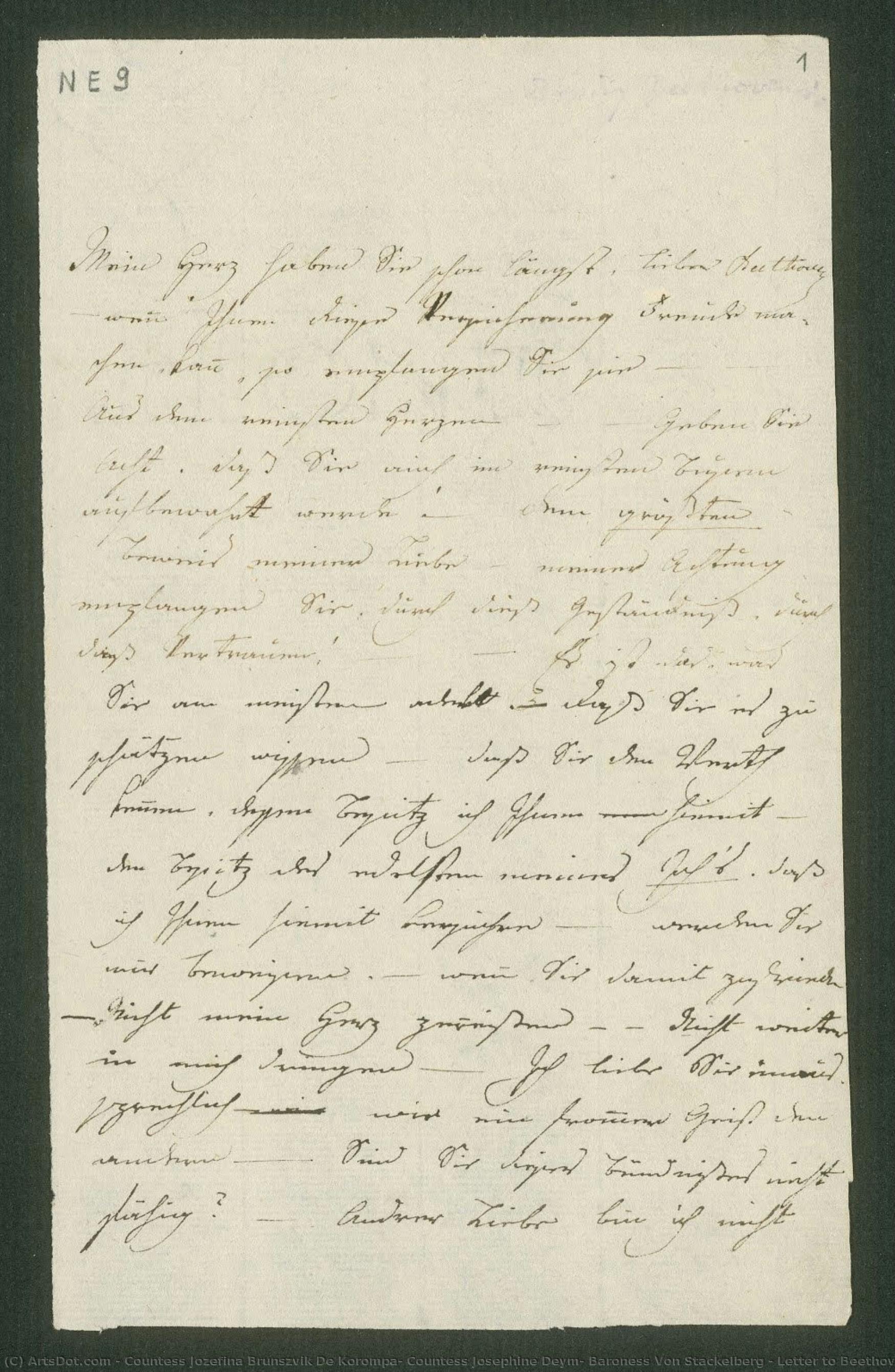
Letter to Beethoven
 1805
1805 19.0 x 11.0 cm
 Beethoven-Haus Bonn
 Read More
Hand Made Oil Reproduction
Hand-painted oil on canvas in your size and frame, made to order by our artists. ( Buy Print Buy Image)




































Pick from our preset sizes that match the artwork's original proportions.

You may enter your own dimensions to fit a specific frame or space. If your selected size does not match the original image's proportions, we will either crop the artwork or extend the painting with additional hand-painted elements. A digital mockup will be sent for your approval before production begins.
Please note that the on-screen preview does not reflect the actual cropping or extension. Only the mockup will accurately show the final composition.
While custom sizes are available, we recommend selecting a dimension from the predefined list to preserve the original proportions.
After order, ArtsDot.com team will email client for instructions and provide a mockup preview
Worldwide Delivery () in 3/4 weeks instead of standard 5 weeks. (23 August). No compromise on quality.

Free Worldwide Express Shipping

High-Quality Linen Canvas

Full Shipping Insurance

Customs Tax Refund Guarantee

True Color Matching Guarantee

60-Day Return Policy (Defects Only)

100% Money-Back Guarantee

Bulk Discount Offer
 Glass option is only available in size under 110 CM

Letter to Beethoven
Reproduction Medium
Reproduction Size
-


Total Price
$ 263
Related Artworks









Artist Biography
The Enigmatic Muse: The Life and Legacy of Josephine Deym
In the grand, sweeping tapestry of the Romantic era, few figures cast a shadow as tantalizing and complex as Josephine Deym. Known variously by her noble titles—Countess Jozefina Brunszvik de Korompa or Baroness von Stackelberg—she existed at the delicate intersection of aristocratic duty and profound artistic passion. While she may not have left behind a gallery of canvases, her life served as a living masterpiece of emotion, acting as the silent, beating heart behind some of the most intense musical expressions in Western history. To study Josephine is to explore the very essence of the Romantic spirit: a soul caught between the rigid structures of 18th-century nobility and the untamed, tempestuous emotions of the burgeoning 19th-century movement.
Born in 1779 amidst the splendor of the Hungarian aristocracy, Josephine’s early years were steeped in the cultivation of intellect and grace. Raised within the magnificent walls of Martonvásár Castle, her upbringing was defined by a rigorous education in classical literature and languages, yet it was music that would become her true language. As a gifted pianist, she possessed a sensitivity to melody that transcended mere technical skill, allowing her to connect deeply with the burgeoning genius of Ludwig van Beethoven. This connection, forged during piano lessons in Vienna, would eventually evolve into one of the most debated and romanticized relationships in musicology, positioning her as a central figure in the narrative of Beethoven’s "Immortal Beloved."
A Life Defined by Duty and Desire
The trajectory of Josephine's life was often dictated by the heavy mantle of her social standing. Despite the profound emotional resonance she shared with Beethoven—a connection documented through at least fifteen deeply moving love letters where he expressed eternal devotion—the realities of her station demanded a different path. Her marriage to the much older Count Joseph Deym in 1804 was a strategic union, orchestrated to preserve the social and financial stability of her lineage. This period of her life represents a poignant tension between the private self, capable of immense passion, and the public persona of a high-ranking Countess navigating the complexities of European courtly life.
Yet, even within the confines of her matrimonial duties, Josephine remained an influential presence in the cultural landscape. Her role was not merely that of a passive observer but of an active participant in the musical circles of her time. The letters exchanged between her and Beethoven reveal a woman of remarkable strength and intellect, capable of sustaining a profound emotional bond despite the physical and social distances imposed by her marriage. This era of her life is characterized by a bittersweet duality: the fulfillment of aristocratic expectations contrasted with the lingering echoes of an unfulfilled, transcendent love.
Historical Significance and Eternal Resonance
The historical significance of Josephine Deym lies not in a catalog of personal works, but in her role as a catalyst for artistic inspiration. She remains a symbol of the "unattainable desire" that fueled much of the Romantic era's creative output. For scholars and art historians alike, she represents a vital link to understanding the emotional landscape of the early 19th century. Her life serves as a window into the lives of women of her era—women who possessed immense intellectual and emotional depth but whose agency was often circumscribed by the rigid hierarchies of birth and marriage.
Today, Josephine’s legacy endures through the fragments of correspondence and the enduring legends that surround her name. She remains an icon of the Romantic movement, embodying the era's preoccupation with longing, tragedy, and the sublime. As we look back upon her life, we see more than just a noblewoman; we see a muse whose very existence helped shape the emotional contours of some of the greatest musical compositions ever written, ensuring that her spirit continues to resonate through the halls of history.
Quick Facts
- Artistic Movement Or Style: Symbolism
- Artists Or Movements Influenced By This Artist: ['Romantic Portraiture']
- Artists Who Influenced This Artist: ['Ludwig van Beethoven']
- Date Of Birth: August 27, 1913
- Full Name: Nina Schenk Gräfin von Stauffenberg
- Nationality: German
- Notable Artworks: ['']
- Place Of Birth: Kowno, Imperial Russia